Cross-Engine Visibility
Why AI Cites You on Some Platforms but Not Others
Why the Same Question Gets You Different Answers on Different AI
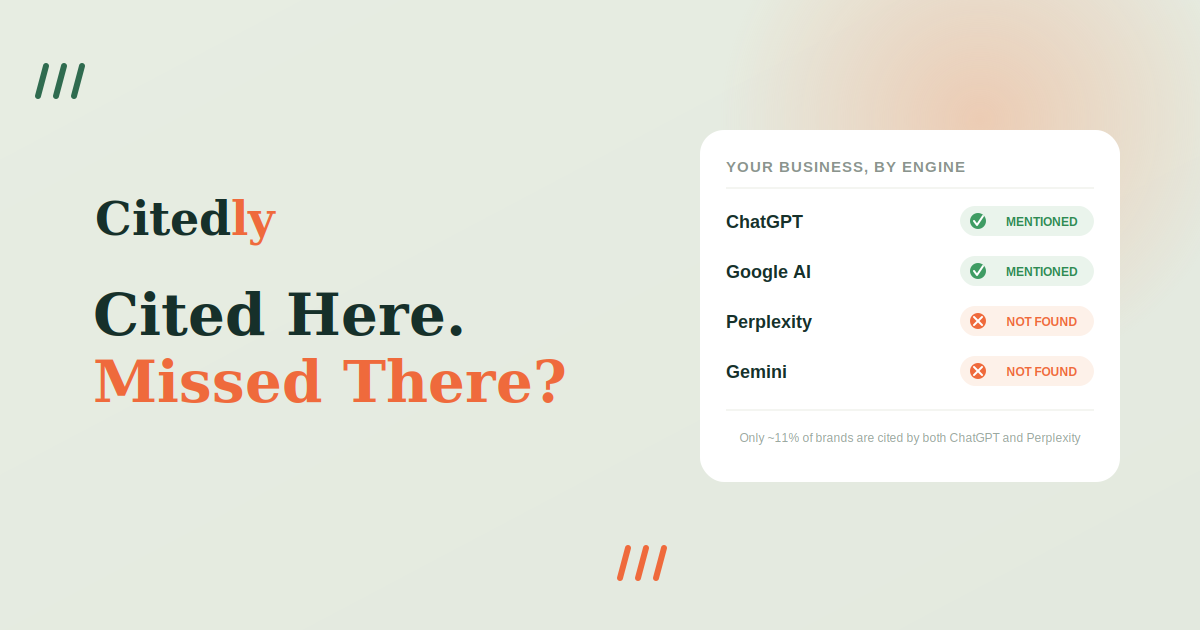
Ask ChatGPT, Perplexity, and Google's AI the same question about your category and you'll often get three different shortlists: one names you, one doesn't, one gets you half right. That's not a glitch. It's the direct result of how these systems are built. Sometimes you're in the answer and still invisible — a ghost citation, where you're the source but never the name.
Each engine assembles its answer from a different set of trusted sources. So whether you're cited on a given platform comes down to one thing: does your presence overlap with the sources that specific engine reads? If it does, you're in the pool. If it doesn't, you're invisible there, no matter how strong you are elsewhere. This is the same underlying shift we cover in what AI citations are; this post is about why it plays out unevenly across engines.
How AI Decides Who to Cite (the Order Matters)
Here's the part most advice gets backwards. A model doesn't read the whole web, find the best page, and cite it. It works more like a person answering off the top of their head, then checking their facts.
- First, it builds a shortlist from memory. It recalls the handful of companies it's confident exist and belong in your category.
- Then, it finds pages to support that shortlist. The lookup confirms the names it already recalled — it doesn't build the list from scratch.
If your business wasn't in that initial recall set, no amount of on-page polish gets you in, because the model never went looking for you. That recall comes from entity confidence: how sure the model is about what you are and what you do, built from repeated, consistent mentions across independent sources. As High Ticket AI Systems puts it, the shortlist gets decided off your site, before a model reads a single page you wrote.
A company nobody writes about has low confidence, so it rarely makes any shortlist. This is exactly why two businesses with near-identical websites can have completely different AI visibility, and it's the deeper version of why AI skips your site.
Which Sources Each AI Engine Actually Reads
This is the crux of the "some platforms but not others" problem. The engines pull from measurably different places, so your presence has to be broad to cover all of them.
| Engine | Leans most on | If you're missing there |
|---|---|---|
| ChatGPT | Bing's index, Wikipedia, Reddit | You're absent from the biggest AI surface |
| Perplexity | Reddit, LinkedIn, G2, forums | Cited elsewhere but skipped by Perplexity |
| Google AI Overviews | Google's index, Yelp, Facebook | Strong on Reddit, still invisible in Google's AI |
| Gemini | Google index, YouTube, LinkedIn | Missing from video and professional queries |
The pattern across every study is consistent: platforms where people talk about companies — Reddit, YouTube, LinkedIn, Wikipedia, review sites — outrank company websites themselves. So if you show up in one AI and not another, it's usually because your footprint is strong on the sources one engine reads and thin on the sources another prefers. For the ChatGPT-specific mechanics, see getting cited by ChatGPT; for the Google side, showing up in AI Overviews.
The one-line reason: you can't argue your way into an AI answer from your own domain — you can only be corroborated into one, and each engine checks different corroborators.
Why Off-Site Mentions Beat Anything You Publish Yourself
A model has no way to verify a claim you make about yourself, and every way to verify a claim other people make about you. Every business says it's the best at something. That sentence carries no information because it's on 40,000 homepages. But a description in someone else's article, written by someone with no reason to say it unless it were true, carries real weight.
The data backs this hard. Ahrefs' study of 75,000 brands found brand mentions correlate with AI visibility at 0.664, versus just 0.218 for backlinks — roughly a 3x gap. All the top signals live on properties you don't own. It's the core reason mentions beat backlinks for AI, and why the work happens off your site.
Two things matter more than raw volume:
- Independence: a mention someone chose to write beats one you placed. This is why buying bulk mentions from a syndication service does almost nothing.
- Consistency: forty mentions describing you the same way across 25 domains is a fact the model states without hedging. Fifteen sources describing you fifteen different ways produce a model that describes you vaguely — functionally the same as being invisible.
When AI Names You but Gets You Wrong
Being cited and being described accurately are two different wins, and the second failure is one most businesses never check for. Citation and brand recognition aren't the same thing. Stacker's analysis of 456 stories found AI responses cited brand content far more often than they mentioned the brand itself — a page can become a trusted source without the company becoming part of the answer.
When a model has low confidence about you, it fills the gaps by interpolating, and interpolation always lands on the average of your category. That shows up in three recognizable ways.
Wrong category
It files you under the nearest visible neighbor. A podcast-led agency gets called a "podcast production company," because production is the visible part.
A price you never published
If your pricing isn't stated anywhere, the model borrows one — often from a competitor's page or an old article.
A competitor's method
The most damaging one. If your differentiator isn't stated in a memorable sentence, the model attaches the generic mechanism it associates with your category, describing you as doing the ordinary version of what you do.
The fix for all three is the same: state what you are (and what you're not) plainly, in consistent language, in enough independent places that there's nothing left for the model to guess at.
How to Get Cited Across All the Major Engines
Because each engine reads different sources, the goal is broad, consistent presence — not optimizing for one platform's preferences. The moves that build it:
- Earn mentions on the community platforms AI reads. Genuine Reddit answers, LinkedIn posts, and YouTube content (with transcripts, since spoken words are invisible to AI until they're text) cover the sources most engines pull from.
- Get on the review and reference sites. G2, Trustpilot, Yelp, and a Wikidata entry give each engine independent corroboration in the places it looks.
- Lock your description everywhere. One consistent name, category, and one-line description across every profile, so every engine builds the same confident picture.
- Structure your own pages to confirm the shortlist. Once a model recalls you, it looks for a clean block to quote, so keep your pages built for AI to extract.
- Earn the mention itself. The mechanics of getting named in the answer are in getting mentioned in AI.
- Track it per engine, not as one score. Because visibility differs by platform, measure each separately — the method is in tracking your AI citations.
How to Diagnose Your Own Cross-Engine Gaps
Before fixing anything, identify exactly where each AI engine gets your business right, wrong, or leaves you out completely. You can do a useful cross-engine check in about 20 minutes once a month, and the goal is to turn every inconsistency into a specific action.
Ask Every Engine the Same Questions
Use clean sessions and run the exact same prompts across ChatGPT, Perplexity, Gemini, and Google AI. Start with four simple questions:
- What does [Company] do?
- Who is [Company] built for?
- How is [Company] priced?
- What are the main alternatives to [Company]?
Then add 5 to 10 commercial prompts your buyers might actually ask:
- Best [service] for small businesses
- Best [category] in [city]
- [Your brand] vs [competitor]
- Who can help with [specific problem]?
Using the same prompts matters because it lets you compare engines directly instead of testing completely different questions on each platform.
Log Exactly What Each Engine Gets Wrong
Create a simple sheet with one row per question and one column for each engine. Don't just mark "mentioned" or "not mentioned" — record the specific problem:
- Wrong category
- Wrong pricing
- Missing service
- Outdated information
- Competitor mentioned instead
- Correct brand mention but no citation
- Correct citation but inaccurate description
For example, ChatGPT might correctly describe your service but use outdated pricing, while Gemini may understand your pricing but completely miss one of your core offerings. Those are two different problems and usually require two different fixes.
Read the Sources AI Is Already Citing
When Perplexity, Google AI Overviews, or another engine provides citations, open them. Look for patterns:
- Which review sites appear repeatedly?
- Which Reddit threads are being used?
- Which comparison pages rank as sources?
- Are industry publications showing up?
- Are competitor pages being cited directly?
- Which directories or community sites keep appearing?
If three out of five cited results come from review platforms, reviews should become a priority. If comparison articles dominate, your next move may be getting included in those lists or creating stronger comparison content yourself.
The fastest way to improve AI visibility is often not finding new places to publish. It's becoming visible on the sources the engine already trusts.
Find the Platforms Where Your Brand Is Missing
Cross-engine differences are useful because they tell you where your off-site presence is weakest. For example:
- ChatGPT mentions you, but Perplexity does not
- Google understands your business, but Gemini gets the category wrong
- One engine cites your website, while another only cites competitors
- Your brand appears for informational prompts but disappears for "best" or comparison queries
That gives you a practical next step instead of a vague instruction to "improve AI SEO." If one engine repeatedly cites Reddit and your brand has no Reddit footprint, that's a clear gap. If another relies heavily on review or comparison sources where your competitors appear and you don't, that becomes your next target.
Turn Every Gap Into One Specific Fix
Your audit should end with actions, not observations. A useful monthly review might produce a list like:
- Update the pricing sentence on the homepage
- Add one missing service to Organization schema
- Strengthen the company description across LinkedIn and directories
- Publish a comparison page for a competitor-heavy prompt
- Build more reviews on a platform AI already cites
- Earn a mention in an industry roundup
- Update an outdated page that AI is still referencing
You don't need to fix everything at once. Start with the errors appearing across multiple engines, or on the prompts closest to a buying decision.
The Real Cost of Being Cited on Only One Platform
Showing up on one AI engine and missing the rest isn't a partial win — it's a quiet, compounding loss, because you never see the customers the other engines sent elsewhere. And these aren't small, overlapping audiences you can safely ignore; each major engine reaches a different, sizable slice of your market.
| AI engine | Reach (2026) | Skews toward | Miss it and you lose... |
|---|---|---|---|
| ChatGPT | ~900M weekly users | Broad consumer + research | The largest single AI audience |
| Google AI Overviews | ~1.5B monthly users | Everyday + local search | Mainstream and "near me" buyers |
| Gemini | Billions via Google apps | Android, Gmail, Workspace users | Professional and mobile-first buyers |
| Perplexity | ~30M+ users, fast-growing | Researchers, high-intent buyers | The audience that compares before buying |
Reach figures are approximate 2026 public estimates; the point isn't the exact number, it's that each engine is a distinct, large audience — not a rounding error. More context in our AI search statistics roundup.
You Lose Customers You'll Never Know About
When Perplexity names a competitor instead of you, that buyer never lands on your site, never fills out a form, and never appears in your analytics. There's no bounce to review, no drop-off to diagnose — the customer simply went somewhere you weren't. This is what makes single-platform visibility so risky: the loss is completely invisible, and you can't fix a leak you can't see. Most businesses don't even realize it's happening until a competitor's name keeps coming up and theirs doesn't.
One Engine's Blind Spot Becomes a Competitor's Home Turf
If you own ChatGPT but you're absent from Google's AI Overviews, the competitor who shows up there gets that entire audience uncontested. You're not losing a head-to-head — you're not in the race at all on that platform. Over months, the customers who rely on that engine come to see your competitor as the obvious choice in your category, simply because they've never once been shown your name as an option.
The Gap Widens on Its Own
AI leans on the brands already being talked about, so early absence on a platform compounds into lasting absence. Every month a competitor is the cited answer, more of the web references them in that context, which raises the model's confidence in them and makes them even likelier to be cited next time. It's a flywheel, and it spins in their favor while you're not on the platform.
Your Visibility Is Only as Strong as Your Weakest Engine
Customers don't all use the same AI — your ideal buyer might swear by Perplexity while their neighbor asks ChatGPT and their kid uses Gemini. If even one major engine skips you, a real, self-selected slice of your market is being handed a shortlist you're not on, no matter how dominant you are everywhere else. AI visibility doesn't average out across platforms; a gap on one is a hole in your coverage, full stop.
Your Takeaway
Being cited somewhere isn't the goal. Being cited wherever your customer happens to ask is — and that only happens when your presence covers every engine, not just the one you personally use.
How Citedly Closes the Gaps
Getting cited on every engine means building and maintaining presence across a dozen different sources at once, keeping your description consistent everywhere, and re-checking each platform as the answers shift — which is a lot to run while you're running a business. That's the work Citedly takes over.
We map which sources each engine reads for your category, build your presence on the ones you're missing, lock your description so no model has to guess, and track your visibility platform by platform — so whether a customer asks ChatGPT, Perplexity, or Google, your name is already in the pool.
Who Is Citedly For?
Citedly is for any business that no longer wants to just rank on Google, but to get named by AI engines too — from local shops to multi-location brands. Whatever your size, the goal is the same: be the business AI recommends, not the one it skips. Plans start at $299/month, no contract — see how that compares to the wider market in our GEO pricing guide.
| Plan | Price | Best for |
|---|---|---|
| Starter | $299/mo | Local & small businesses getting into AI answers for the first time |
| Growth ⭐ | $499/mo | Growing SMBs competing for buyer queries across multiple engines |
| Authority | $799/mo | Established businesses going after "you vs. them" comparison searches |
| Enterprise | Custom | Multi-location brands, franchises, and competitive categories |
Frequently asked questions
Why does ChatGPT cite my business but Perplexity doesn't?
Because they read different sources. ChatGPT pulls heavily from Bing, Wikipedia, and Reddit, while Perplexity leans on Reddit, LinkedIn, and G2. If your presence is strong on one engine's sources but thin on another's, you'll appear on one and not the other. Only about 11% of domains are cited by both.
How do I get cited on all AI platforms, not just one?
Build broad, consistent presence across the community, review, and reference sites the different engines trust — Reddit, LinkedIn, YouTube, G2, Wikidata — rather than optimizing for a single platform. Keep your business description identical everywhere so each engine builds the same confident picture of you.
Why does AI get facts about my business wrong?
Low entity confidence. When the web describes you inconsistently or leaves gaps, the model interpolates and lands on your category's average: wrong category, a borrowed price, or a competitor's method. Stating what you are and aren't, consistently and in many places, is the fix.
Do backlinks help me get cited across engines?
Less than you'd think. Ahrefs found brand mentions predict AI visibility about three times more strongly than backlinks. Links still help traditional rankings, but for getting named in AI answers, earned mentions across trusted sources matter more.
How do I know which platforms cite me and which don't?
Ask each engine the same set of buyer questions in clean sessions and log who names you, or track it automatically per engine. Checking each platform separately is essential, since your visibility genuinely differs across them.
See Where AI Puts Your Business Today
Run your real buyer prompts across five AI engines and find out whether you get named, free, in about 60 seconds. Or book a call and we'll walk you through it.
Keep exploring
Read More from Citedly