Tool Comparison
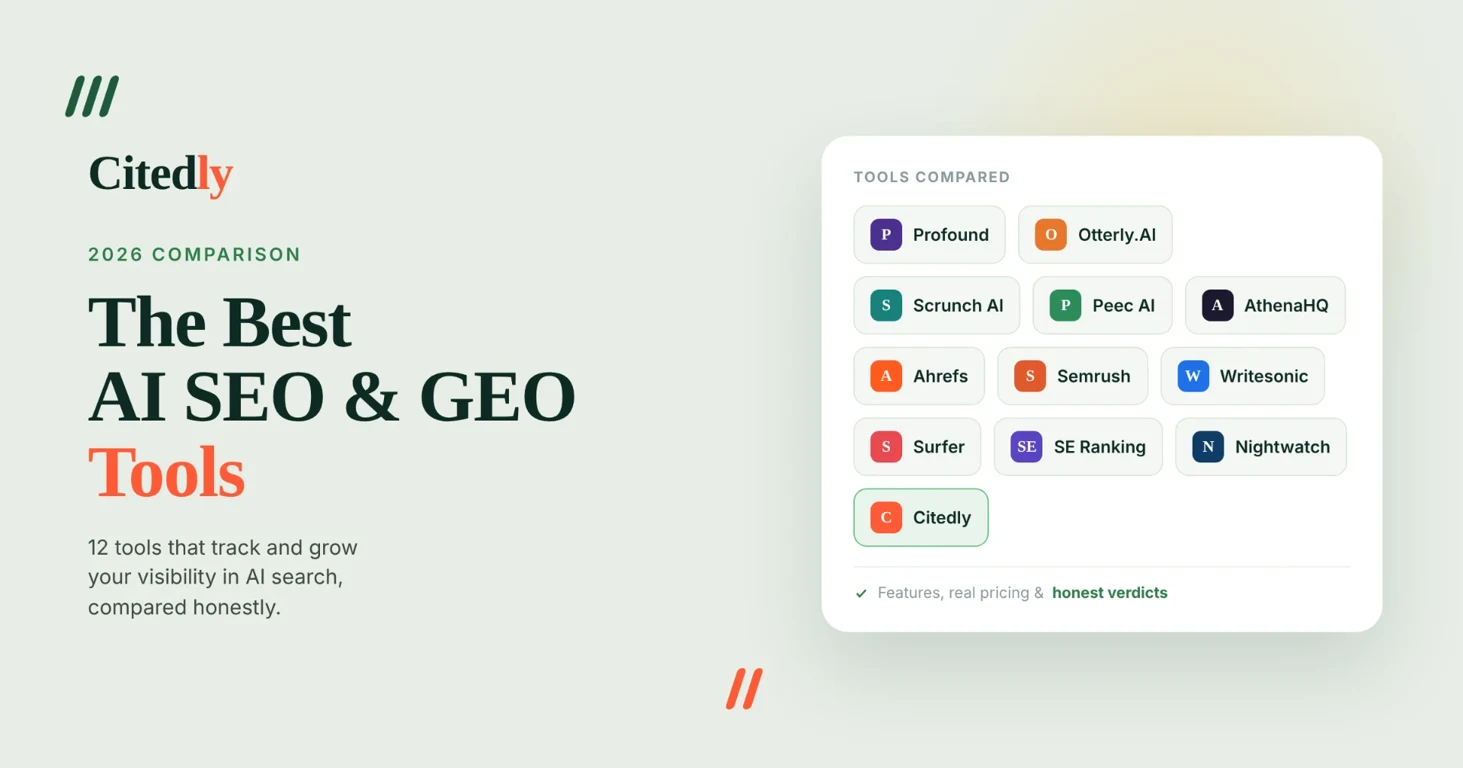
12 Best AI SEO Tools in 2026: GEO & AI Visibility Platforms Compared
What AI SEO Actually Means in 2026
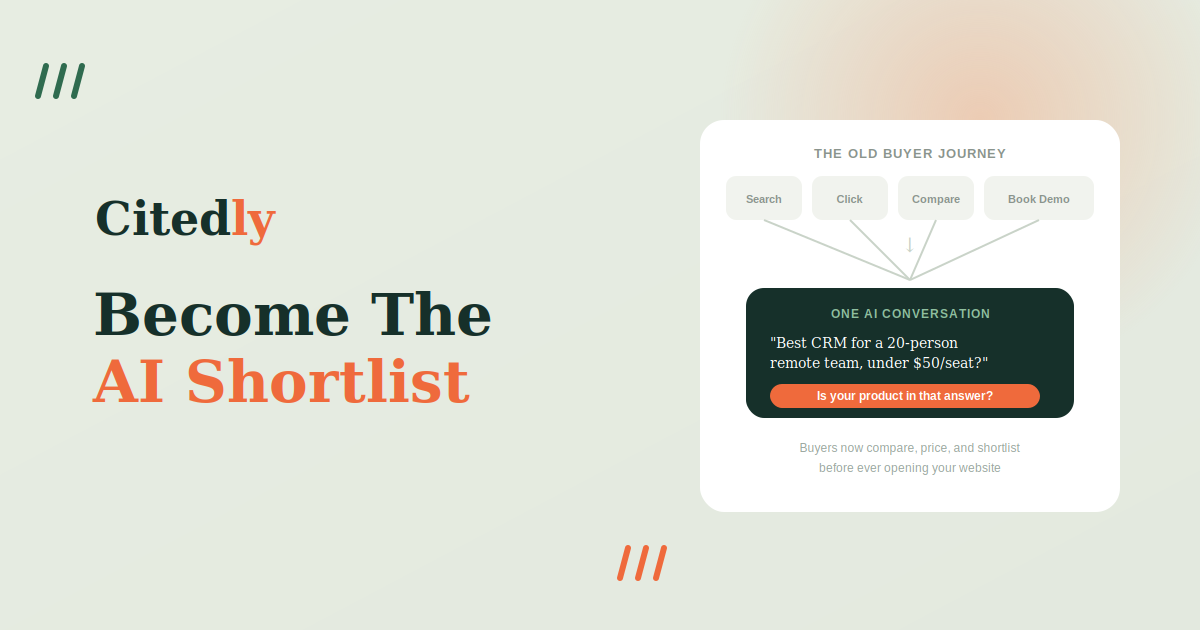
AI SEO has moved beyond the question, “Does my website rank?” A growing share of the work now happens after the clickless answer is generated: does the brand appear, is it described accurately, does the engine cite the company’s own pages, and does the brand survive into a shortlist or recommendation? That is why the market now includes tools labeled AI SEO, GEO, AEO, AI visibility, answer-engine optimization and LLM tracking, even though they often do very different jobs.
The most useful way to compare these products is not by counting how many models they track. It is to ask what happens after the software identifies a visibility gap. Some tools measure the gap. Some diagnose it. Some help create content. A smaller group connects the data to broader SEO workflows. And a service model such as Citedly goes one step further by taking responsibility for the execution.
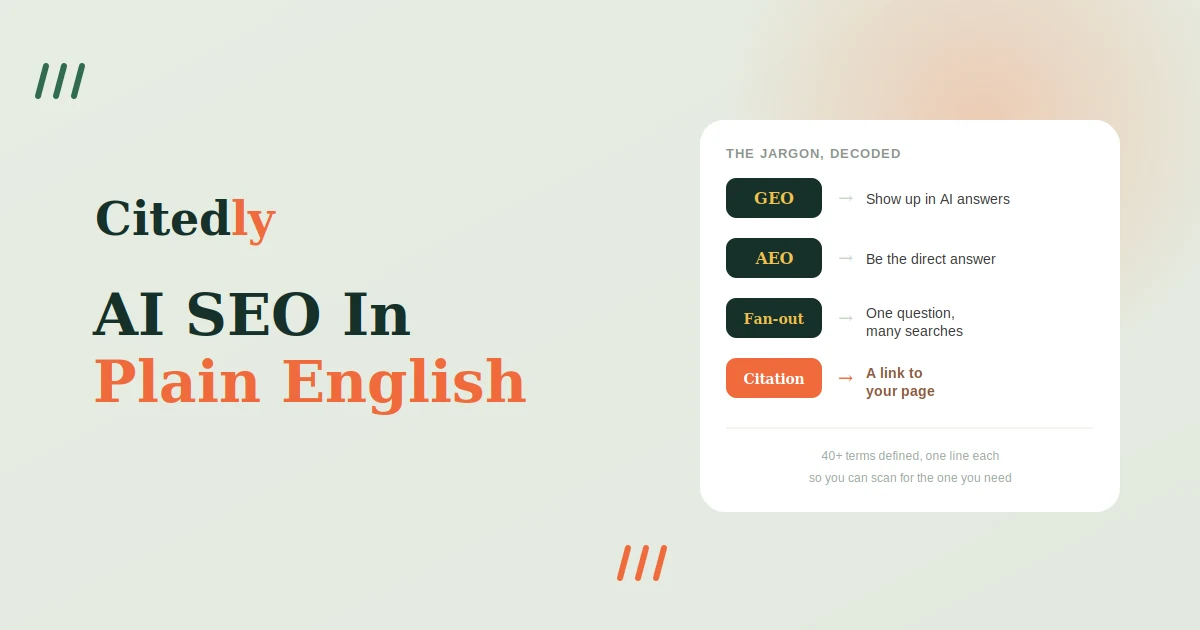
If you are still separating citations, mentions and recommendations into one generic “AI visibility” number, start with Citedly’s guide to AI citations vs. brand mentions. Those outcomes need different fixes, and the distinction makes the rest of this comparison much easier to evaluate.
If you want the terminology separated before comparing tools, read AI citations vs. brand mentions.
How We Evaluated the Tools
We compared each product across four practical dimensions: what it measures, whether it helps diagnose why visibility is being won or lost, whether it supports action after the diagnosis, and who ultimately has to do the work. We also reviewed the public pricing model described in the original October 2026 research draft and spot-checked current public pricing for several platforms during this revision.
This is deliberately not a “feature-count wins” ranking. A $29 monitoring product can be excellent at monitoring and still be the wrong choice for a company that needs technical fixes, content and authority work. Likewise, an enterprise AEO platform can be powerful but unnecessary for a small team that only needs a small prompt set and a simple competitor benchmark.
AI SEO Tools Compared: Pricing, Model and Who Does the Work
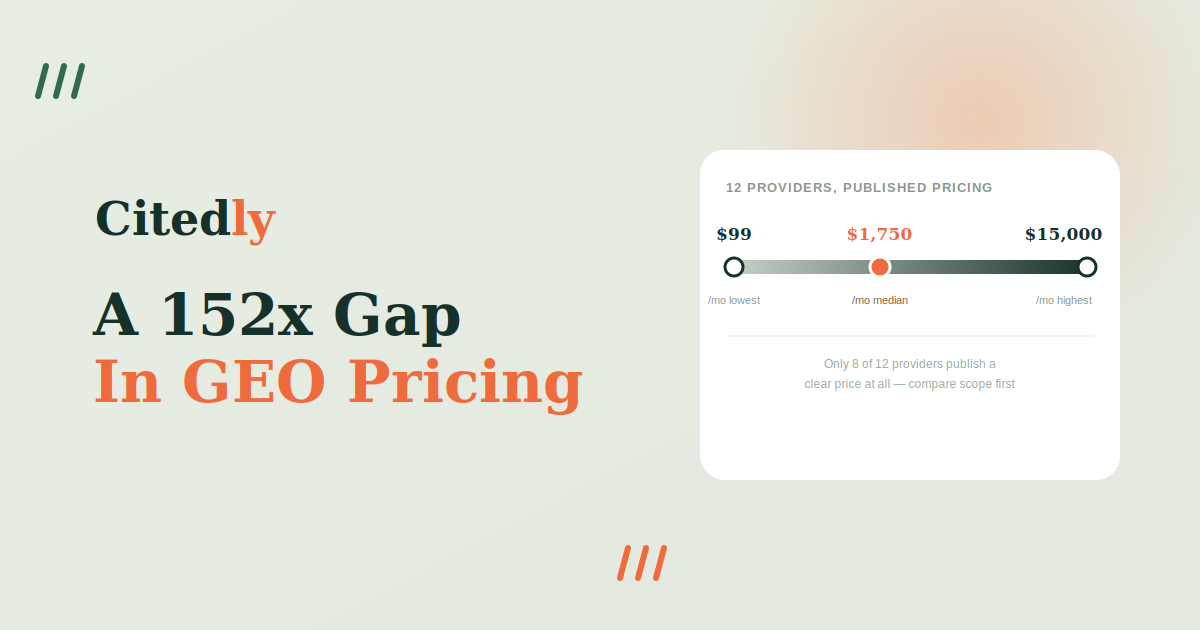
Pricing is a snapshot, not a permanent specification. Several vendors use annual-billing discounts, prompt limits, credits or add-ons, and enterprise tiers can vary substantially. The more important column is the final one: who is responsible for acting on the data?
| Platform | Model | Starting Price | Upper Public Tier | Who Executes? |
|---|---|---|---|---|
| Profound | AI visibility + AEO platform | $99/mo | $399/mo + Enterprise | You |
| OtterlyAI | AI visibility + GEO optimization | $29/mo | $489/mo + Enterprise | You |
| Peec AI | AI search analytics | $95/mo | $495/mo + Enterprise | You |
| Scrunch | AI visibility / observability | $250/mo | Custom Enterprise | You |
| Semrush | SEO + AI visibility | $99/mo AI Visibility | Broader SEO + AI tiers / Enterprise | You |
| Surfer | SEO content + AI visibility | $49/mo | $299/mo + Enterprise | You |
| Ahrefs | SEO + Brand Radar AI | $129/mo core | $449/mo + AI add-ons | You |
| Writesonic | AI SEO + content + GEO | $79/mo | $399/mo + Enterprise | You |
| SE Ranking | SEO + AI visibility | $89/mo AI Search tier | $345/mo AI Search tier | You |
| Nightwatch | Rank tracking + AI visibility | €79/mo | €399/mo + Enterprise | You |
| AthenaHQ | AI visibility + optimization | Free | $295/mo + Enterprise | You |
| Citedly | Done-for-you AI SEO/GEO | $299/mo | $799/mo + Enterprise | Citedly |
1. Profound
Profound is one of the most enterprise-oriented products in this category. Rather than treating AI visibility as a report inside a traditional SEO suite, it was built around answer-engine optimization from the start. It tracks brand visibility, citations, sentiment and competitive presence, and its Agent workflows extend that intelligence into research, briefs, reporting and optimization workflows.
The platform is most compelling when AI-search measurement is already becoming a cross-functional marketing problem. Its FactCheck capabilities are also useful for brands that care not only about whether they appear, but whether answer engines describe their products, pricing or policies correctly. The trade-off is that Profound is still software: even when the platform identifies the opportunity, an internal or agency team still needs to turn that insight into technical, content and authority work.
Pricing
| Plan | Price | What you get |
|---|---|---|
| Starter | $99/mo | 50 prompts, ChatGPT tracking, 100 Agent credits/month |
| Growth | $399/mo | 100 prompts, 3 answer engines, 400 Agent credits/month |
| Enterprise | Custom | Up to 9 answer engines, custom prompts, larger workflows, enterprise support |
Pros
Strong purpose-built AEO infrastructure rather than treating AI visibility as a small add-on.
Agent workflows can turn visibility data into content and operational workflows.
FactCheck is valuable for brands where inaccurate AI descriptions of pricing, products or policies are a real risk.
Strong fit for larger marketing organizations and enterprise workflows.
Profound has built its own large-scale prompt data ecosystem.
Cons
The $399 Growth tier is significantly more expensive than lightweight trackers.
Smaller companies may be paying for capabilities they won't use.
It is still a software platform—your team remains responsible for implementing the recommendations.
Enterprise-level functionality requires a sales-led relationship.
Best For
Enterprise marketing teams, AEO specialists and organizations that want AI-search intelligence connected to operational workflows.
2. OtterlyAI
OtterlyAI began as a dedicated AI visibility tracker and has expanded into a broader GEO optimization layer. It monitors brand mentions and citations across major answer surfaces and adds crawlability checks, content audits, citation-gap analysis and prioritized recommendations.
That makes it more useful than a dashboard that simply reports that a brand is missing. OtterlyAI tries to show which competitors or sources are winning and where the underlying gap may sit. Its low entry price is attractive for smaller teams, although the larger prompt volumes and more advanced capabilities move into much more expensive tiers. The implementation itself still belongs to the customer.
Pricing
| Plan | Price | What you get |
|---|---|---|
| Lite | $29/mo | 15 prompts, 4 AI engines, daily tracking |
| Standard | $189/mo | 100 prompts, API/MCP, Agent Analytics |
| Premium | $489/mo | 400 prompts, API/MCP, Agent Analytics |
| Enterprise | From $1,000/mo | Custom prompts, SSO, GEO health checks, dedicated support |
Pros
Very low barrier to entry compared with enterprise AI visibility platforms.
Strong coverage of the major AI search surfaces.
GEO Audit goes beyond conventional rank tracking.
Citation-gap analysis can identify the pages being used instead of yours.
Multi-country tracking is particularly useful for international brands.
API and MCP access make the data easier to integrate into existing workflows.
Cons
The cheaper plans are still primarily a measurement and recommendation layer.
More prompts, engines and advanced requirements push you toward much more expensive tiers.
Recommendations don't automatically mean someone implements the strategy for you.
AI visibility is volatile, so users can easily overreact to individual fluctuations instead of looking at longer-term patterns.
Best For
SEO teams, agencies and brands that want a dedicated AI visibility platform with a relatively accessible entry point.
3. Peec AI
Peec AI stays focused on AI-search analytics rather than trying to become a full SEO platform. Its core value is clean visibility, position, sentiment, share-of-voice, competitor and source analysis across AI-generated answers. That narrow focus is useful when a company already has a traditional SEO stack and wants a dedicated intelligence layer for AI search.
Peec is particularly useful for teams that need to separate topics and intents, compare visibility against competitors and understand which sources are shaping AI answers. The limitation is the same one shared by most analytics-first products: visibility data does not create the missing page, fix technical retrieval issues or earn third-party corroboration by itself.
Pricing
| Plan | Price | What you get |
|---|---|---|
| Starter | $95/mo | 50 prompts, 3 models, 1 project, daily tracking |
| Pro | $245/mo | 150 prompts, 3 models, 2 projects |
| Advanced | $495/mo | 350 prompts, 5 projects, multi-country, Looker Studio |
| Enterprise | Custom | Custom prompts, all models, API, SSO, unlimited projects |
Pros
Clean, AI-search-first interface and positioning.
Strong competitive and source-level visibility.
Intent classification helps separate informational, commercial and transactional prompts.
Strong international and multi-project capabilities at higher tiers.
AI Shopping and AI referral tracking make it more relevant as AI becomes a commerce channel.
Cons
It is primarily an analytics and intelligence platform, not a full SEO implementation service.
Content recommendations still require your team to execute.
Advanced functionality becomes expensive for agencies managing many brands.
You still need traditional SEO tooling for areas such as comprehensive backlink analysis and technical SEO.
Best For
SEO and content teams that want dedicated AI-search analytics without replacing their existing SEO stack.
4. Scrunch AI
Scrunch is built around AI-search observability. It tracks prompt-level visibility, share of voice, sentiment, citations, AI referrals and bot activity, then uses its Signals layer to surface opportunities from that data. This makes the product more diagnostic than a basic mention tracker.
The stronger fit is for brands that want to understand not only whether they appear, but which pages and sources are being retrieved and how that behavior changes across answer engines. At its current entry price, however, Scrunch is harder to justify for a small company that only wants a limited set of prompts monitored.
Pricing
| Plan | Price | What you get |
|---|---|---|
| Core | $250/mo | 125 prompts, 5 site audits, 1 workspace, 5 users |
| Enterprise | Custom | More prompts, complete audits, API, SSO, expanded LLM coverage |
| Agency Core | $500/mo | Agency-focused multi-brand workflow |
| Agency Enterprise | Custom | Enterprise agency requirements |
Pros
Strong AI-search observability.
Tracks more than simple brand mentions.
URL-level and citation-level analysis is useful for diagnosing which content actually gets retrieved.
Signals and Explorer make the platform more actionable than a pure reporting dashboard.
Good fit for teams that care about AI referrals as well as visibility.
Cons
$250/month makes it considerably more expensive than entry-level trackers.
Core still requires your team to turn insights into SEO/content/authority execution.
Some newer capabilities are still evolving.
If you only need 20–50 prompts monitored, the platform may be more than you need.
Best For
Brands and agencies that want deeper AI-search observability and a more diagnostic view of visibility gaps.
5. Semrush
Semrush remains fundamentally a broad SEO and digital marketing intelligence platform, and that is exactly why its AI Visibility layer is attractive. Keyword research, competitive analysis, backlinks, site auditing and conventional rank tracking already live in the same ecosystem, so AI visibility becomes another dimension of an existing workflow rather than a separate operating system.
For an established Semrush customer, that integration is difficult to ignore. The AI Visibility product tracks mentions, competitors, prompts, sentiment and search health, while the broader suite provides the traditional SEO context needed to interpret those results. The trade-off is breadth: teams that only need dedicated GEO analytics may find the platform larger and more expensive than necessary.
Pricing
| Plan | Price | What you get |
|---|---|---|
| AI Visibility Base | $99/mo/domain | 25 custom prompts, AI visibility reports, competitor research |
| SEO | $139/mo monthly | Traditional SEO + AI visibility |
| Advanced | $549/mo monthly | 40 websites, 5,000 keywords, 200 AI prompts/day, API |
| Enterprise | Custom | Large-scale AI prompt tracking, automation, integrations |
Pros
Probably the broadest traditional SEO + AI ecosystem on this list.
Excellent competitor research.
AI visibility and conventional search data live in the same ecosystem.
Strong reporting and agency functionality.
Useful for organizations that need to understand whether traditional SEO and AI visibility are moving together.
Cons
The platform can become expensive as additional capabilities and users are added.
Its breadth can make it overkill for someone who only wants AI visibility.
Like other software platforms, it tells you where the gaps are; your team still has to fix them.
AI visibility is one part of a much larger ecosystem, so the experience isn't as GEO-first as platforms such as Profound or Peec.
Best For
Established SEO teams, agencies and businesses that want traditional SEO and AI visibility in one ecosystem.
Industry Signal
Semrush's own AI visibility customer examples include SEO professionals from brands such as Hotmart, while its agency case study documents AI-search work tied to substantial increases in AI referral traffic and conversions. Semrush
Semrush AI Visibility customer examples
6. Surfer
Surfer sits at the intersection of content optimization and AI visibility. Its advantage is that a content team can identify where the brand is missing in AI answers and then move directly into the same product family to improve the pages that should be earning those mentions or citations.
This makes Surfer a strong fit when the bottleneck is content quality, coverage or on-page structure. It is not a full backlink platform or technical crawler, so it works best as part of a broader stack. Citedly’s own guide to structuring content for AI explains why the content layer increasingly needs to be designed around retrievable answer blocks rather than long introductions and keyword density alone.
Pricing
| Plan | Price/mo, annual billing | What you get |
|---|---|---|
| Discovery | $49 | Content optimization basics, 120 documents |
| Standard | $99 | 360 documents + 25 AI prompts |
| Pro | $182 | 50 AI prompts/day + advanced AI/content capabilities |
| Peace of Mind | $299 | 100 AI prompts/day, unlimited documents/workspaces, API |
| AI Search Analytics | From $82 | Standalone AI visibility tracking |
Pros
Strong connection between visibility data and actual content optimization.
Easier for content teams than highly technical GEO platforms.
AI Tracker is integrated into an established content workflow.
Strong option if your biggest AI visibility problem is content quality and coverage.
Good balance between traditional SEO and AI search.
Cons
AI visibility is not its only focus.
AI Search Analytics is limited to a smaller set of AI platforms than some dedicated tools.
It isn't a backlink or technical SEO crawler, so it does not replace a full SEO stack.
You still need people to decide what content should actually be created and how authority should be built.
Best For
Content and SEO teams that want AI visibility connected directly to content optimization.
Industry Signal
Surfer features customer examples including GetResponse, where its Head of Content & SEO discusses using the platform to monitor how the brand appears in AI tools. Surfer SEO
7. Ahrefs
Ahrefs brings AI visibility into one of the strongest traditional SEO data ecosystems through Brand Radar. The combination is useful because AI mentions and citations can be interpreted alongside backlinks, keywords, competing pages and the wider content ecosystem.
That matters when a team wants to understand whether traditional authority and AI retrieval are moving together or diverging. Citedly treats that difference explicitly in its analysis of AI citations vs. backlinks. Brand Radar is still an intelligence product, however: the customer remains responsible for changing content, fixing technical issues and building authority after the gap is identified.
Pricing
| Plan | Price/mo | What you get |
|---|---|---|
| Lite | $129 | SEO suite + 5 tracked AI prompts |
| Standard | $249 | More projects, keywords and 10 AI prompts |
| Advanced | $449 | 5,000 keywords + 20 AI prompts |
| Brand Radar AI | From $199 | AI Visibility Index + 2,500 checks |
| Custom Prompts | $50–$250 | 2,500–25,000 checks |
Pros
Extremely strong traditional SEO and backlink data ecosystem.
Brand Radar's search-backed prompt database is useful for category-level research.
Can identify cited pages and competing brands.
AI visibility can be analyzed alongside SEO, YouTube and Reddit signals.
Strong choice for established SEO professionals who already live inside Ahrefs.
Cons
You may be paying for a huge traditional SEO platform when your immediate need is AI visibility.
Brand Radar and custom prompt tracking can create additional costs on top of the core subscription.
Keyword and backlink data still don't tell you exactly what Google Search Console tells you about your own first-party search performance.
Ahrefs gives you intelligence; it does not become your outsourced SEO team.
Best For
Experienced SEOs, agencies and companies that already rely heavily on Ahrefs for traditional SEO research.
Industry Signal
Ahrefs' Brand Radar case study with Octopus Energy is particularly useful because the SEO team replaced manual AI-response tracking with Brand Radar and used the resulting insights to rethink content strategy across markets. Ahrefs
Ahrefs Octopus Energy Brand Radar case study
8. Writesonic
Writesonic combines AI-search visibility with a large content-production workflow. Its current plans pair prompt tracking with AI articles, site audits and agentic workflows, making it more action-oriented than a pure monitoring tool.
That is attractive for teams producing a large volume of content, but the same strength can become a weakness if output volume outruns editorial control. AI-generated content still needs original evidence, expert input, accurate entity information and a clear reason to exist. The platform can accelerate production; it cannot replace content strategy.
Pricing
| Plan | Price/mo | What you get |
|---|---|---|
| Starter | $79 | 50 prompts, 50 daily answers, 1 project |
| Basic | $199 | 100 prompts, 300 daily answers |
| Growth | $399 | 200 prompts, 600 daily answers + expanded AI-search features |
| Enterprise | Custom | Custom prompt and platform coverage |
Pros
Strong content-production ecosystem.
AI visibility is connected to content rather than treated as a standalone report.
Useful for teams producing a large amount of content.
Lower entry point than some enterprise-first GEO platforms.
Good fit for marketers who want research → content → optimization in one environment.
Cons
Content generation and AI visibility are not the same as a complete SEO strategy.
Large-scale AI content production can create a quality-control problem if the editorial process is weak.
The platform does not eliminate the need for original research, expert input or authority building.
Teams can easily mistake producing more content for improving AI visibility.
Best For
Content-heavy marketing teams that want AI-search visibility and content production in the same environment.
9. SE Ranking
SE Ranking is a broader SEO platform that has added a dedicated AI Search layer. It is especially appealing to SMBs and agencies that want prompt and AI-result tracking without moving into an enterprise-first GEO platform.
Its AI Search add-on can sit beside traditional keyword tracking, site audits and other SEO workflows. That combination makes the product practical, but less specialized than dedicated AI-search systems such as Profound or Peec. As with most trackers, the value depends on whether the team has a reliable process for converting visibility gaps into implementation.
Pricing
| Tier | Monthly price | Coverage |
|---|---|---|
| 200 checks | $89 | 200 prompts/checks |
| 450 checks | $179 | 450 checks |
| 1,000 checks | $345 | 1,000 checks |
| Higher volume | Custom | Volume-based |
Pros
Strong value for SMBs and agencies.
Combines traditional SEO with AI search.
AI visibility API is available.
Five major AI search environments are covered.
More approachable than enterprise-first platforms.
Cons
AI visibility is still one part of a broader SEO platform.
Advanced AI-search workflows are less specialized than dedicated GEO platforms.
As with most trackers, identifying a visibility gap doesn't mean the platform will execute the fix.
Teams looking for deep AI-first content workflows may need additional tools.
Best For
SMBs and agencies that want traditional SEO and AI visibility together at a comparatively accessible price.
10. Citedly — The Done-for-You Alternative
Citedly is deliberately different from the other products in this list. It is a done-for-you AI SEO and GEO service rather than a software dashboard. The program combines buyer-prompt research, AI visibility testing, technical fixes, content and page optimization, competitor analysis, authority work and ongoing measurement. You can review the current scope on Citedly’s plans page.
That distinction matters because the purchase is different. Most tools tell a team what AI says about the brand. Citedly is designed around the next questions: why is the brand missing, what evidence is absent, what needs to change, and who will make those changes? This also means Citedly is not the right choice for someone who only wants a standalone DIY dashboard.
The fairest comparison is therefore not “Citedly vs. a $29 tracker.” It is “software plus the internal people required to execute” versus an outsourced AI SEO program. That is also why a service can cost more than a tracker while still be cheaper than assembling separate technical SEO, content, analytics and authority resources.
Pricing
| Plan | Price | What Citedly does |
|---|---|---|
| Starter | $299/mo | 5 buyer prompts, 3 engines, technical check, 1 key page rebuilt, analytics |
| Growth | $499/mo | 10 prompts, full buyer-question mapping, competitor analysis, 3 GEO blogs, up to 3 pages rebuilt |
| Authority | $799/mo | 15 prompts, major AI engines, comparison targeting, dashboard, 5 GEO blogs, up to 5 pages rebuilt |
| Enterprise | Custom | Multi-location, franchise/category-scale programs, dedicated team |
Pros
Done-for-you implementation rather than software-only reporting.
Combines technical SEO, GEO, content and AI visibility instead of treating them as isolated activities.
Designed around buyer questions rather than simply keyword lists.
Competitor AI recommendations are part of the workflow.
The company can actually make the changes instead of handing the client another list of recommendations.
Productized pricing is considerably lower than hiring separate technical SEO, content, GEO strategy and analytics specialists.
Cons
It is not designed for someone who simply wants a standalone DIY dashboard.
Businesses that already have a large internal SEO/GEO team may prefer owning the entire execution stack themselves.
Citedly is a service, so capacity and strategic fit matter more than simply comparing feature checkboxes.
It is intentionally focused on execution for growing businesses rather than enterprise consulting overhead.
Best For
Growing businesses that want AI SEO execution handled for them instead of building an internal GEO operating layer.
11. Nightwatch
Nightwatch has historically been known for rank tracking, and its expansion into AI/LLM visibility makes it attractive to teams that do not want separate dashboards for Google rankings and AI prompts. Keywords, AI prompts, competitors, sentiment and visibility can be managed in one workflow.
That makes Nightwatch especially relevant for agencies and SEO teams that already think in terms of monitored positions. It remains fundamentally a tracking and intelligence platform, so the customer still needs an execution layer for the content, technical and authority work that follows.
Pricing
| Plan | Price | What you get |
|---|---|---|
| Starter | €79/mo | 500 keywords, 50 AI prompts, 5 websites |
| Professional | €159/mo | 2,500 keywords, 150 AI prompts, 25 websites |
| Agency | €399/mo | 7,500 keywords, 500 AI prompts, 100 websites |
| Enterprise | Custom | 20,000+ keywords and custom limits |
Pros
Excellent combination of traditional rank tracking and AI visibility.
No per-seat pricing.
AI prompts and Google keywords live in one system.
Strong agency fit.
Includes keyword research, prompt research, site audit and content tools.
Cons
The platform is still fundamentally a tracking/intelligence product.
Higher-volume agencies will quickly move toward the €399 tier.
It isn't as AI-first as dedicated GEO platforms such as Profound.
You still need a strategy and execution layer to turn tracking into growth.
Best For
SEO agencies and teams that want conventional rank tracking and AI visibility in the same product.
12. AthenaHQ
AthenaHQ is positioning itself as an AI-search command center rather than a lightweight tracker. Its platform combines broad model coverage with content optimization, citation intelligence, competitor tracking, sentiment, crawlability and executive reporting.
The product is most compelling for larger organizations where AI visibility is becoming a shared concern across SEO, brand, PR and leadership. Its credit model and enterprise-oriented features make it less straightforward than a basic prompt tracker, but the breadth is useful when governance and cross-team reporting matter.
Pricing
| Plan | Price | What you get |
|---|---|---|
| Essential | Free | $25 free credit, 300 credits, basic visibility analysis |
| Starter | $295/mo | 3,600 credits, 11-model visibility, content optimization, actions |
| Enterprise | Custom | Custom credits, multi-region, SSO, ACE, recommendation engine, executive dashboards |
Pros
Very broad AI-engine coverage.
Strong enterprise reporting and governance.
Includes both monitoring and optimization.
Useful for PR and brand teams, not only SEO teams.
GA4 and Google Search Console integration helps connect AI visibility to actual site performance.
Strong competitive intelligence layer.
Cons
$295/month is a significant jump from lightweight trackers.
Credits make usage somewhat different from simple “X prompts per month” pricing.
Advanced enterprise features require the custom tier.
Like other software platforms, the customer still owns implementation unless additional services are involved.
Best For
Brands, enterprise marketing teams and PR/SEO organizations that want a broad AI-search management layer.
Which AI SEO Tool Should You Actually Choose?
There is no universal winner because these products solve different layers of the problem. The simplest way to choose is to start with the job you need completed, not the longest feature list.
| If your main need is... | Best fit |
|---|---|
| Enterprise AEO workflows | Profound |
| Affordable dedicated AI tracking | OtterlyAI |
| Clean AI-search analytics | Peec AI |
| Deep AI observability | Scrunch |
| Traditional SEO + AI visibility | Semrush |
| Content optimization + AI visibility | Surfer |
| SEO/backlinks + AI visibility | Ahrefs |
| Content production + GEO | Writesonic |
| Accessible SEO + AI tracking | SE Ranking |
| Rank tracking + AI visibility | Nightwatch |
| Enterprise AI command center | AthenaHQ |
| Done-for-you execution | Citedly |
The Real Difference: Software vs. Execution
Imagine that a visibility platform tells you a competitor appears in nearly half of the commercial prompts where your brand is absent. That is useful information, but it is not yet a strategy. Someone still has to determine which prompts matter, understand the intent, identify the sources being cited, diagnose the missing evidence, fix the site, create or improve the right pages, strengthen third-party corroboration and then retest the same questions.
If you are comparing software cost with an outsourced program, see Citedly’s AI visibility pricing benchmark.
What Citedly Does Differently
Citedly’s workflow starts with the questions buyers actually ask, not only a keyword database. Those questions are tested across relevant AI surfaces, compared against competitors, mapped to missing pages or evidence, and then routed into technical, content or authority work. The process is closer to an SEO program than to a reporting dashboard.
That also changes how pricing should be interpreted. A lightweight tracker and a done-for-you program should not be compared as though they include the same labor. For a more detailed breakdown of what different budgets buy, see Citedly’s GEO pricing guide.
For a deeper example of how the model changes by audience, see AI SEO for B2B companies.
AI SEO Tools Do Not Replace SEO
GEO does not mean “forget Google and optimize only for ChatGPT.” Traditional SEO still matters because AI systems and answer surfaces depend on discoverable, accessible and understandable information from the web. Technical access, clear entities, useful pages, authority and third-party corroboration continue to matter even when the final interface is an AI-generated answer instead of a list of blue links.
If a site has strong content but is still absent from AI answers, the problem may sit in retrieval, technical access or entity clarity rather than writing quality. Citedly’s guide to why AI is not citing your website walks through those failure modes in more detail.
For technical and retrieval problems, use Why AI Isn’t Citing My Website.
What Should You Measure In AI SEO/GEO?
One “AI visibility score” is not enough to diagnose performance. A business can be cited without being named, mentioned without being recommended, or recommended inaccurately. Those outcomes have different commercial meaning and require different interventions.
| Metric | What it answers |
|---|---|
| Prompt Coverage | How many relevant buyer questions include your brand? |
| Brand Mention Rate | How often is the company explicitly named? |
| Citation Rate | How often are your pages used as supporting sources? |
| Recommendation Share | How often does the company survive into a shortlist or recommendation? |
| Competitor Capture | Which competitors appear when you do not? |
| Source Influence | Which third-party sources repeatedly shape AI answers? |
| Entity Accuracy | Does AI describe the business correctly? |
| AI Referral Traffic | Are AI answers sending measurable visitors to the site? |
For the measurement workflow, read How to Track AI Citations.
The Most Important Question to Ask Before Buying an AI SEO or GEO Tool
Do not begin with “How many AI platforms does it track?” Begin with “When this product finds a visibility problem, what happens next?” A tracking product gives you data. An optimization platform gives you recommendations and workflows. An execution service researches the gap, makes the changes and keeps testing. Those are three different products even when all three use the phrase “AI visibility.”
Final Verdict
There is no single best AI SEO tool in 2026. Profound is compelling for enterprise AEO workflows. OtterlyAI and Peec AI are strong dedicated visibility platforms. Scrunch is a good fit for deeper observability. Semrush and Ahrefs are natural choices for established SEO teams. Surfer and Writesonic make more sense when content is the operational center of the program. SE Ranking and Nightwatch provide practical combinations of traditional tracking and AI visibility, while AthenaHQ is moving toward a broader enterprise command-center model.
Citedly is the outlier because it is not trying to win with the largest database or the most complex dashboard. Its proposition is simpler: if the problem is not a lack of information but a lack of implementation, the service is designed to do the work rather than hand the team another report.
If your goal is to improve the probability that AI systems actually name and recommend the business, not merely monitor the current state, continue with Citedly’s guide on getting your business mentioned in AI.
Frequently asked questions
What is the best AI SEO tool in 2026?
There is no universal winner. Profound and Peec AI are strong for dedicated AI-search intelligence, Semrush and Ahrefs are strong for teams already invested in traditional SEO, Surfer is useful when content optimization is central, and Citedly is designed for businesses that want the implementation handled for them.
What is the difference between an AI SEO tool and GEO software?
The terms overlap heavily. AI SEO generally describes the broader practice of improving visibility across organic search and AI-generated answers, while GEO or AEO software often focuses more narrowly on visibility, citations, prompts and recommendations inside answer engines.
Are AI SEO tools worth paying for?
They can be, but the value depends on whether the data leads to action. A visibility tracker is useful when a team can turn prompt, competitor and source insights into content, technical and authority changes.
Is Citedly an AI SEO tool?
Citedly is better described as a done-for-you AI SEO/GEO service. It uses AI visibility measurement as part of the workflow, but the product includes research and implementation rather than requiring the customer to operate another dashboard.
Do I still need Google Search Console?
Yes. Third-party tools are useful for market, competitor and AI-search intelligence, but Google Search Console remains the first-party source for a site’s Google impressions, clicks, queries and search performance.
Should I use multiple AI SEO tools?
Sometimes. Large teams may combine a traditional SEO suite, a dedicated AI visibility platform and separate content tooling. Smaller teams should be careful not to stack overlapping products without a clear process for who will act on the data.
Related Citedly Resources
If you are evaluating AI SEO beyond the software itself, the next useful questions are how much GEO costs, how citations differ from backlinks, how citations are tracked, and why a technically sound website can still be absent from AI answers.
Start with How Much Does GEO Cost? for budget context.
For authority strategy, read AI Citations vs. Backlinks.
For recommendation visibility, read How to Get Your Business Mentioned in AI.
The next phase of SEO is not about abandoning rankings. It is about making sure that when the search experience changes from “show me the websites” to “tell me which one I should choose,” your brand is still part of the answer.
Ready to Stop Monitoring and Start Improving AI Visibility?
If you want a dashboard, several of the tools above are excellent choices. If you want the research, technical fixes, content, page optimization, authority work and ongoing measurement handled for you, Citedly is built for that job.
See Where AI Puts Your Business Today
Run your real buyer prompts across five AI engines and find out whether you get named, free, in about 60 seconds. Or book a call and we'll walk you through it.
Keep exploring
Read More from Citedly