AI SEO Services
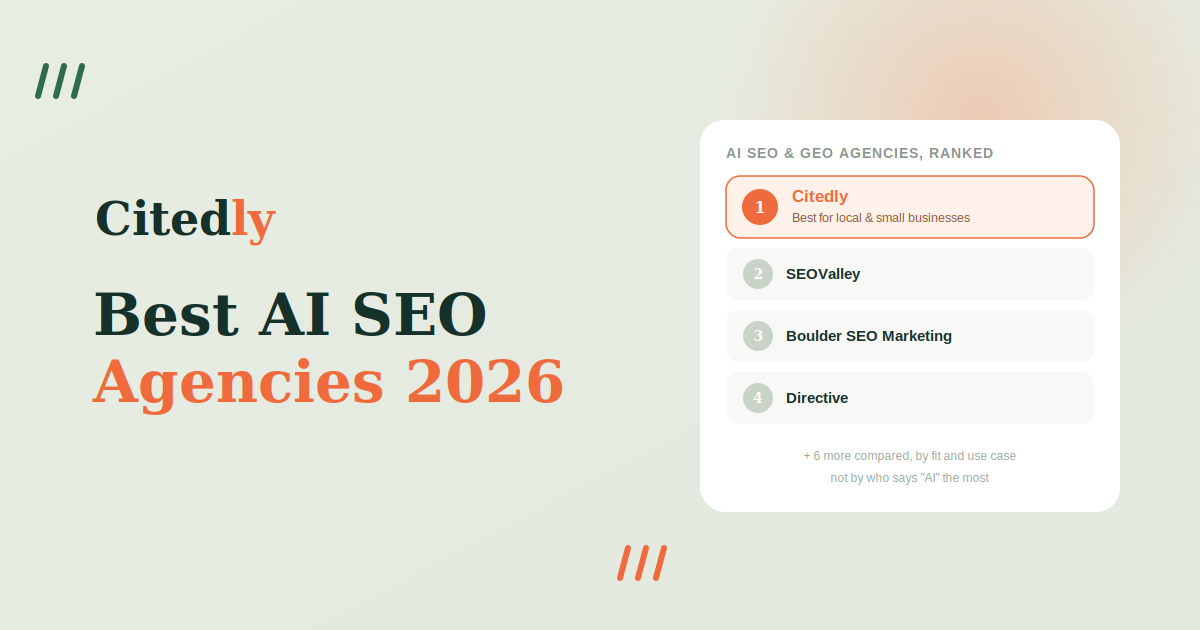
Best AI SEO Services in 2026: 10 GEO, AEO & AISEO Agencies Compared
By the Citedly team · Updated September 2026 · Provider details reviewed from public service and pricing pages
What Counts as an AI SEO, GEO or AEO Service in 2026?
AI SEO has become one of the noisiest categories in digital marketing. Agencies that spent years selling traditional SEO now advertise GEO, AEO, LLM optimization and AI visibility. Newer providers lead with prompt tracking and citation monitoring. Software companies have added managed services. The result is a market where two providers can use the same label while delivering completely different work.
That matters because showing up in ChatGPT is not the same job as ranking a blue link, and appearing in Google AI Overviews adds another retrieval surface with its own source patterns. A strong provider still needs classic SEO fundamentals, but should also understand how AI systems discover, cite, mention and recommend brands.
Our view after reviewing the market is more nuanced than “traditional SEO is dead.” It is not. The stronger distinction is between providers that merely re-label familiar SEO deliverables and providers that add a real AI-search operating layer on top of those foundations.
At a Glance: Best AI SEO Agencies and GEO Services in 2026
| Provider | Best For | AI / GEO Differentiator | Public Price / Model |
|---|---|---|---|
| Citedly | Local businesses, SMBs, home services, multi-location | Query Intelligence, prompt mapping, citation/mention tracking, done-for-you pages | $299 / $499 / $799/mo + custom Enterprise |
| SEOValley | SMBs to larger brands wanting SEO + GEO | Up to 50 AI questions/topics, AI-readable restructuring, authority + tracking | Custom / package-led |
| Boulder SEO Marketing | Local + national brands wanting broad agency support | GEO, llms.txt, AI agent, GBP, PR, technical SEO | $2,000-$4,000/mo public tiers |
| PikaSEO | Small SaaS teams / founders | SEO + GEO content engine, first-party data, comparison/alternative pages | Low-cost DIY + managed offers |
| Ranked.ai | Budget-conscious SMBs and agencies | Prompt tracking + AI visibility inside managed SEO platform | $99 / $198 / $349/mo |
| Directive | B2B SaaS / enterprise | GEO tied to pipeline, AI readability, prompt and referral measurement | Custom / higher-touch |
| Omniscient Digital | B2B SaaS with mature content motion | Citation analysis, technical GEO, brand mentions, LLM monitoring | Full-service from ~$10K/mo |
| Siege Media | Content-led brands / enterprise editorial | AI share of voice + third-party authority + content | Custom |
| 1Digital Agency | Ecommerce | Product/schema/feed/AI shopping optimization | Custom / ecommerce packages |
| First Page Sage | B2B, healthcare, legal, professional services | Thought-leadership SEO adapted to AEO/GEO | Custom |
How We Compared the Agencies
We did not score providers based on who uses the most AI language. We looked at whether the public service actually changes the research, execution and measurement model. The strongest AISEO/GEO providers generally add several layers that conventional SEO alone does not cover.
Prompt and buyer-query research: does the provider identify conversational questions, recommendation prompts and comparison intent?
Engine-specific visibility: does it test ChatGPT, Gemini, Perplexity, Google AI or other answer engines separately?
Citations vs mentions: does it understand that being used as a source is different from being named as a brand?
Technical discoverability: can it handle crawling, indexation, Bing, schema, page structure and AI-access issues?
Execution: does the team actually build, rewrite or fix pages, or mainly send dashboards and recommendations?
Authority: does the program address reviews, third-party mentions, earned media and the external sources AI trusts?
Commercial fit: is the service built for local SMBs, ecommerce, SaaS, enterprise or agencies?
Reporting: can the provider show whether a business is being cited, mentioned and recommended more often over time?
This is also why a business should not confuse AI citations with backlinks. Both can matter, but they measure different forms of visibility and authority.
AI SEO Should Build on SEO, Not Just Rename It
Many of the agencies below still deliver technical SEO, content, local SEO, PR, links or digital authority work. That does not make them “fake” GEO agencies. Generative systems still need retrievable, credible source material. The problem begins when the provider changes the label but not the research or reporting.
| Traditional SEO Foundation | AISEO / GEO / AEO Layer |
|---|---|
| Keyword volume and SERP intent | Conversational prompts, buyer questions and recommendation queries |
| Google rankings | AI mentions, citations, recommendation share and cited-source position |
| Organic competitors | Brands AI actually recommends for the same prompt |
| Backlinks | Links + unlinked mentions + reviews + third-party corroboration |
| Organic sessions | AI referral traffic + visibility inside answers |
| Blog calendar | Prompt-gap-driven service, comparison, pricing and trust pages |
| Google-centric technical SEO | Google + Bing + AI crawler access + machine-readable structure |
The 10 Best AI SEO, GEO & AEO Services in 2026
1. Citedly — Best AI SEO Service for Local Businesses and SMBs
Citedly is the most purpose-built option in this comparison for local and small businesses, especially home-service companies where one AI recommendation can turn directly into a phone call. It is designed for HVAC companies, plumbers, electricians, roofers, window cleaners, garage-door businesses and similar operators that need both local search visibility and visibility inside AI answers.

The central difference is that Citedly does not begin with a generic keyword export. Its AI SEO for local businesses methodology begins with a proprietary Query Intelligence System built from real public customer questions and AI-style conversations. Those queries are cleaned, deduplicated and sorted by intent — research, pricing, comparison, repair-versus-replace, local recommendation and ready-to-hire.
That matters because the work downstream becomes much more specific. If a business is absent from a “best HVAC company near me” prompt, the fix may be a location/service page plus stronger reviews and entity signals. If it is absent from a “repair or replace” conversation, the missing asset may be an answer-first decision guide. If AI cites the site but does not name the brand, the problem may be entity recognition rather than page quality.
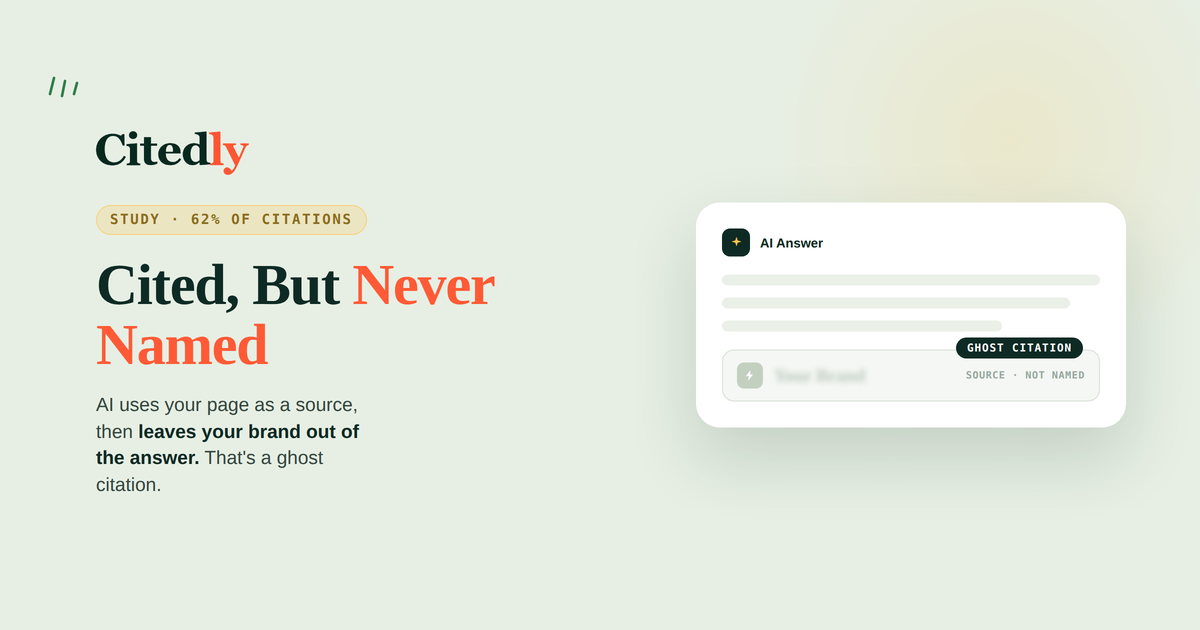
Citedly also separates AI citations from brand mentions and tracks them differently. That avoids a common measurement problem where a site looks visible because AI uses its pages as sources, while the business itself never gets named.
| Best for | Core services | AI/GEO layer | Pricing | Markets / fit | Watch for |
|---|---|---|---|---|---|
| Local businesses, SMBs, home services, multi-location | Technical AI indexing, GEO content, service/location pages, schema, tracking | Proprietary Query Intelligence; prompt mapping; competitor recommendation analysis; citation/mention tracking | Starter $299; Growth $499; Authority $799; Enterprise custom | Built for US, UK, Canada, Australia and other English-language markets; strongest fit is local/service businesses | Not positioned as an enterprise PR agency or ecommerce-feed specialist |
Current Citedly pricing is month-to-month. Growth includes full prompt mapping, competitor tracking and three GEO blog posts per month; Authority adds comparison-prompt targeting, broader tracking and done-for-you implementation.
Why Citedly Starts With Query Intelligence, Not Just Keywords
Most SEO and GEO strategies still begin in roughly the same place: keyword databases, Google Search Console, competitor pages and search-volume estimates.
Those inputs are useful, but they do not fully represent how people search inside ChatGPT, Gemini, Perplexity or Google AI.
People speak to AI differently.
Someone looking for an HVAC company may never type:
“HVAC repair Phoenix.”
Instead, they might ask:
“My AC is running but the house still isn't cooling. Who should I call near me?”
Or:
“I was quoted $8,000 for a new furnace. Is that reasonable, and which local companies should I compare?”
Those questions reveal substantially more about problem, location, buying stage, price sensitivity and recommendation intent than a traditional keyword alone.
That is why Citedly built its Query Intelligence System.
What Is Citedly's Query Intelligence System?
Citedly's Query Intelligence System is a research and optimization framework designed to identify the real conversational questions customers ask before choosing a business, then measure which brands AI engines recommend for those questions.
Instead of generating a prompt list from keywords alone, Citedly analyzes large collections of real-world questions and public conversational-search data.
For example, during Citedly's research into HVAC search behavior, the system started with 11,426 real homeowner questions and separately analyzed patterns from a public dataset containing more than 500,000 AI conversations.
The purpose is not simply to collect more keywords.
It is to understand how buyers actually describe:
their problem
urgency
budget
location
service requirement
comparison criteria
repair-versus-replace decision
preferred provider
buying readiness
That creates a very different AI SEO strategy.
The Citedly Query Intelligence Loop
Citedly turns that research into a four-stage process:
| Stage | What Citedly Does | Example |
|---|---|---|
| 1. Discover | Identify real buyer questions and conversational search patterns | “Should I replace my 12-year-old AC or repair it?” |
| 2. Map | Test which brands, websites and third-party sources AI currently uses | ChatGPT recommends Competitor A while citing a review site |
| 3. Build | Create or improve the asset needed to compete for that answer | Service page, location page, comparison page, pricing content, reviews, schema or entity signals |
| 4. Verify | Re-run the same queries and measure whether visibility improved | Citedly.co begins appearing as a citation, mention or recommendation |
This is the key difference between publishing content and closing an AI visibility gap.
If an AI engine is consistently recommending a competitor for:
“Best HVAC company in Dallas for heat-pump installation”
Citedly does not automatically respond by publishing another generic HVAC article.
The system first determines why that competitor is winning.
It might be because they have:
a stronger Dallas service page
better third-party reviews
more consistent business information
comparison-page visibility
better Bing indexing
clearer service specialization
stronger external mentions
content that AI can extract more easily
The action comes from the query gap.
What Citedly Measures Beyond Rankings
Traditional SEO reporting usually centers on keyword positions, traffic and backlinks.
Those remain useful, but AI search requires another layer of measurement.
Citedly tracks:
| Metric | What It Tells You |
|---|---|
| Prompt Coverage | How many important buyer questions your brand appears in |
| AI Citation Rate | How often your website is used as a source |
| Brand Mention Rate | How often AI actually names your business |
| Ghost Citation Rate | How often AI cites your content without naming your brand |
| Competitor Recommendation Share | Which competitors AI recommends instead |
| Source Influence | Which third-party pages are influencing AI answers |
| Engine Gap | Where you appear in ChatGPT but disappear from Gemini, Perplexity or Google AI |
| Intent Coverage | Whether you appear for research, pricing, comparison and ready-to-buy questions |
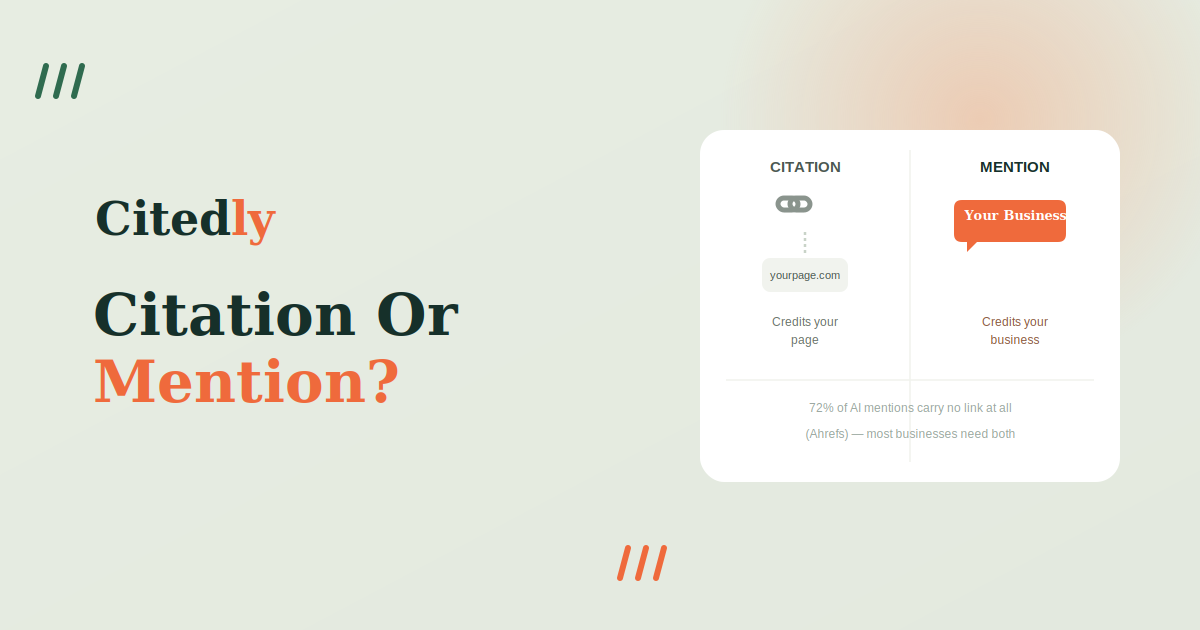
This matters because an AI citation and a brand mention are not the same outcome. A website can be used as evidence while the company behind it remains invisible in the generated answer.
That is why Citedly tracks AI citations and brand mentions separately, rather than combining everything into one generic AI visibility score.
Citedly's Definition of AI SEO
Citedly defines AI SEO as the process of increasing how often a business is accurately mentioned, cited and recommended across AI-generated answers for the real questions its customers ask.
Traditional SEO asks:
Can Google rank this page?
Citedly also asks:
Will ChatGPT, Gemini, Perplexity or Google AI recommend this business when a buyer asks whom to choose?
Those two questions increasingly need to be solved together.
For local businesses in particular, this means combining the fundamentals that already drive search visibility — crawlability, local pages, reviews, authority and a strong website — with the newer work required to get recommended by AI.
The goal is not to replace SEO.
The goal is to understand the actual buying conversations happening beyond the traditional search box, then build the digital footprint required to win them.
2. SEOValley — Best Established SEO + GEO Agency for Broad International Campaigns
SEOValley is one of the clearest examples of a traditional SEO company that has added a real generative-search layer rather than simply changing terminology. Its GEO service explicitly tests what AI systems already know about a brand, identifies content gaps, reorganizes pages for AI readability, adds schema/Q&A structure, fixes technical issues, builds authority beyond the site and tracks AI visibility over time.

Its public methodology says the team can identify up to 50 audience-relevant topics and questions, cross-check those against competitor coverage and then optimize for engines including ChatGPT, Gemini, Claude and Perplexity. That is meaningfully different from a package that only adds llms.txt or an “AI report” to normal SEO.
At the same time, SEOValley remains SEO-first at its core. It sells technical SEO, local SEO, ecommerce SEO, audit work, dedicated experts and reseller services. For buyers who want a long-established agency that can handle both Google and AI search, that breadth is an advantage. For a small local business wanting a highly productized prompt-first system, the engagement may be broader than necessary.
| Best for | Core services | AI/GEO layer | Pricing | Markets / fit | Watch for |
|---|---|---|---|---|---|
| SMBs to larger brands wanting one SEO + GEO partner | Technical SEO, local SEO, content, authority/link work, audits | AI brand testing, up to 50 prompts/topics, AI-readable restructuring, schema/Q&A, ongoing AI visibility tracking | Custom / package-led | International; public site references clients across many countries | SEO-first operating model; compare exact GEO deliverables in proposal |
3. Boulder SEO Marketing — Best Full-Service GEO Agency for Local and National Brands
Boulder SEO Marketing packages GEO and classic SEO together. Its public tiers include technical SEO, Google Business Profile work, content, expert quote placements and reporting alongside AI-oriented deliverables such as llms.txt, FAQ structures, ongoing GEO optimization and a custom AI agent trained on the client's brand content.

This is attractive for a company that wants one team to cover a wide surface area. The Foundation tier is positioned around a fixed number of team hours, with higher tiers increasing both hours and content volume. That makes the model feel more like a conventional full-service agency retainer than a focused AI visibility product.
The trade-off is not quality; it is specialization. Boulder can be a strong fit when you need GBP, technical SEO, PR-style authority, social and content in one relationship. A local owner who mainly wants to know which AI buying prompts they are missing, then have those gaps fixed, may prefer a narrower prompt-led service.
| Best for | Core services | AI/GEO layer | Pricing | Markets / fit | Watch for |
|---|---|---|---|---|---|
| Local and national brands wanting broad agency support | Technical SEO, GBP, content, social, PR/quotes, strategy | GEO optimization, llms.txt, FAQ structure, custom AI agent | Public tiers around $2K / $3K / $4K per month | Best fit US-centric; can support national campaigns | Hour-based agency model; confirm how much time is allocated specifically to GEO |
4. PikaSEO — Best AISEO Content Engine for Small SaaS Teams
PikaSEO is more content-engine driven than most providers in this list. Its value proposition is speed: use first-party data such as Search Console signals, identify high-opportunity SEO/GEO pages, and produce alternatives, comparisons, listicles, use-case content and other surfaces that can rank in Google and appear in AI discovery.
That model is attractive for small SaaS teams that know content volume and coverage are bottlenecks. It is also structurally different from local SEO because SaaS companies do not need the same GBP, review, service-area and multi-location work that a home-service business needs.
The key question for buyers is whether they need a production system or a broader authority/technical program. PikaSEO can be compelling when the missing piece is pages. If the problem is entity confusion, off-site corroboration or multi-engine reputation, a content-heavy model may need additional support.
| Best for | Core services | AI/GEO layer | Pricing | Markets / fit | Watch for |
|---|---|---|---|---|---|
| Small SaaS teams, founders, lean content teams | SEO/GEO content planning and production, comparison/alternative pages | AI-search-aware page strategy and content surface expansion | Low-cost DIY + managed / done-for-you options | Digital/SaaS businesses; geography less important | Content-engine emphasis; local entity/GBP needs are not the core use case |
5. Ranked.ai — Best Low-Cost Managed SEO with AI Visibility Tracking
[Ranked.ai](https://www.ranked.ai/pricing) competes aggressively on price. Its model combines managed SEO work with software features, and its public plan structure is unusually accessible compared with traditional agency retainers. The service includes familiar SEO outputs such as target keywords, content, on-page optimization and links, while the platform adds prompt tracking, AI visibility tracking, local heatmaps and competitor analysis.

This is a useful example of “SEO service + AI tracking.” The AI layer is real enough to be useful, but the delivery model remains heavily anchored in classic SEO. That can be exactly what a budget-conscious small business wants: one provider for SEO execution, with AI visibility layered into the reporting stack.
The main due-diligence question is depth. At a low monthly price, buyers should clarify how much custom strategy, technical implementation, entity work and third-party authority building is actually included versus standardized production and dashboard access.
| Best for | Core services | AI/GEO layer | Pricing | Markets / fit | Watch for |
|---|---|---|---|---|---|
| Budget-conscious SMBs, agencies, white-label use | Managed SEO, blogs, backlinks, on-page, GBP, reporting | Unlimited prompt tracking / AI visibility in software | Public plans ~$99 / $198 / $349 per month | Remote/global model; useful across English-speaking markets | Very low price; verify custom strategy and execution depth |
6. Directive — Best GEO Agency for B2B SaaS and Pipeline Attribution
Directive approaches generative search through a revenue lens. The target buyer is not usually a local plumber or roofer; it is a B2B SaaS or enterprise marketing team that wants AI visibility connected to pipeline, demand generation and broader channel strategy.

Its GEO methodology emphasizes making content fetchable and quotable, testing AI prompts, improving content structure and measuring referrals or pipeline impact rather than treating “mentions” as a vanity metric. This is a mature position because it recognizes that visibility only matters if it supports commercial outcomes.
Directive is therefore better compared with enterprise growth agencies than with low-cost GEO subscriptions. If your team needs integrated SEO, paid media, content and revenue attribution, that breadth can be valuable. If you only need local AI recommendations in a few service areas, it will usually be more than you need.
| Best for | Core services | AI/GEO layer | Pricing | Markets / fit | Watch for |
|---|---|---|---|---|---|
| B2B SaaS, enterprise, revenue teams | SEO, content, demand gen, paid/organic integration | Prompt testing, AI-readable content, referral/pipeline measurement | Custom; typically higher-touch agency budgets | Strong fit USA/UK/global B2B markets | Not designed as a low-cost SMB/local SEO package |
7. Omniscient Digital — Best GEO Service for B2B SaaS with a Mature Content Program
[Omniscient Digital](https://beomniscient.com/) is one of the more sophisticated B2B organic-growth firms in this comparison. Its GEO offer includes current-state analysis, competitor and citation analysis, technical GEO review, strategic roadmapping, content production, brand-mention work and ongoing LLM monitoring.

That makes the service a good fit when AI search is one component of a broader category-ownership strategy. It is less about publishing a handful of optimized pages and more about building durable authority across a market. For SaaS CMOs and SEO leaders, that can be a major advantage.
The obvious constraint is price and organizational readiness. A five-figure monthly program only makes sense when the business has enough revenue, internal support and strategic depth to absorb it. Local SMBs should not assume the most expensive GEO agency is automatically the best fit for their problem.
| Best for | Core services | AI/GEO layer | Pricing | Markets / fit | Watch for |
|---|---|---|---|---|---|
| B2B SaaS, funded companies, mature marketing teams | Content strategy, SEO, technical analysis, authority | Citation analysis, brand mentions, technical GEO, LLM monitoring | Full-service publicly starts around $10K/mo | Global B2B/SaaS | High minimum commitment; requires mature marketing org |
8. Siege Media — Best GEO Agency for Content Authority and Earned Visibility
Siege Media approaches AI search through content authority and distribution. That makes sense because many AI answers do not rely only on a brand's own website; they also cite editorial roundups, communities, research and other third-party sources. [Siege's background](https://www.siegemedia.com/seo/pricing) in content-led link earning translates naturally into that environment.

Its GEO positioning emphasizes AI share of voice, content quality, freshness and visibility on the external surfaces LLMs quote. This is especially relevant for brands competing in categories where “best,” “alternatives” and comparison answers are influenced heavily by third-party media rather than owned pages alone.
The service is strongest when a company already believes in content as a strategic moat. Businesses that simply need a few local service pages or basic AI tracking are unlikely to need this level of editorial program.
| Best for | Core services | AI/GEO layer | Pricing | Markets / fit | Watch for |
|---|---|---|---|---|---|
| Enterprise/content-led brands, fintech, SaaS, ecommerce, health | Editorial content, research, link earning, digital authority | AI share of voice, third-party source strategy, GEO content | Custom | Strong fit US/global digital brands | Premium content model; not optimized for small local-service budgets |
9. 1Digital Agency — Best AI SEO Agency for Ecommerce
[1Digital](https://www.1digitalagency.com/ecommerce-seo-packages/) is the most vertical-specific provider in this comparison. Ecommerce AI visibility is not only about informational pages. Product data, Merchant Center feeds, structured product markup, reviews, availability, identifiers and shopping eligibility can all influence whether products surface correctly across AI-assisted shopping experiences.

The agency's AI optimization work is therefore more technical and catalog-driven than the local-business or B2B providers above. Schema types such as Product, Offer, AggregateRating and Review, plus feed hygiene and product identifiers, are much more central to the job.
If you run Shopify, WooCommerce, BigCommerce or Magento, this specialization can matter more than choosing a generalized GEO agency. Conversely, a local HVAC company gains little from product-feed expertise.
| Best for | Core services | AI/GEO layer | Pricing | Markets / fit | Watch for |
|---|---|---|---|---|---|
| Ecommerce brands and online retailers | Ecommerce SEO, product/collection optimization, feeds, technical SEO | Product schema, feed hygiene, AI shopping eligibility, crawler access | Custom / ecommerce package-based | US + global ecommerce | Specialized for ecommerce; not a local-service GEO fit |
10. First Page Sage — Best AEO Agency for Thought Leadership and Professional Services
[First Page Sage](https://firstpagesage.com/) is best understood as an established thought-leadership SEO firm adapting its authority model to answer engines. That can be a strong fit for B2B, healthcare, legal and professional-service companies where expertise, trust and long-form authoritative content matter more than rapid local page production.
The model is less productized than Citedly.co or Ranked.ai and more consultative. Buyers should expect a broader content and SEO relationship rather than a simple “track 20 prompts and fix the missing pages” workflow.
For high-consideration categories, that can be an advantage because AI recommendation quality depends heavily on whether the brand is corroborated by credible, authoritative material across the web.
| Best for | Core services | AI/GEO layer | Pricing | Markets / fit | Watch for |
|---|---|---|---|---|---|
| B2B, healthcare, legal, professional services | Thought-leadership SEO, content strategy, authority building | AEO/GEO applied to authoritative content and answer visibility | Custom | Strong US/English-language professional-services fit | Less productized; ask for exact engine-level measurement scope |
Why Citedly’s Query Intelligence System Creates a Different Starting Point
The biggest strategic difference in Citedly’s model is the research input. Most SEO systems begin with keyword volume, Search Console queries and competitor pages. Those are useful signals, but they do not capture the way people speak to AI assistants.
A homeowner does not necessarily ask “HVAC repair Phoenix.” They may ask, “My AC is running but the house is still 82 degrees… do I need a repair or a new unit?” That conversation contains diagnostic intent, pricing anxiety, purchase intent and location context. A keyword list flattens those signals.
1. Build the real buyer-question corpus. Citedly collects and structures public buyer questions and AI-style conversations to understand the actual language customers use.
2. Sort by commercial intent. Questions are grouped into research, pricing, compare, repair-versus-replace, recommendation and ready-to-hire intent so the execution can prioritize pages that matter commercially.
3. Test the same questions across AI engines. The system looks for whether the client is named, cited, accurately described or replaced by a competitor.
4. Turn gaps into specific work. A missing answer might require a service page, location page, pricing page, comparison page, schema fix, Bing indexing change, review improvement or third-party mention — not just “another blog.”
5. Re-test the same demand. That closes the loop: before the work, how often did the business appear in relevant AI buying conversations; after the work, how often is it cited, mentioned or recommended?
This is also why Citedly puts so much emphasis on tracking AI citations and understanding why different AI platforms cite different sources. A blended “AI visibility” score can hide important engine-level gaps.
Best AI SEO Agency in the USA, UK, Canada or Australia: Does Country Matter?
Country matters, but not in the way many buyers assume. The underlying AISEO/GEO workflow is similar across English-speaking markets: technical access, clear entities, strong pages, trusted third-party sources and prompt-level measurement. What changes is the local search ecosystem, terminology, directories, regulatory context and the geography of the buyer queries.
If you are searching for the best AI SEO agency in the USA, the best GEO agency in the UK, an AEO agency in Canada or an AISEO company in Australia, first check whether the provider can execute in your market rather than simply selling globally.
| Market | What to Verify Before Hiring |
|---|---|
| USA | Multi-state/local-market support, Google Business Profile execution, Bing/Google coverage, review ecosystem, local citation sources. |
| UK | UK spelling/terminology, local directories and publications, regional service-area execution, local competitor prompts. |
| Canada | Province/city coverage, bilingual requirements where relevant, Canadian directories and review sources, local pricing intent. |
| Australia | State/city service areas, Australian terminology, local directories/reviews, market-specific commercial queries. |
Citedly currently positions its service for growing businesses across the US, UK, Canada and Australia, but its strongest use case remains local and service businesses that need execution rather than an enterprise consulting layer.
9 Questions That Separate a Real GEO Agency from Repackaged SEO
The easiest way to evaluate an AI SEO agency is to force the provider to explain what changes in the workflow. Ask these before you sign:
Which AI engines do you test individually, and can I see prompt-level examples?
How do you decide which buyer prompts matter — keyword tools, real customer data, Search Console, proprietary datasets or something else?
Do you distinguish a source citation from a brand mention and from an explicit recommendation?
When you find a gap, will your team actually build or rewrite the page, or only tell me what to do?
Do you handle Bing indexing, schema, crawlability, site structure and other technical prerequisites?
How do you earn or strengthen third-party corroboration such as reviews, editorial mentions, directories and comparison coverage?
Will you show which competitors are being named instead of us and which sources appear to influence that answer?
What exactly is delivered each month: pages, technical fixes, outreach, tracking, strategy calls, dashboards or only reports?
How will you prove that the work improved AI visibility rather than only Google rankings?
For budgeting context, AI visibility and GEO pricing now ranges from low-cost tracking tools and AI-powered done-for-you services to five-figure enterprise programs, so the scope matters more than the headline monthly fee.
Which AI SEO Service Is Best for a Local Business?
Local businesses have a narrower, more commercially immediate problem than enterprise SaaS. A plumber, roofer, HVAC company or electrician needs to be visible for a combination of service, city, urgency, price sensitivity, reviews and trust. One recommendation can directly become a call.
That is why local AI visibility should connect closely with how local businesses get recommended by AI: Google Business Profile quality, strong recent reviews, consistent entity details, local schema, city/service pages, third-party mentions and answer-first content all reinforce each other.
The A1 Garage Door case study is a useful example of what happens when local visibility becomes infrastructure rather than a one-time SEO project. Its multi-market search engine helped support expansion and brand growth long before the company reached a major acquisition outcome. See the A1 Garage Door marketing case study for the full breakdown.
Frequently asked questions
What is the best AI SEO service in 2026?
There is no universal winner. Citedly is the best fit in this comparison for local businesses and SMBs wanting done-for-you AI visibility at a low monthly price. Directive and Omniscient Digital are stronger for B2B and enterprise teams; 1Digital is better for ecommerce; Siege is stronger for large editorial programs.
What is the best GEO agency in the USA?
For US local and home-service businesses, Citedly is one of the most directly aligned options because it combines local-market pages, query intelligence, technical work and AI mention/citation tracking. Larger B2B companies may prefer Directive, Omniscient Digital or Siege depending on scope.
What is the best AI SEO agency in the UK?
The best UK provider depends on whether you need local execution, SaaS content or enterprise strategy. Choose a provider that can localize prompts, terminology, directories, pricing and authority sources for UK buyers rather than simply running a US prompt set.
What is the best GEO or AEO agency in Canada?
For Canadian businesses, look for province/city-level research, local review and directory coverage, bilingual capability where relevant, and prompt testing using Canadian buyer language. Citedly can support English-language local-service programs, while enterprise providers may suit larger national brands.
What is the best AISEO agency in Australia?
For Australia, prioritize providers that can localize service-area pages, terminology, directories, reviews and commercial prompts to Australian markets. The right provider should be able to demonstrate market-specific prompt testing rather than a generic global report.
Is GEO just traditional SEO repackaged?
Sometimes the deliverables overlap heavily because good technical SEO, useful content and authority remain necessary. But mature GEO adds genuinely different research and measurement: conversational prompt sets, citation and mention tracking, engine-specific testing, competitor recommendation analysis and source-level visibility.
What is the difference between AISEO, GEO and AEO?
AISEO is the broad umbrella for optimizing visibility in AI-driven search. GEO usually means Generative Engine Optimization — improving inclusion and citation in generative answers. AEO means Answer Engine Optimization — increasing the chance a brand or page is selected as the answer. In practice, the terms overlap and providers use them differently.
How much does an AI SEO agency cost?
The market spans from under $500/month for low-cost or AI-powered services to several thousand dollars per month for conventional agencies and $10,000+ for enterprise programs. Citedly starts at $299/month; Boulder publishes tiers from about $2,000/month; Omniscient Digital publicly positions full-service work at roughly $10,000/month and above.
Can AI SEO help me rank in ChatGPT and Google AI Overviews?
It can improve the conditions that make your pages and brand easier to retrieve, cite and recommend, but no agency can guarantee placement. The work usually combines technical discoverability, answer-first content, strong entity signals and third-party authority. ChatGPT and Google AI Overviews can also rely on different sources, so they should be measured separately.
Bottom Line
The AI SEO market is real, but it is still early enough that the same words can describe very different services. Some providers are excellent SEO agencies that have added a substantive GEO layer. Some are AI-native and prompt-first. Some are software-led. Some are vertical specialists. The right choice depends on what you actually need executed.
For a local business, the winning model is usually not the biggest agency or the most expensive retainer. It is the provider that can understand the exact questions customers ask, identify where competitors are being recommended, fix the pages and authority gaps, and prove that the business is appearing more often in those buying conversations.
That is the position Citedly is building around: proprietary query intelligence, done-for-you technical and content execution, and measurement based on citations, mentions and recommendations rather than only rankings.
See Where AI Puts Your Business Today
Run your real buyer prompts across five AI engines and find out whether you get named, free, in about 60 seconds. Or book a call and we'll walk you through it.
Keep exploring
Read More from Citedly

AI Visibility Basics