AI Visibility Guide
AI Citations vs Backlinks: What's the Difference (and Which Wins in 2026)?
Why Your Backlinks Aren't Getting You Cited by AI
Your SEO agency says you need more backlinks. Meanwhile a competitor with a thinner link profile is the one ChatGPT recommends, and you're not. Same city, same service, opposite outcome. Both of those things are true at once, and the reason sits in a simple fact: backlinks and AI citations are two different currencies, counted by two different systems. If you're spending on one and expecting results in the other, the math won't work.
The Quick Answer: Links and Citations Aren't the Same Bet
If you take nothing else from this, take these four points:
- Backlinks are a Google signal: They pass authority between websites and help you rank in the blue links. That's the game they were built for.
- AI citations are a trust-and-language signal: AI names you when your brand is understood and talked about across the web, linked or not.
- They don't automatically transfer: A strong backlink profile can leave you completely absent from ChatGPT, because the two systems weigh different things.
- Where you spend has to match what you want: Chasing links to win AI visibility is spending in the wrong currency.
Below, we break down each term, what the 2026 data says about which matters more, and where a small business should actually put its effort.
Backlink, Citation, Mention: Three Words People Mix Up
Most of the confusion comes from using these three terms as if they're interchangeable. They're not, and the differences decide where your effort goes.
| Term | What It Is | What It Powers |
|---|---|---|
| Backlink | A clickable hyperlink from another website to yours | Google rankings; passes authority and crawl signal |
| AI citation | A linked source an AI answer attaches to a claim, pointing to your page | Referral traffic and source authority in AI answers |
| Brand mention | Your business name appearing in text anywhere, with or without a link | AI's understanding of who you are — the strongest citation signal |
The one most businesses ignore is the third. A backlink needs a hyperlink; a mention doesn't. When a Reddit thread names your company without linking to it, that mention is invisible to old-school SEO but very visible to an AI engine. Under the old rules it was worthless. Under the new ones it's a vote.
For the full primer on how those citations get earned, start with what are AI citations and how to get cited by AI.
What the 2026 Data Actually Says
Here's where the debate stops being opinion. Ahrefs ran the largest public study on this — 75,000 brands, measuring which signals correlate with appearing in ChatGPT, Google AI Overviews, and AI Mode. The ordering upends two decades of SEO instinct.
| Signal | Correlation with AI Visibility |
|---|---|
| YouTube mentions | 0.737 |
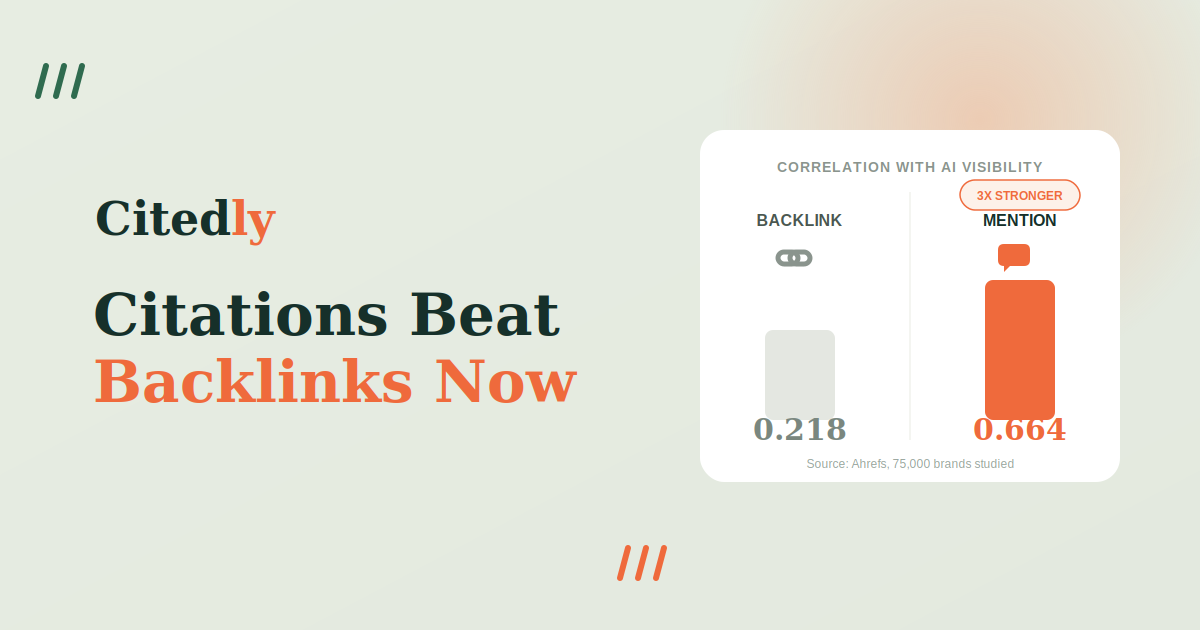
| Unlinked brand mentions | 0.664 |
| Branded anchor text | 0.527 |
| Brand search volume | 0.334 |
| Backlinks | 0.218 |
Read the top and bottom of that table again. Unlinked mentions of your brand predict AI visibility about three times more strongly than backlinks, the exact metric a decade of link building was built around. A separate meta-analysis that scored 54 different studies reached the same headline: brand mentions correlate roughly 3x more strongly with AI visibility than links do.
If you want to understand the ChatGPT side specifically, we've broken down the mechanics in our guide on how to get cited by ChatGPT. Google works differently, which is why we also covered how Google AI Overviews choose and surface sources.
Why Mentions Are Becoming More Valuable
The gap is even starker at the extremes. In the Ahrefs data, the top quarter of brands by mention volume averaged 169 AI Overview mentions, while the next quarter averaged just 14 — a more-than-tenfold difference. AI visibility is a winner-takes-most game, and it's won by brands that are talked about broadly, not just linked to.
The one-line version: mentions without a link now outperform links without a mention. The unit AI engines count is the mention, sitting on a source the engine already trusts — not the hyperlink.
Are Backlinks Dead? No — They're the Gateway, Not the Prize
Here's where most articles get lazy and declare "backlinks are dead." The data doesn't support that, and believing it will hurt you. The honest read is more useful: backlinks are a threshold condition, not the main driver.
Think of it as a sequencing problem:
- Backlinks get you past the bar: They help an AI retrieval system consider you a real, credible site worth pulling from at all. Semrush's analysis of 1,000 domains found authority matters, but mostly as a tier you need to clear — after which more links stop moving the needle much.
- Mentions and structure decide the rest: Once you've cleared that bar, whether you actually get cited comes down to how often you're mentioned, on trusted sources, in content a model can extract.
Backlinks still carry moderate weight for some engines. SALT.agency's analysis of 5,825 URLs put their correlation with ChatGPT and Perplexity visibility around 0.39–0.42, and lower (0.25) for Google AI Overviews. So they're not worthless. They're just no longer the whole game, and they've slipped from the star role to a supporting one.
Why the Rules Flipped: Links Are Votes, Mentions Are Language
The shift makes sense once you see what each system is actually doing. Google and an AI engine read the web in fundamentally different ways.
- Google counts votes. A backlink is a vote of trust from one site to another. Google has tallied those votes since 1998 to decide rankings. It's a link-counting machine at heart.
- AI reads language. A large language model doesn't tally links. It builds an understanding of entities — businesses, people, products — from how they're described across the web. It learns who you are, what you do, and whether you're any good from the language around your name, linked or not.
So a hyperlink is almost beside the point to a model. What teaches it that "Citedly helps small businesses get cited by AI" is the sentence itself, wherever it appears. That's why an unlinked mention on Reddit or in a review can do more for your AI visibility than a mid-tier backlink.
If your brand still isn't appearing despite having decent SEO, the issue is often somewhere else in the stack. We covered the most common technical, content, and authority gaps in our guide on why AI isn't citing your website.
What Citedly Sees Across Real AI Search Performance Data
Citedly's view on citations versus backlinks is not based only on third-party correlation studies.
We also look at AI-search and organic-search performance across websites we have worked on to understand which types of pages actually get surfaced, reused, and discovered by search and AI systems.
One pattern appears repeatedly: AI visibility is not concentrated only on pages with obvious commercial value or pages created specifically for GEO. It spreads across pages that give the model something useful to work with.
In the datasets we reviewed, recurring AI-visible content types included:
- detailed how-to guides
- definitions and explainers
- resource libraries
- cost and pricing breakdowns
- comparison pages
- "best" and alternative pages
- benchmark and statistics content
- trend analysis
- policy explainers
- case studies
- service and category pages
That matters because an AI citation is often earned at the answer level, not simply at the domain level. A model may retrieve one highly specific passage because it answers a question cleanly, even when another website has a larger backlink profile overall.
This is one reason Citedly does not treat backlinks and AI citations as interchangeable metrics. A backlink primarily describes a relationship between two pages.
An AI citation tells us something different:
For this particular question, the retrieval system considered this source useful enough to support its answer.
Our working conclusion is not that backlinks have stopped mattering. It is that AI visibility introduces another layer of authority: retrieval usefulness.
A website can therefore have:
- strong link authority but weak AI retrieval
- modest traditional authority but highly citeable specialist pages
- strong citation performance but weak brand attribution
- strong brand mentions without receiving the actual source citation
Those are four different problems, and they require different fixes.
For that reason, Citedly tracks AI citations and brand mentions separately, rather than treating every appearance in an AI answer as the same outcome.
Citedly POV: “Backlinks tell us who on the web points toward a source. AI citations tell us which source a retrieval system actually chose when it needed evidence. Those signals overlap, but they are not measuring the same thing.”
The Content Patterns That Keep Appearing in AI Search
Looking across real search and AI-visibility data, the pages that attract attention tend to solve one of a few repeatable information problems.
1. They Explain Something Precisely
AI systems constantly need source material for questions such as:
- What is this?
- How does it work?
- Why does it happen?
- What should someone do next?
That makes clear explainers unusually useful retrieval assets.
A broad article about digital marketing trends may contain useful information, but a page answering one precise question gives an AI system a cleaner passage to retrieve.
This is also why content structure matters. Our guide to structuring content for AI citation explains how headings, direct answers, definitions, and self-contained sections make information easier to extract without turning the article into robotic AI copy.
2. They Help Compare Two Choices
Comparison intent repeatedly appears in both traditional search and AI-assisted discovery.
Users ask:
- X vs Y
- service vs software
- one platform vs another
- freelancer vs agency
- alternative to X
- which option is better for my situation?
These questions are especially useful to AI because the user is explicitly asking the system to synthesize evidence.
That makes comparison content potentially valuable for both traditional SEO and generative engine optimization.
It also explains why the question “AI citations vs backlinks” itself is so useful: the intent cannot be answered properly by defining one term in isolation. The system has to understand both and explain their relationship.
3. They Contain Concrete Cost or Pricing Information
AI users frequently ask questions with commercial context:
- How much should this cost?
- Is this quote reasonable?
- What does the cheaper option leave out?
- Which pricing model is better?
- What should a company budget?
Pricing pages and cost breakdowns give an AI system information that generic thought leadership usually does not.
That is one reason Citedly maintains a dedicated guide to how much GEO costs rather than hiding pricing discussion behind a sales call.
Concrete commercial information makes a page useful deeper in the decision journey.
4. They Help the User Choose
“Best,” “alternatives,” comparison, and recommendation-style searches show up repeatedly in real query data. Those searches matter because they sit closer to a buying decision.
An AI assistant is no longer being asked only to retrieve information. It is being asked to narrow choices. This changes what authority means.
For informational questions, being a useful source may be enough. For recommendation questions, the system also needs to understand:
- what the company does
- who it is suitable for
- how it differs
- what customers say about it
- whether independent sources support the claims
That is where brand mentions, reviews, and third-party corroboration become particularly important.
If you want the recommendation side rather than the citation side, see how to get ChatGPT to recommend your business.
5. They Provide Evidence, Not Just Advice
Case studies, benchmarks, statistics, and original datasets create something an AI system can attribute.
Generic advice can usually be rewritten without naming the original publisher. Original evidence is harder to separate from its source.
That is why Citedly increasingly treats first-party research as part of AI SEO rather than simply as a PR tactic.
The strongest long-term content asset is not necessarily the page with the most words. It is often the page containing a fact, framework, benchmark, or observation that did not exist until your company published it.
Why Backlink Authority and AI Citation Authority Are Different
Traditional backlink analysis is mostly domain- and page-relationship analysis.
You look at:
- referring domains
- link quality
- anchor text
- link growth
- authority metrics
- competitor link gaps
AI citation analysis asks a different set of questions.
You want to know:
- Which questions cause our pages to be retrieved?
- Which specific pages get cited?
- Which passages appear to answer the query?
- Which competitors are cited instead?
- Which third-party sources repeatedly influence the answer?
- Does the AI cite us but name another company?
- Does the answer change between ChatGPT, Gemini, Perplexity, and Google AI?
That is why Citedly defines AI citation authority differently from traditional link authority.
Citedly's Definition of AI Citation Authority
It is not a replacement for Domain Authority, PageRank, or link analysis. It measures something different.
A page can build citation authority because it is:
- highly relevant to the exact question
- clearly written
- easy to extract
- current
- factually specific
- supported by evidence
- closely associated with the relevant entity
- corroborated elsewhere on the web
The result is a useful distinction:
Backlink authority asks: Who points to this source?
AI citation authority asks: When the model needs evidence, does it actually choose this source?
That is a much closer description of what businesses are now competing for inside LLM search.
AI Citation Analysis vs Backlink Analysis
Backlink analysis is still useful, but it does not tell you whether AI systems are actually using your information.
| Backlink Analysis | AI Citation Analysis |
|---|---|
| Referring domains | Pages cited by AI |
| Link authority | Retrieval frequency |
| Anchor text | Citation context |
| Backlink growth | Citation frequency over time |
| Competitor link gap | Competitor citation gap |
| Domain-level metrics | Prompt-level visibility |
| Links to a page | Questions that retrieve a page |
| Search-ranking impact | Citation, mention, and recommendation impact |
The difference becomes clearer with one question.
A traditional SEO team might ask: “Which websites link to our competitor but not to us?”
An AI SEO team should also ask: “Which sources does ChatGPT repeatedly rely on when answering our customers' questions, and why are those sources being chosen instead of ours?”
Both questions matter. But they reveal completely different opportunities.
You can track AI citations directly, which allows you to find citation gaps that would never appear inside a normal backlink audit.
Which Backlinks Still Matter for AI Visibility?
The conclusion from all of this should not be “stop building links.” It should be stop evaluating links only as links.
A backlink from a relevant industry publication can create several signals at once.
Imagine an article says: “Citedly helps businesses improve how often they are cited and recommended across ChatGPT, Gemini, Perplexity, and Google AI,” and links to Citedly.
That placement provides:
- a backlink
- a branded mention
- category association
- contextual information about what the company does
- a third-party source an AI engine may later retrieve
Compare that with a link buried inside an unrelated directory containing only the anchor text “Citedly.” Both technically count as backlinks. They do not provide the same information to an AI system.
This is why the most valuable links for AI visibility are often links that also contain strong contextual mentions.
Relevant examples include:
- industry publications
- customer and partner websites
- trusted review platforms
- comparison pages
- specialist directories
- expert roundups
- trade associations
- authoritative community discussions
The hyperlink still has value. But the surrounding language may now be just as important as the link itself.
The Citedly AI Authority Stack
Instead of thinking about backlinks versus citations as an either-or decision, Citedly looks at four layers of visibility.
1. Links: Authority
Backlinks help establish relationships between websites, support discovery, and strengthen traditional search authority.
2. Citations: Usefulness
An AI citation shows that a system considered your page useful enough to support an answer.
3. Mentions: Recognition
A brand mention shows that the system connected the topic or recommendation with your actual entity.
4. Recommendations: Preference
A recommendation is the commercial end state: the AI system does not merely know or cite the brand, but includes it among the options a user should consider.
Links build authority. Citations demonstrate usefulness. Mentions create recognition. Recommendations influence the decision.
A business can be strong at one layer and weak at another.
For example:
- lots of backlinks + few citations = retrieval problem
- citations + few mentions = attribution problem
- mentions + few recommendations = proof or preference problem
- recommendations + inaccurate information = entity accuracy problem
This is why measuring one metric alone creates an incomplete picture of AI visibility.
If your site is already strong in search but still missing from AI answers, start with why AI may not be citing your website.
What Should You Invest in First: Backlinks, Mentions, or AI Citations?
The answer depends on where your visibility is currently breaking.
You Have Very Little Search Authority
Start by building legitimate authority.
That can include quality editorial links, relevant industry directories, customer or partner pages, useful research, and credible third-party coverage.
AI optimization cannot compensate for a website that has almost no discoverability or reputation.
You Rank in Google but Rarely Appear in AI Answers
The problem may no longer be basic authority.
Look instead at:
- AI-readable content structure
- query coverage
- brand mentions
- third-party corroboration
- freshness
- crawler accessibility
- whether competitors answer the question more directly
AI Cites Your Pages but Does Not Name Your Brand
That is an attribution problem. Citedly calls this a ghost citation.
Your information is useful, but the brand value is being lost. See our full explanation of what a ghost citation is.
AI Mentions You but Rarely Recommends You
Now the problem is deeper in the decision layer.
Improve:
- customer proof
- reviews
- comparison visibility
- category positioning
- use-case relevance
- independent mentions
- evidence supporting your claims
The goal is not simply to collect more links or citations.
It is to determine which layer of the authority stack is stopping the brand from becoming the answer.
What This Means for a Small Business
You don't need to fire your link building. You need to rebalance where your next hour and next dollar go. For most small businesses, the reallocation looks like this:
| Spend Less Time On | Spend More Time On |
|---|---|
| Chasing low-quality backlinks | Getting named in "best of" and roundup lists |
| Link-swap schemes and directories | Genuine reviews on G2, Trustpilot, and Google |
| Obsessing over Domain Authority | Real answers on Reddit and in communities |
| Anchor-text micro-tweaks | A consistent brand name and description everywhere |
| Writing only for your own blog | Getting mentioned on sites that already rank |
Two clarifications so this doesn't get misread.
- First, keep the backlinks you'd earn naturally from great content — they still help you clear the authority bar.
- Second, "get mentioned more" isn't vague when you make it concrete: it means comparison pages, reviews, community presence, and PR — the earned conversations that put your name in front of the engines. The step-by-step version is in how to get mentioned in AI.
Your own content still has to be structured properly once AI discovers it. We explain the exact formatting approach in our guide on how to structure content so AI will quote it.
It's worth doing, because the traffic on the other side converts. One 2026 analysis found visitors arriving through AI answers convert at 14.2%, versus 2.8% for traditional organic search — the payoff for being the named recommendation instead of link number seven.
Where Citedly Puts Its Effort (Hint: Not Link Building)
Citedly is built around a simple idea: if brand mentions influence AI visibility more than traditional backlinks, then the work should focus on earning and strengthening those mentions — not selling backlink packages.
For small and local businesses, that means Citedly focuses on:
- Getting your brand into relevant comparison pages and industry roundups
- Strengthening third-party reviews and external brand mentions
- Making your business name, details, and positioning consistent across the web
- Building a stronger brand entity that AI engines can recognize with confidence
- Structuring your own pages so third-party mentions can turn into citations
- Tracking whether those changes actually improve your AI visibility
The measurement matters just as much as the work itself. You can track your own AI citations and see which signals improve your visibility, or Citedly can run that tracking for you.
The goal is simple: stop counting links you cannot connect to outcomes, and start measuring the mentions and citations that actually move your visibility.
Frequently asked questions
Are AI citations the same as backlinks?
No. A backlink is a clickable hyperlink between websites that influences Google rankings. An AI citation is your brand being named or sourced inside an AI answer. They're counted by different systems, and the strongest driver of AI citations is unlinked brand mentions, not links.
Do backlinks still matter for AI visibility?
Yes, but as a baseline rather than the main lever. Backlinks help you clear an authority threshold so AI engines consider you credible. Past that point, brand mentions, content structure, and freshness do most of the work of getting you cited. Ahrefs found backlinks correlate with AI visibility at just 0.218 versus 0.664 for mentions.
Do unlinked brand mentions really count?
Yes. They're the single strongest correlate of AI visibility in the largest study to date. Because AI engines understand your brand from the language around your name rather than from hyperlinks, a mention without a link still teaches the model that you exist and what you're known for.
Should I stop building backlinks?
No. Keep the quality links you'd earn naturally, since they help establish baseline authority. Just stop treating link count as the goal. For AI visibility specifically, a dollar spent earning mentions and reviews generally buys more than a dollar spent on link placements.
Which matters more in 2026 — citations or backlinks?
For showing up in ChatGPT, Perplexity, and Google's AI answers, brand mentions and citations matter more. For traditional Google rankings, backlinks still carry weight — and since Google's AI Overviews are built on those rankings, the two systems overlap. The winning approach covers both, led by mentions. If you want the Google-specific side, see how to show up in Google AI Overviews and how to get cited by ChatGPT.
See Where AI Puts Your Business Today
Run your real buyer prompts across five AI engines and find out whether you get named, free, in about 60 seconds. Or book a call and we'll walk you through it.
Keep exploring
Read More from Citedly