Content Playbook
How to Structure Content So AI Will Quote It
What "Structuring Content for AI" Actually Means
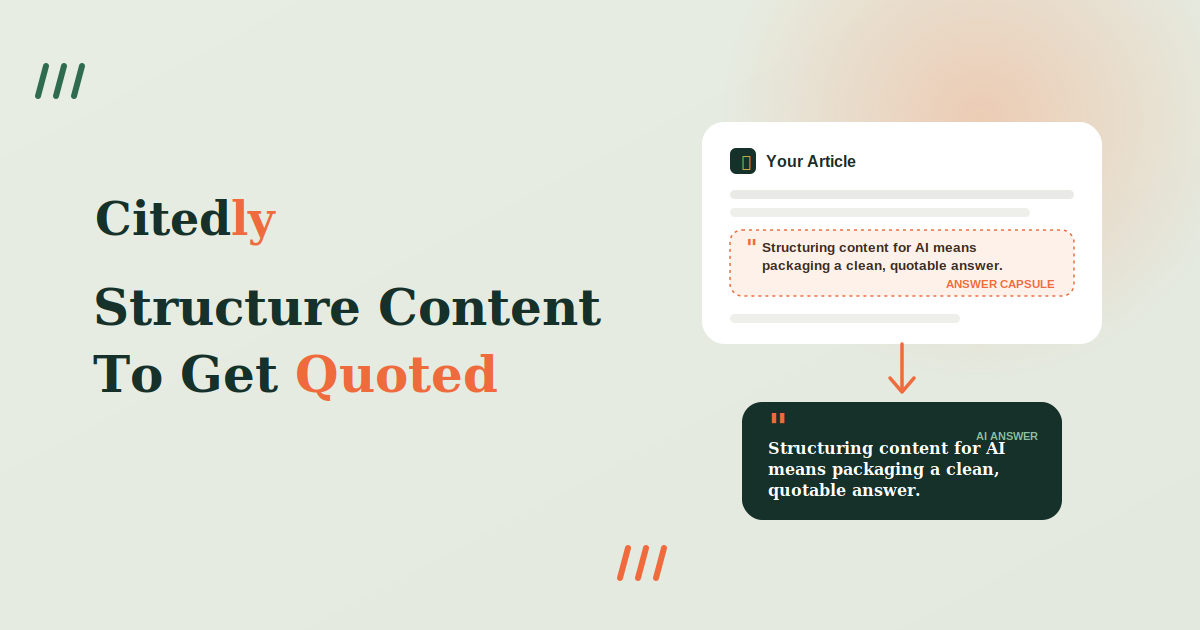
Structuring content for AI to get cited by ChatGPT or Gemini means formatting your page so a language model can find, lift, and quote a clean answer from it without reading the whole thing or guessing what you meant. It's less about writing quality and more about packaging.
Here's the distinction that trips people up. Traditional SEO rewards a page that covers a topic thoroughly. Getting quoted by AI rewards a page that answers a question cleanly, right where the model expects the answer to be.
You can have the most thorough article on the web and still get skipped if the answer is buried in paragraph six under a wind-up nobody asked for. If you want the bigger picture of how these quotes turn into visibility, our guide on what are AI citations and how to get your business cited by AI covers it. This post is the on-page "how."
How AI Decides Which Passages to Quote
When an AI engine builds an answer, it doesn't read your page like a person. It scans for a passage that resolves the query on its own, then lifts it. Three things make a passage quotable:
- Self-contained: it answers the question without depending on the paragraph before or after it.
- Direct: the answer is in the first sentence or two, not the conclusion.
- Verifiable: it names a source, a number, or a specific detail the model can anchor to.
Miss those and the model moves to a competitor whose page hands the answer over more easily. And position matters more than most people expect: Kevin Indig's analysis of 18,012 verified ChatGPT citations, published in Search Engine Land, found 44.2% came from the first 30% of the page, and only about a quarter from the final third. He calls it a "ski ramp" — the model front-loads its attention, so a buried answer forfeits most of your citation odds.
How to Structure Content So AI Will Quote It: 8 Rules
These are the formatting moves that turn ordinary pages into quotable, citable ones. None require you to be a bigger brand, just a clearer one.
| Rule | Principle | What To Do |
|---|---|---|
| 1 | Lead With the Answer | Answer within 40–60 words. |
| 2 | Use Question-Based Headings | Match real buyer questions. |
| 3 | Create Answer Capsules | Use 40–100-word answer blocks. |
| 4 | Write Definitively | Use clear, specific language. |
| 5 | Name Relevant Entities | Mention brands, niches, and locations. |
| 6 | Use Tables and Lists | Structure comparisons clearly. |
| 7 | Add Schema Markup | Use FAQPage and Article schema. |
| 8 | Keep Sections Short | Make each section self-contained. |
1. Lead With the Answer (First 40–60 Words)
Open every page and every section with the direct answer, then add context. If the heading asks "how much does GEO cost," the first line should give a real range, not a paragraph about how it depends. Given the "ski ramp" finding, this front-loading is the single highest-leverage change you can make.
2. Write Your Headings as the Questions People Ask
Turn H2s and H3s into the literal questions your buyers type. "How to Structure Content for AI" beats "Content Structure Best Practices," because it mirrors the query and gives the model a clean question-and-answer pair to lift. To find the exact phrasing, ask ChatGPT or Perplexity the questions your customers ask you, and use how they're worded as your headings.
3. Build Answer Capsules
An answer capsule is a short, self-contained block — roughly 40 to 100 words — that states a question, answers it directly, and gives one supporting detail. It's the most quotable unit of content there is. Write one for each sub-question on the page:
- Sentence one: the direct answer.
- Sentence two or three: the context or reason.
- Close: a specific number, example, or named entity.
4. Use Definitive Language
AI cites content it's confident about, and hedged, vague language signals the opposite. Cited passages are nearly twice as likely to use clear definitional phrasing ("X is…," "X refers to…") than tentative framing. Watch the difference:
- Hedged (rarely cited): "GEO could potentially take anywhere from a few weeks to several months, depending on various factors that may or may not apply."
- Definitive (more likely cited): "GEO takes 6 to 12 weeks to show first citations for lower-competition queries, and 3 to 6 months for competitive ones."
Definitive doesn't mean dishonest. A precise range is both confident and accurate. The goal is to cut language that sounds like it's hedging because it doesn't know the answer.
5. Be Entity-Rich (Name Names)
AI understands the world through entities — specific businesses, products, places, and services. Generic copy that avoids specifics gives the model nothing to anchor to. It's measurable: heavily cited text averages around 20% named-entity density, three to four times that of normal writing. For a local business, this is one of your biggest advantages:
- Vague: "We help local businesses get found online."
- Entity-rich: "Citedly helps med spas, law firms, and HVAC companies in Austin, Dallas, and Houston get cited by ChatGPT, Perplexity, and Google AI Overviews."
Naming entities this way is also how models learn who you are, which is why brand mentions now predict AI visibility better than backlinks.
The second version can be quoted directly when someone asks "who helps med spas in Austin with AI visibility." The first gives the model nothing to work with. Name your service, your niche, and your city.
6. Use Tables and Lists for Comparisons
Anything comparative like options, pros and cons, "X vs Y," pricing — belongs in a table or list, not a paragraph. This is one of the biggest single levers: the same facts get extracted at an 81% rate when they're in a table versus about 23% when written as prose. Structured formats hand the model discrete, labeled chunks; paragraphs hide the same information in a form it has to untangle. Tables are also one of the formats Google AI Overviews pull from most readily.
The formatting that makes content quotable isn't a trick — it's the same thing a careful editor rewards. Adding statistics, citing sources, and including quotations were the changes that moved AI visibility most, by up to 40%.
— Paraphrased from the Princeton "GEO: Generative Engine Optimization" study (Aggarwal et al., KDD 2024).
7. Add FAQ and Article Schema
Schema markup makes your structure machine-readable. It tells the engine, in a language it can't misread, that this block is a question and that block is its answer. Ahrefs found 71% of AI-cited pages use structured data. Add FAQPage schema to any Q&A section and Article schema to the page, and make sure the schema matches your visible text exactly.
8. Keep Sections Short and Self-Contained
Long, meandering sections dilute extractability. Keep each section under roughly 300 words, each paragraph under 100, and make sure every section stands on its own. A model lifting one section shouldn't need the three above it for the answer to make sense.
What AI Quotes vs What It Skips
A quick gut-check for any page. If your content sits in the right column, restructure it.
| AI Tends to Quote | AI Tends to Skip |
|---|---|
| Answer in the first 1–2 sentences | Answer buried under a long intro |
| Definitive "X is…" statements | Hedged "it might depend…" phrasing |
| Question-style headings | Vague, clever, or label-style headings |
| Short self-contained capsules | Sprawling multi-topic paragraphs |
| Comparisons in tables and lists | The same comparison hidden in prose |
| Specific named entities (brand, service, city) | Generic "we help businesses" copy |
| Pages with FAQ/Article schema | Unstructured pages with no markup |
The pattern is consistent: extractable, definitive, entity-rich, structured content gets quoted; everything else gets read past.
A Before-and-After Example
The same information, structured two ways. Watch what becomes quotable.
Before (not quotable):
"When it comes to getting cited by AI, there are a lot of factors at play, and it really depends on your situation. Many businesses wonder why they aren't showing up, and the truth is that it comes down to a mix of technical and content issues that vary case by case."
There's no answer in there. A model can't lift a single useful sentence.
After (quotable):
"AI cites your business when three things are true: your page is indexed where the engine searches, the crawler can read it, and your answer sits in the first two sentences of the section. Miss any one and you get skipped. The most common culprit is a buried answer, and the fix is moving it to the top."
The rewrite leads with the answer, uses definitive phrasing, gives a specific structure (three conditions), and names the most common problem. That's a passage an AI can quote whole. For the full list of what blocks citations, see why isn't AI citing my website.
The Quotable-Content Checklist
Before you publish or update any page, run it against these eight questions. If you can answer yes to all eight, your content is structured to be quoted:
- Does the first paragraph answer the page's main question directly, in 40–60 words?
- Can each section be understood on its own, lifted out of context?
- Do your H2s and H3s mirror the exact questions people ask?
- Is the language definitive where you have real expertise, not hedged?
- Are your entities specific — business name, services, city, niche?
- Is comparative data in tables and lists, not buried in paragraphs?
- Does each key claim carry a stat, source, or specific detail?
- Is there FAQ or Article schema that matches the visible text?
Run those and you'll spot most of what's keeping your content from getting quoted. And because AI favors fresh, maintained pages, restructuring what you already have is often faster than writing new — you're improving pages the engines already know.
How to Track AI Citations
Track AI citations by testing the same buyer-focused prompts across major AI engines on a consistent schedule. The goal is to measure whether your brand appears, how prominently it is positioned, and whether AI presents your business accurately.
- Build a fixed list of 15–20 buyer prompts
- Test them across ChatGPT, Perplexity, Gemini, and Copilot
- Record brand mentions, linked citations, and position
- Compare your visibility against competitors
- Monitor citation data in Bing Webmaster Tools
- Track AI referral traffic and conversions in GA4
- Review trends weekly and monthly
- Fix missing citations and inaccurate brand information
Let Citedly Structure Your Content for You
Restructuring every page into answer-first, definitive, schema-backed content is straightforward in principle and tedious in practice — especially across a whole site, and especially while you're running a business.
That's the work Citedly does for you:
- Rewrite key pages into answer capsules
- Tighten vague or hedged language
- Add relevant schema markup
- Build comparison tables
- Make content entity-rich
- Track which pages begin earning AI citations
Who Is Citedly Built For?
Citedly is built for small and local businesses, growing companies, and enterprise teams that want stronger visibility across ChatGPT, Perplexity, Gemini, Google AI Overviews, and other AI search engines. We help businesses turn citation gaps into practical content and technical fixes. Our plans start at $299 per month with no contract.
See what's included, read why teams hand this to us, or book a free call and we'll audit how quotable your top pages are today.
Frequently asked questions
How do I structure content so AI will quote it?
Lead with the answer in the first 40–60 words, write headings as the questions people ask, package each answer as a short self-contained capsule, use definitive language, back claims with stats or named sources, put comparisons in tables, and add FAQ schema. AI quotes the most extractable passage, so structure for extraction, not just reading.
What is answer-first content?
Answer-first content puts the direct answer at the top of a page or section, before any introduction. It's the format AI engines quote most: one 2026 study found 44.2% of ChatGPT citations come from the first 30% of a page.
Does FAQ schema help AI quote my content?
Yes. FAQPage schema makes your question-and-answer structure machine-readable, so engines can identify and pull the pairs cleanly. Ahrefs found 71% of AI-cited pages use structured data. Make sure the schema matches your visible text exactly.
How long should a passage be for AI to quote it?
Aim for self-contained blocks of roughly 40 to 100 words — long enough to answer fully, short enough to lift whole. Keep whole sections under about 300 words so each one stands on its own.
Why does putting content in a table help?
Because AI extracts structured data far more reliably than prose. The same facts get pulled at roughly an 81% rate from a table versus 23% from a paragraph, so any comparison, price list, or set of options belongs in one.
See Where AI Puts Your Business Today
Run your real buyer prompts across five AI engines and find out whether you get named, free, in about 60 seconds. Or book a call and we'll walk you through it.
Keep exploring
Read More from Citedly