AI Visibility Guide
What Are AI Citations and How to Get Cited by AI (2026 Guide)
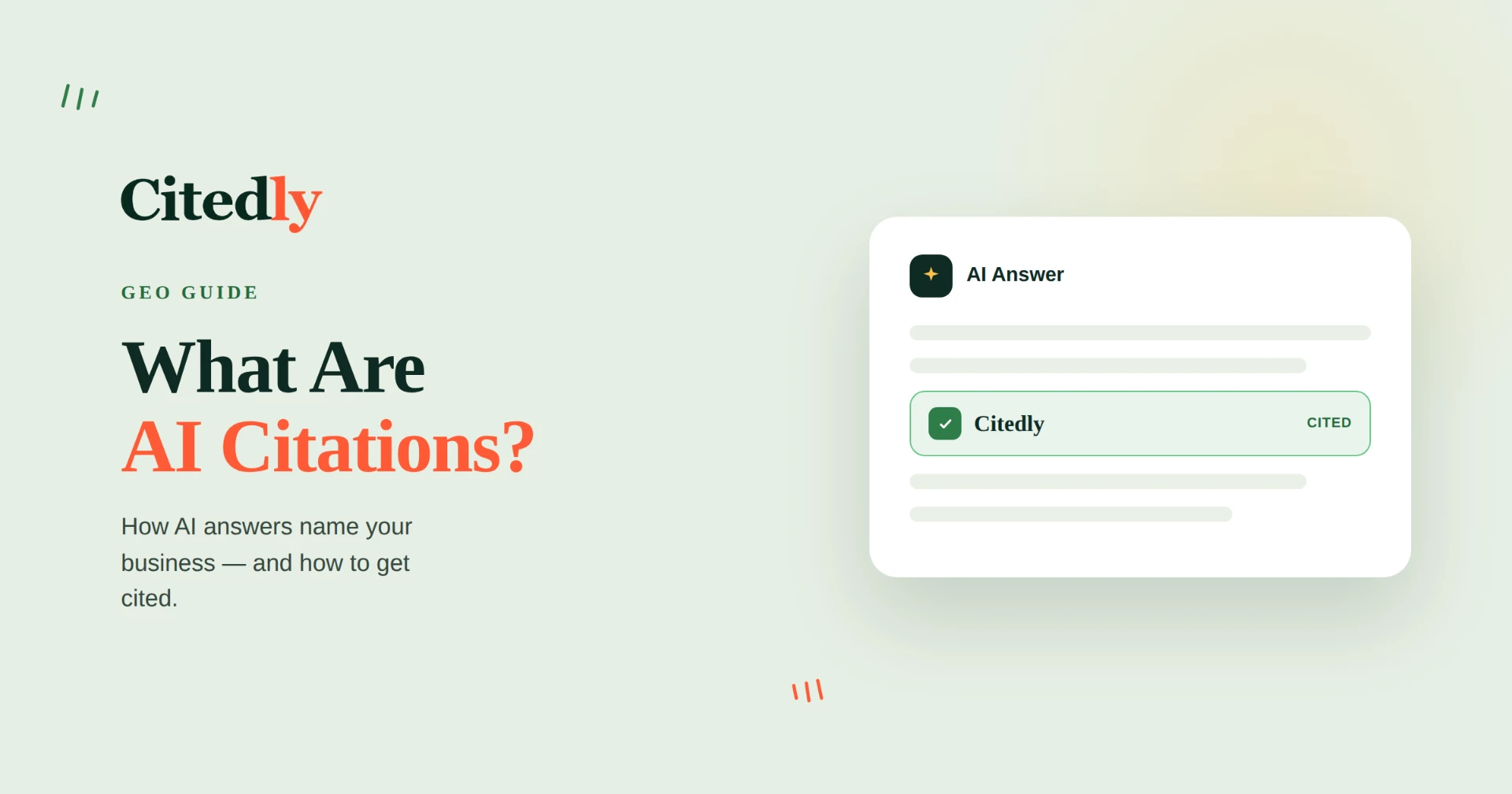
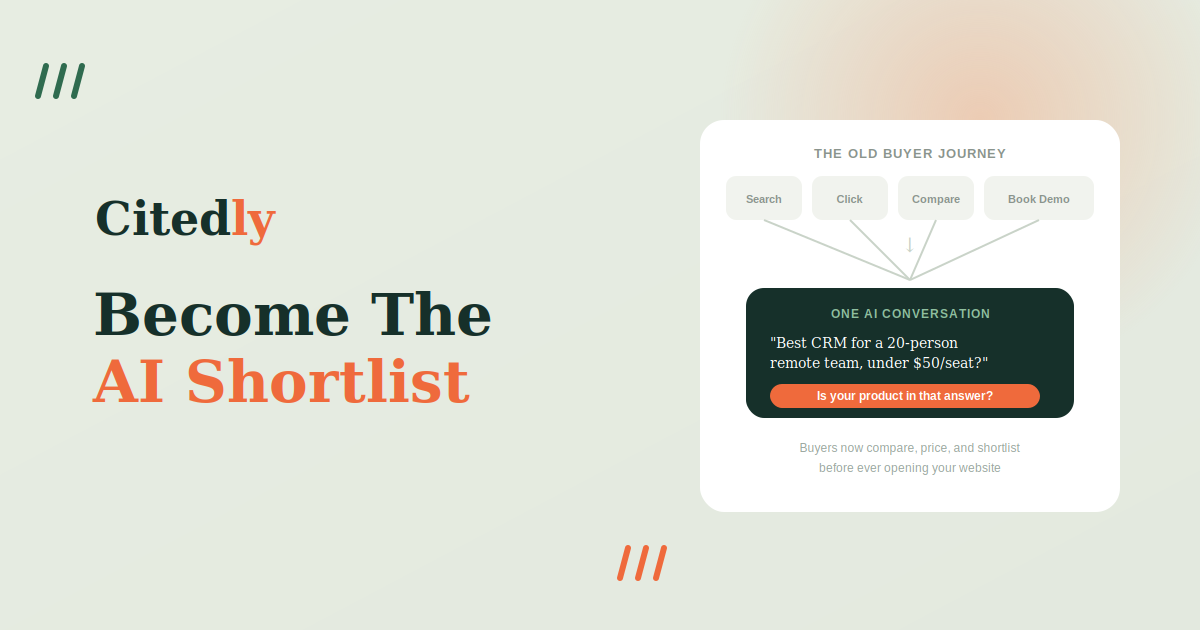
An AI citation is what you get when ChatGPT, Perplexity, Gemini, or Google's AI Overviews names your business, or links to your page, inside the answer it gives a user. Think of it as the replacement for a top-ten ranking. Instead of being one of ten blue links someone might click, you are the source the machine quotes when it tells them who to hire or what to buy.
That change is already here. When someone asks ChatGPT "who's the best plumber in Austin" or "which tool tracks brand mentions in AI," they usually act on the two or three names the answer gives them. They rarely open a search tab afterward. So the question every business owner should be asking has quietly moved from "where do I rank?" to "does AI mention me at all?" — and for most businesses right now, the honest answer is usually no. (Being named and being linked are two different wins — see citations vs mentions.)
This guide covers what AI citations are, why they now matter more than your Google position, how AI decides who to cite, and the exact steps to get cited by AI even if your website is new and small. Let's get into it.
What Are AI Citations?
An AI citation is any moment an AI answer credits your business as a source. That shows up in two forms, and the difference matters.
The first is a linked citation: the little source link or footnote an engine like Perplexity or Google's AI Overviews attaches to a claim, pointing back to your page. The second is a brand mention: your name appearing in the answer text itself, whether or not there's a link. If ChatGPT writes "for subscription video editing, options include ShortVids and a few others," that's a mention, and for a service business it's often worth more than a link, because the user reads your name as a recommendation.
Both are what people mean when they talk about AI visibility, or "share of model": how often, and how prominently, AI names you when someone asks about your category. The old game was ten blue links and a scroll. The new game is being one of the three names the answer actually says out loud. Making sure your business is one of those names is exactly what Citedly is built to do.
What Is the Difference Between an AI Citation and an AI Mention?
An AI citation is a source attribution that connects an AI-generated answer to a specific webpage, document, or publisher. It commonly appears as a clickable source link, footnote, citation card, or reference beside the claim.
An AI mention happens when an AI answer names your brand, product, service, or expert without necessarily linking to your website. For example, when ChatGPT includes your company in a list of recommended providers but does not attach a source link, that is an AI brand mention.
| Factor | AI Citation | AI Mention |
|---|---|---|
| What appears | A source link, footnote, or citation card | Your brand or business name in the answer |
| Link required | Usually yes | No |
| Primary value | Sends referral traffic and validates a claim | Builds brand visibility, recognition, and recommendation value |
| How to track it | Citation URLs, source cards, and AI referral traffic | Brand mentions across prompts and AI engines |
| Optimization focus | Clear, extractable, well-sourced content | Consistent entity signals and third-party brand mentions |
Both contribute to AI visibility and share of model. AI citation optimization helps your pages become usable sources, while earning brand mentions helps AI systems understand who you are and when to recommend you. A strong strategy should therefore focus on both: getting cited in AI search and learning how to get mentioned in AI answers.
For businesses researching how to improve brand visibility in AI search engines, the distinction is practical: citations strengthen source authority and referral traffic, while mentions strengthen entity recognition and recommendation frequency. The most effective strategies improve brand visibility in AI search engines by making the brand easy to identify, the content easy to extract, and the supporting claims easy to verify. And if this sounds like too much to run yourself, Citedly can take it off your plate — here's why businesses hand this to us.
Why AI Citations Matter More Than Rankings in 2026
Two things happened at once. AI answers exploded in reach, and they started eating the clicks that used to go to websites.
On Reach
ChatGPT crossed roughly 900 million weekly users, and by early 2026 Google was showing AI Overviews on about a quarter of all searches, according to tracking from Conductor. Your customers are seeing AI answers whether you're in them or not. For the full picture, we keep a running set of AI search statistics with sources and dates — and if you're budgeting for the work, see what GEO costs.
On Clicks
When an AI Overview appears, Seer Interactive measured organic click-through on that query falling by around 60%. The traffic doesn't vanish evenly, though. It concentrates on whoever gets named in the answer. So the businesses cited by AI are quietly absorbing the demand that used to be split across a whole page of results, and everyone below the fold is getting squeezed.
Here's the part that surprises people: the traffic you do get from AI is better. Seer Interactive and others have found AI-referred visitors convert at several times the rate of ordinary Google organic clicks. That makes sense when you think about it. Someone who arrives after AI specifically recommended you is much closer to buying than someone idly clicking a search result. Fewer visits, but the right ones.
How Does AI Cite Sources and Decide What to Cite?
If you are wondering how AI cites sources or how to be a source for AI, it helps to stop picturing a ranking algorithm and start picturing a researcher on a deadline. When you ask ChatGPT a question, it runs its own searches, grabs a handful of pages, skims them, and builds an answer from the passages it can actually use. Three gates decide whether your page makes it in.
Gate One: Can It Fetch You?
The engine has to be able to reach and read your page. If you're not indexed where it searches, or your content only loads through JavaScript that its crawler doesn't run, you're out before the race starts. This is a technical gate, and it's where most small businesses quietly fail without knowing it.
Gate Two: Does It Pick You?
Out of the pages it fetched, it chooses the ones that best match the question. This is less about domain authority than people assume. A focused page that answers the exact question often beats a famous site whose page rambles.
Gate Three: Can It Extract a Clean Answer?
The model pulls a specific passage to quote or paraphrase. A page that states its answer plainly in two sentences gets lifted. A page that makes the reader wait four paragraphs for the point gets skipped, even if the point is excellent.
The Princeton team that coined the term "generative engine optimization" (Aggarwal and colleagues, published at KDD 2024) tested nine content changes across roughly 10,000 queries to see which ones actually moved the needle on gate three.
The winners weren't keyword tricks. Adding relevant statistics, citing your sources, and including quotations boosted visibility in AI answers by up to 40%. Keyword stuffing, the old SEO reflex, did nothing. The model reads it as low quality. In other words, writing that a human editor would call "well-sourced and specific" is exactly what an AI finds easy to cite.
AI Citations vs. Backlinks: What Actually Changed
If you've done any SEO, your instinct is probably "so I need more backlinks." Not exactly. The currency has shifted, and it's worth being precise about how. Backlinks still help you rank in traditional Google, which still feeds a lot of AI. But for getting cited, the thing that correlates most strongly with visibility isn't links. It's mentions — we put the two side by side, with the numbers, in AI citations vs backlinks. Ahrefs studied around 75,000 brands and found branded web mentions, linked or not, were the strongest signal tied to AI visibility. A forum thread that names your company without linking to it still teaches the model that you exist and what you're known for. Under the old rules that mention was worthless. Under the new ones it's a vote.
| Factor | Backlinks (Old Game) | AI Citations (New Game) |
|---|---|---|
| What counts | A clickable link from another site | A mention of your brand, linked or not |
| Main benefit | Helps you rank in Google's blue links | Gets you named inside the AI answer |
| Who wins | Bigger domains with more links | Clear, well-structured, well-sourced pages |
| New site odds | Slow; trust takes months to build | Fast; a good answer can be cited in weeks |
| Best lever | Outreach and link building | Answer-first content + third-party mentions |
Keep any link building you're doing, but stop treating links as the whole job. For AI citations, a mention on Reddit or an industry list can do more than a mid-tier backlink.
How to Get Cited by AI: A 7-Step Framework
This is the part you came for. None of it is exotic. It's the same handful of moves in the right order, and the order matters because step one blocks everything after it.
1. Get Indexed Where AI Looks — Starting With Bing
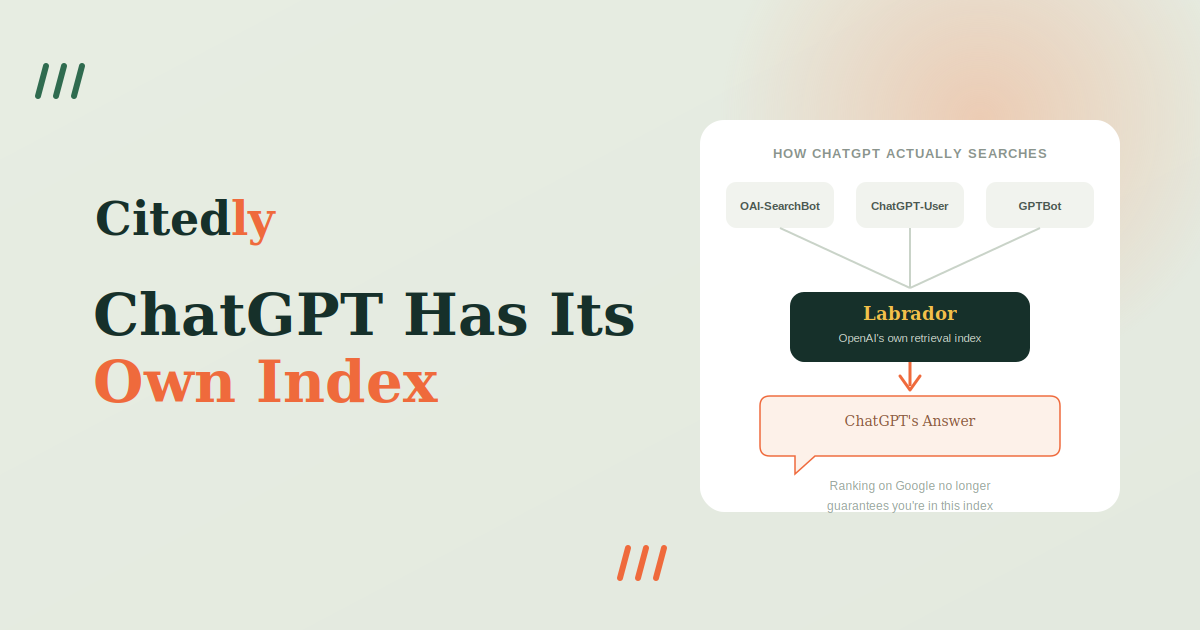
ChatGPT's live search runs on Bing's index, not Google's. Seer Interactive found that 87% of ChatGPT's citations matched Bing's top organic results for the same query. Yet most business owners have never opened Bing Webmaster Tools. Verify your site there, submit your sitemap, and turn on IndexNow so new pages get crawled in hours instead of weeks. Do Google Search Console too, but if you only have time for one this week, Bing is the higher-impact move for AI. The full Bing-first playbook lives in our guide on how to get cited by ChatGPT.
2. Open the Door for AI Crawlers
The engines send named bots to read you: OAI-SearchBot for ChatGPT's search, PerplexityBot, ClaudeBot, and others. Plenty of sites block these by accident in their robots.txt file, usually left over from a developer being cautious. Check that the crawlers you want citations from are allowed. Blocking OAI-SearchBot means ChatGPT can rank you in Bing and still never quote you.
3. Answer the Question in the First Two Sentences
Go back to gate three. AI lifts self-contained passages, so put the answer at the top of the page and each section, before any wind-up. If someone asks "how much does GEO cost," the first line under that heading should give a real range, not a paragraph about how it depends. You can add the nuance right after. Lead with the answer, then earn the reader's patience for the detail. There's a formatting recipe behind this — see how to structure content so AI will quote it.
4. Write Like a Well-Sourced Editor
This is the Princeton finding made practical. Replace vague claims with specific numbers. Attribute your facts to named sources. Add a relevant quote where it fits. A sentence with a statistic in it is structurally easier for a model to lift and credit than a sentence of opinion, because it's a clean, checkable unit of information. Notice how many numbers are in this article. That's not decoration, it's the mechanism.
5. Build Comparison and "Best Of" Pages
The queries where AI names a specific business are overwhelmingly comparison queries: "best X," "X vs Y," "top tools for Z." Most businesses have nothing on these pages, so the AI names whoever bothered to write one. An honest, useful "best options for [your category]" page (yes, including yourself, fairly ranked) is some of the most citable real estate on the web right now.
6. Add Structured Data
Schema markup (Organization, Service, FAQPage, Article) is how you tell an engine, in a language it can't misread, what your page is and who you are. It won't force a citation on its own, but it removes ambiguity at exactly the moment the model is deciding whether it understands you well enough to quote you.
7. Earn Mentions on Sources AI Trusts
This is the half most people skip, and it's the accelerator. Self-praise on your own site is the weakest signal there is. What moves the needle is other places vouching for you: a genuine answer on Reddit, a review on G2 or Trustpilot, an inclusion in someone else's industry roundup, a founder posting real expertise on LinkedIn. Perplexity in particular leans heavily on community platforms; one analysis found nearly half of its most-cited sources came from Reddit, Quora, and similar forums. Your website makes you eligible to be cited. These mentions are what make the AI actually pick you.
Where AI Pulls Its Citations From
One reason "just do SEO" is bad advice for AI is that the engines don't share a source list. A page that gets cited constantly by ChatGPT might never show up in Perplexity, because they're reading different parts of the web. Only about 11% of domains get cited by both ChatGPT and Perplexity, according to analysis from Radyant. So it helps to know who reads what before you decide where to put your effort.
| Engine | Mainly Pulls From | How You Win It |
|---|---|---|
| ChatGPT (Search) | Bing's index | Verify in Bing, allow OAI-SearchBot, and publish answer-first pages |
| Perplexity | Community sites — Reddit, Quora, and forums | Build a genuine forum presence plus strong owned content |
| Google AI Overviews | Google's own index | Rank in the organic top 10–20, then structure content for extraction |
| Google AI Mode / Gemini | Google index + YouTube, LinkedIn, and Maps | Maintain entity consistency, publish video, and build a strong Google presence |
You don't have to win all four at once. For most small businesses, ChatGPT-via-Bing plus a real Reddit and review presence is the fastest, cheapest place to start.
How Small Businesses Get Cited by AI Without a Big Budget
There's a myth that AI only quotes household names. The data says otherwise. seoClarity found that about 25% of the URLs most frequently cited by AI have no Google organic visibility at all.
AI engines are not always looking for the most famous website. They are looking for the clearest, most relevant, and most extractable answer to a specific question.
What Small Businesses Should Focus On
Small businesses do not need to outspend larger competitors. They need to:
- Identify the specific questions their buyers ask.
- Answer those questions more clearly than broad, generic competitors.
- Make sure Bing and AI crawlers can access and index their pages.
- Use answer-first content that gives the main response immediately.
- Build consistent third-party mentions across reviews, directories, forums, and industry websites.
- Keep the business name, services, and brand information consistent across every platform.
A focused website can earn AI citations within a specific niche while a larger competitor gets skipped because its content is vague, buried, or difficult to extract.
Where the Process Commonly Breaks
The strategy itself is straightforward, but execution can become difficult. Common problems include:
- AI crawlers being blocked in the robots.txt file.
- Important answers being buried under long introductions.
- Pages not being indexed by Bing.
- Inconsistent business names across profiles.
- Missing schema markup.
- Weak comparison or category pages.
- Too few trusted third-party brand mentions.
- No system for tracking AI citations over time, or a plan for earning AI mentions.
- Presence on only one engine's sources, which is why AI cites you unevenly.
If several of those sound familiar, our breakdown of why AI isn't citing your website walks through the fix for each one.
Doing this internally is possible. The difficulty is managing every technical, content, authority, and tracking requirement while also running the business.
How Citedly Helps
Citedly manages the full AI citation optimization process as a done-for-you service, including:
- Bing indexing
- AI crawler access
- Answer-first content
- Schema implementation
- Comparison content
- Third-party brand mentions
- Monthly AI citation tracking
The service follows the same framework outlined above, starting at $299 per month with no contract. It is built specifically for local and small businesses that want to improve their visibility in ChatGPT, Perplexity, Gemini, Google AI Overviews, and other AI search engines without paying traditional agency retainers.
How to Track Your AI Citations
You can't improve what you can't see, and AI visibility doesn't show up in your normal analytics. A few ways to keep score:
Test by Hand
Write down 15–20 prompts a real buyer would ask, then run them across ChatGPT, Perplexity, Gemini, and Google AI Mode every week. Note when you're named, when a competitor is, and where you're missing. It's tedious but free, and it's the ground truth.
Watch Your Referrals
In GA4, you can filter for AI referrers (ChatGPT passes a chatgpt.com source) to see the traffic AI actually sends you.
Use Bing's New Metrics
In June 2026 Microsoft added AI-visibility data to Bing Webmaster Tools, free, which is a useful signal given Bing's role in ChatGPT.
Track Share of Model Over Time
The number that matters isn't a single citation, it's whether your share of the answers in your category is climbing month over month.
If logging prompts in a spreadsheet every week sounds like something you'll do twice and abandon, that monthly tracking is part of what Citedly does for you, so the measurement doesn't depend on your discipline.
How Much Does Getting Mentioned By AI Cost?
Getting mentioned by AI costs anywhere from nothing to several thousand dollars a month, depending on whether you do it yourself, buy tools, or hire it out. The work itself is the same handful of moves from this guide; what you're really paying for is who does them and how much of it is handled for you.
Here's the honest range in 2026:
| Option | Typical Cost | What You Get | The Catch |
|---|---|---|---|
| Do it yourself | Free (your time) | Full control, no spend | Hours every week, and it's easy to get the technical steps wrong |
| Monitoring tools | ~$29–$120/mo | Alerts on where AI does and doesn't mention you | They tell you you're invisible; they don't fix it |
| Enterprise AI platforms | $1,000s/mo (often custom) | Deep tracking and competitor data | Built for big brands; overkill and overpriced for a small business |
| Traditional GEO / AI SEO agencies | $1,500–$2,500+/mo | Done-for-you work | Priced for larger companies, usually on contracts |
| Citedly | From $299/mo, no contract | The full done-for-you system, built for small businesses | — |
The gap most business owners fall into is the middle: a monitoring tool shows them they're being skipped, but fixing it still lands back on their plate. And the agencies that would fix it start at $1,500 a month and up, which prices out exactly the local and small businesses that need this most.
That's the gap Citedly was built to close. You get the same work an agency does — the Bing indexing, the answer-first content, the schema, the comparison pages, the third-party mentions, and the monthly tracking — as one done-for-you service starting at $299 a month with no contract. See the plans and what's included.
Frequently asked questions
How Do I Get Cited by AI?
Get indexed where AI looks (especially Bing, which powers ChatGPT's search), answer questions directly in the first two sentences of your pages, add statistics and named sources, and earn mentions on trusted third-party sites like Reddit and review platforms. Those four moves cover the technical, content, and authority sides of getting cited.
Do I Need to Rank #1 on Google to Get Cited by AI?
No. AI citations and Google rankings are separate. seoClarity found roughly a quarter of the most-cited AI URLs have no Google organic visibility at all. A clear, well-structured answer can be cited even from a small or newer site.
How Long Does It Take to Get Cited by AI?
Once your pages are indexed and readable, citations for specific, lower-competition questions can appear within a few weeks. Recency helps, because AI tends to favor fresh, up-to-date pages, so new answer-first content can move faster than you'd expect from traditional SEO.
Can a Brand-New Website Get Cited by AI?
Yes. Because AI rewards structure and usefulness over domain age, a new site that answers a question cleanly and earns a few third-party mentions can get cited while older, less focused competitors are ignored.
Are AI Citations the Same as Backlinks?
No. A backlink is a clickable link; an AI citation is your brand being named or sourced inside an answer, and it counts even without a link. Ahrefs found branded mentions, linked or not, are the strongest correlate of AI visibility.
See Where AI Puts Your Business Today
Run your real buyer prompts across five AI engines and find out whether you get named, free, in about 60 seconds. Or book a call and we'll walk you through it.
Keep exploring
Read More from Citedly