AI Mentions
How to Get Your Business Mentioned in AI (and Why It Matters More Than Rankings)
What "Getting Mentioned in AI" Actually Means
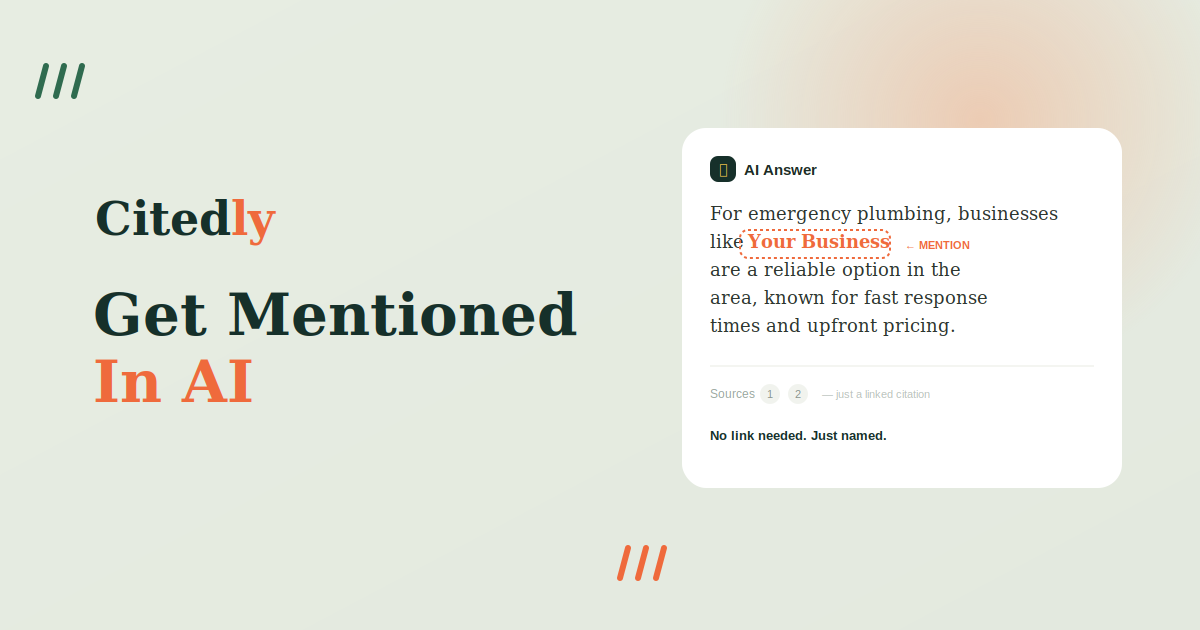
Getting mentioned in AI means your business name appears inside an AI-generated answer — the moment ChatGPT says "for that, businesses like yours often use [Your Company]," or Google's AI summary box lists you among the options. It's the AI-era version of a word-of-mouth referral, except it happens at the scale of every question your category gets asked.
It's worth separating two things people blur together:
- A citation is a linked source the AI attaches to a claim, pointing back to your page.
- A mention is your name written into the answer text, with or without a link.
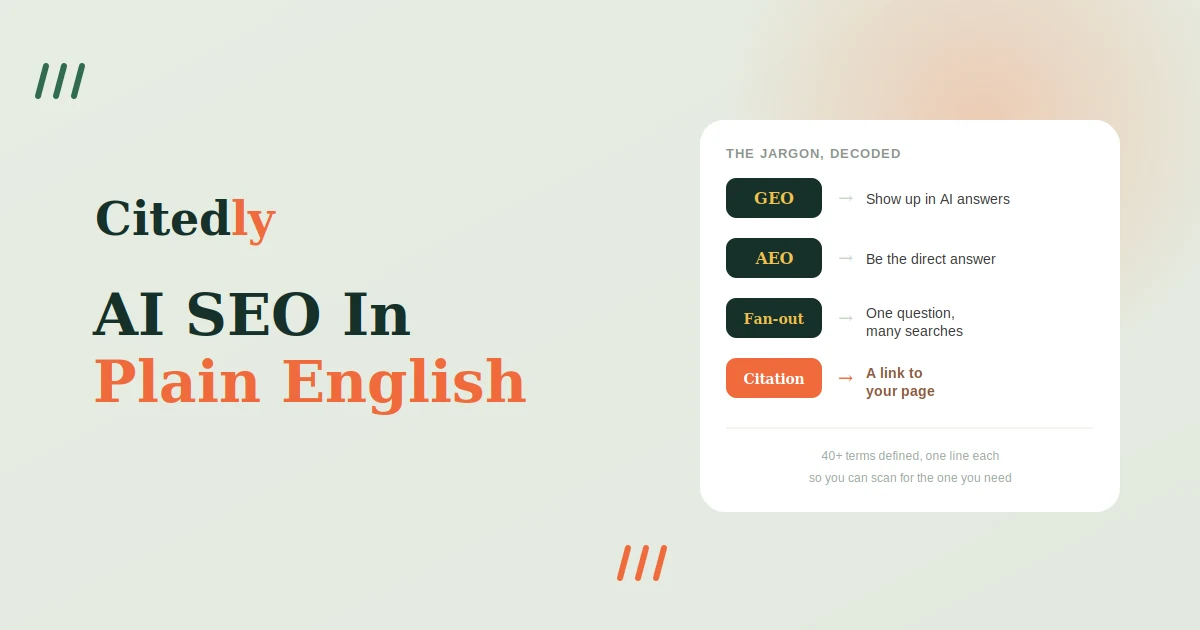
Both matter, but for a business the mention is often the prize — because when AI names you as an option, the reader hears a recommendation. We covered the fundamentals in what AI citations are and the full side-by-side in citations vs mentions; this post is about why the mention specifically matters, and how to earn it.
Why Getting Mentioned in AI Matters for Your Business
This is the part that should move you to act. Being mentioned in AI isn't a vanity metric — it's increasingly where customers decide who to call.
It's Where Buying Decisions Now Start
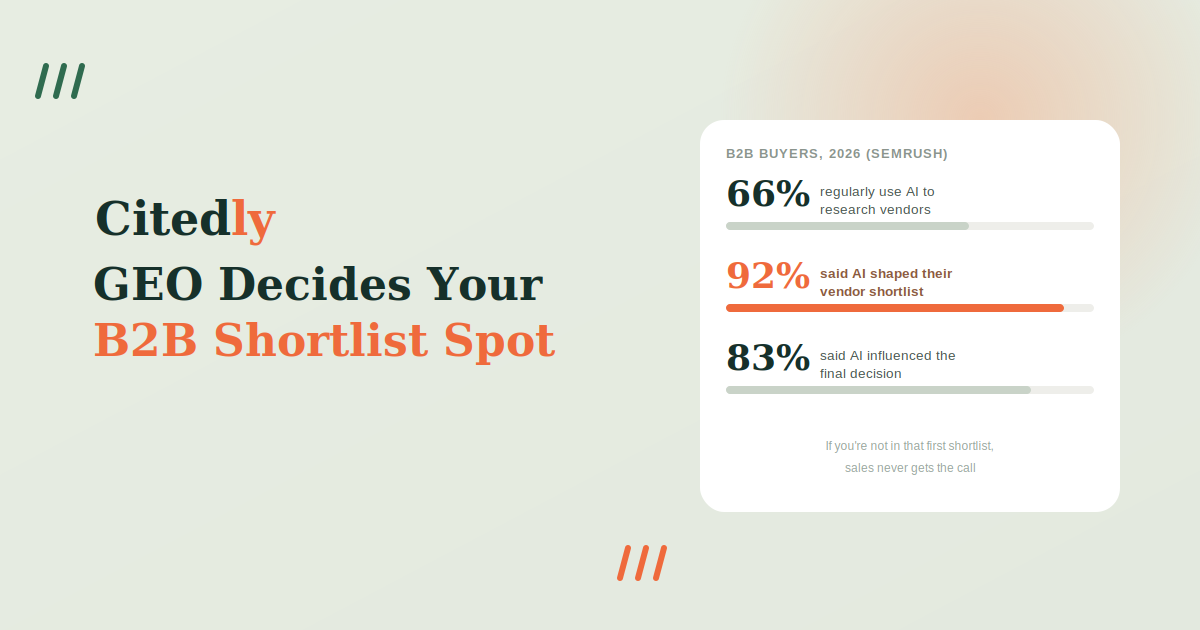
Hundreds of millions of people now ask AI for recommendations before they ever open a search results page. ChatGPT alone crossed 900 million weekly users in 2026 (OpenAI), and for local services, use of AI tools to find a business jumped from 6% to 45% of consumers in a single year (BrightLocal). When someone asks "who's the best [your service] near me," the two or three names the AI gives are the shortlist. If you're not one of them, you're not in the running. Local businesses have a dedicated playbook here — see local AI recommendations.
Being Mentioned Is the Visibility Now
The click is disappearing. Around 93% of AI search sessions end without anyone visiting a website (Superlines), and when Google shows an AI summary, click-through to the top result drops by roughly half. You can't count on people scrolling to find you anymore. The exposure happens inside the answer, so being named there is the visibility, not a step toward it.
AI Mentions Come From Trust, and Trust Transfers
When AI names your business, it's synthesizing what the web says about you — reviews, roundups, community threads. So a mention carries borrowed credibility: the customer isn't reading your ad, they're hearing a recommendation from a tool they trust. That's why the traffic converts. AI-referred visitors convert several times better than ordinary organic clicks and spend about 68% more time on-site (Similarweb, SE Ranking).
Mentions, Not Links, Are What Earn It
Here's the shift most businesses haven't caught: the thing that gets you mentioned isn't backlinks. Ahrefs' study of 75,000 brands found unlinked brand mentions correlate with AI visibility about three times more strongly than backlinks, and 84% of AI citations trace back to earned media rather than a brand's own pages (Muck Rack). Being talked about beats being linked to — the full breakdown is in AI citations vs backlinks.
The one-sentence case: AI has turned "what do people say about this business" into an instant, spoken answer, so getting mentioned is the closest thing there is to scaling word of mouth.
Where Your Business Can Get Mentioned
"AI" isn't one place. Each engine builds answers from different sources, so getting mentioned means showing up across several surfaces, not optimizing for one.
| Where | What it's called | What it reads most |
|---|---|---|
| ChatGPT | AI answers / recommendations | Bing's index, Wikipedia, Reddit, reviews |
| AI Overviews / the "AI summary box" | Google's own index, ranking pages, roundups | |
| Perplexity | Cited AI answers | Reddit, forums, community platforms |
| Gemini | AI answers / AI Mode | Google index, YouTube, LinkedIn |
The Google AI summary box is the one most business owners ask about — how to get your company mentioned there, how to appear in the summary box, how to get featured. Because it's a topic in its own right, we cover the full method in Google AI Overviews. For the ChatGPT side, see getting cited by ChatGPT.
The point for now: presence has to be broad, because only about 11% of domains get mentioned by both ChatGPT and Perplexity — winning one doesn't win the others.
How to Get Your Business Mentioned in AI
Getting mentioned comes down to giving AI engines consistent, trustworthy evidence that your business exists, does what it claims, and is well regarded. Five moves do most of the work:
- Get talked about off your own site: genuine reviews (Google, G2, Trustpilot), inclusion in "best of" roundups, and helpful answers on Reddit are the strongest mention signals there are. This is the highest-leverage thing you can do.
- Lock your entity: use one exact business name, one description, and consistent details everywhere, add Organization schema, and create a Wikidata entry — so AI reads you as one confident, nameable business.
- Structure your pages so AI can lift them: answer-first content with schema makes you quotable; the full method is in structuring content for AI.
- Make sure AI can actually read you: if crawlers are blocked or you're not indexed where the engine searches, none of the above lands — the common blockers are in why AI isn't citing you.
- Measure it: you can't grow what you don't watch; track where you're mentioned versus competitors using AI citation tracking.
Common Mistakes That Keep Your Business Out of AI Answers
Most businesses that stay invisible in AI aren't doing anything obviously wrong — they're making quiet, fixable mistakes that stop the engines from trusting or understanding them.
| Mistake | What it causes | Fix |
|---|---|---|
| Only relying on your own website | AI sees no independent proof | Build reviews, roundups, and external mentions |
| Ignoring review quality | Weakens trust and brand perception | Respond to reviews and improve sentiment |
| Inconsistent brand information | AI struggles to identify one clear entity | Standardize business details everywhere |
| Writing promotional copy instead of answers | Content is harder for AI to quote | Use direct, answer-first content |
| Publishing unrelated content | Weakens topical relevance | Build focused topic clusters |
| Blocking AI access | Crawlers cannot properly read the site | Allow crawlers and expose content in HTML |
| Optimizing once and forgetting it | Visibility drops as answers and sources change | Track performance on a recurring basis |
| Treating Google rankings as AI rankings | Creates false confidence in visibility | Optimize specifically for AI mentions |
Mistake 1: Only Talking About Yourself on Your Own Site
The single most common one. AI doesn't care what your homepage claims — it cares what the rest of the web says about you. If your business only exists on your own domain, with no reviews, roundups, or third-party mentions, the AI has nothing independent to trust, so it stays quiet and names a competitor the internet actually talks about.
The fix: build presence off your site first — reviews, roundups, community mentions. It's the foundation everything else sits on.
Mistake 2: Ignoring Your Review Sentiment (Not Just Your Rating)
Having reviews isn't enough. AI reads the tone of what people say, and how you respond. A page full of unanswered 2-star reviews actively disqualifies you, while a business that replies to criticism and resolves it reads as trustworthy and active. A handled 1-star review can help you more than an ignored 5-star one.
The fix: respond to every review, especially the negative ones. AI notices businesses that engage.
Mistake 3: Inconsistent Business Details Across the Web
If your name, address, phone, or description differ between your site, Google, LinkedIn, and directories, AI can't confidently merge them into one entity. An unsure engine either skips you or repeats whatever it's most confident about — sometimes wrong information.
The fix: standardize your name, details, and one-line description everywhere, and add Organization schema so AI reads you as one business.
Mistake 4: Writing Sales Copy Instead of Answers
Promotional pages that talk up your services rarely get pulled into AI answers, because they don't answer anything. AI is looking for content that solves the exact question a buyer asked, in plain terms.
The fix: write pages that answer real buyer questions directly, answer-first — the approach in answer-first content structure.
Mistake 5: Scattering Content Instead of Building Topical Authority
Publishing random blog posts on unrelated topics teaches AI nothing about what you specialize in. Engines favor businesses that demonstrate deep expertise in one area, not thin coverage of ten.
The fix: cluster your content around your core service so AI clearly associates your brand with that expertise.
Mistake 6: Blocking the Crawlers or Hiding Behind JavaScript
You can do everything else right and still be invisible if AI literally can't read your site — because a crawler is blocked, or your content only loads via JavaScript. This is the silent killer most owners never check.
The fix: make sure AI crawlers are allowed and your content is in the page's HTML; the full list of blockers is in common AI visibility blockers.
Mistake 7: Treating It as a One-Time Project
AI answers change constantly — the sources shift, competitors gain ground, and your facts go stale. Businesses that "optimize once" quietly fall out of the answers over the following months without ever knowing.
The fix: track where you're mentioned on a regular cadence, so you catch a slip before it costs you customers — see tracking AI citations.
Mistake 8: Assuming Google Rankings Carry Over
Ranking #1 on Google doesn't mean AI will mention you — they run on different signals. Businesses that assume their SEO "covers" AI are often shocked to find AI naming competitors who rank below them.
The fix: treat AI visibility as its own discipline, driven by mentions and structure rather than rankings alone; the difference is broken down in mentions vs backlinks.
How to Know If AI Already Mentions Your Business
Before you fix anything, find out where you actually stand — because this won't show up in your normal analytics, and most owners have never checked. It takes about ten minutes.
Ask the engines directly
Open ChatGPT, Gemini, Perplexity, and Google, and type the questions a real customer would ask: "best [your service] in [your city]," "who should I hire for [your service]," "[your service] near me." Note whether your business gets named, and which competitors do.
Read the sources
On Perplexity and Google's AI, look at the cited sources under the answer. Those are the pages the AI trusts for your category, and they're your outreach target list. If you can get mentioned on the sites AI is already reading, you're feeding it directly.
Check your facts
When AI does name you, is the information right? Wrong hours, an old phone number, or a service you don't offer are all signals to fix — and they're more common than you'd think.
Do it across engines, not just one
Being named by ChatGPT doesn't mean Perplexity or Google's AI knows you; they read different sources, so check each.
Here's why this baseline matters: with roughly 93% of AI search sessions ending without a click, being named in the answer is the visibility — so if you're not in it, you're absent from the decision entirely. More on the numbers behind this shift in our AI search statistics.
If checking this by hand every week sounds like something you'll do once and forget, that's exactly what automated tracking is for.
The Cost of Not Being Mentioned
Flip all of that around and the risk is clear. If AI doesn't mention your business:
- A competitor gets named as the recommendation, and takes the customer before you're even considered.
- You have no way to know it's happening — it's invisible in your normal analytics.
- The gap compounds, because AI leans on the brands already being talked about, so early absence becomes lasting absence.
And the window is open right now: with only about 23% of businesses actively working on AI visibility, being mentioned today is far cheaper than it will be once your competitors catch on.
How Citedly Gets Your Business Mentioned
Everything above is doable yourself — it's just a lot of unfamiliar work to run and maintain while you're busy running the business. That's what Citedly handles, and it's built around exactly the signals that earn mentions:
- We build your third-party presence — reviews, roundups, and community mentions, the strongest mention signal there is.
- We lock your entity so AI reads you as one confident, nameable business.
- We structure your pages so AI can quote them, and make sure the crawlers can read you.
- We track your mentions across ChatGPT, Gemini, Perplexity, and Google every month, so you can see it working.
It's made for small and local businesses, done for you, from $299/month, no contract. You don't have to become an AI-search expert. You just have to be the name AI says.
Once the web is talking about you, that consensus is what turns mentions into ChatGPT recommendations.
Frequently asked questions
How do I get my company mentioned in Google AI Overviews?
Get your business into the sources Google's AI pulls from: rank for the query, earn mentions on trusted third-party roundups and review sites, and structure your page answer-first with schema. The full step-by-step is in our guide to Google AI Overviews.
How do I get my business in the Google AI summary box?
The "AI summary box" is Google's AI Overview. Because it's built from Google's ranking results, you first need to rank for the query, then make your answer easy to extract and earn off-site mentions so Google's AI is confident naming you. See the AI Overviews guide for details.
How do I get featured in AI Overviews?
Focus on three things: rank in Google's organic results for the question, answer it clearly in the first 40–60 words of your page, and build the third-party presence that makes your brand a trusted, nameable entity. Full method here.
What's the difference between being cited and being mentioned by AI?
A citation is a linked source AI attaches to a claim; a mention is your brand name appearing in the answer text, link or not. For most businesses the mention matters more, because being named reads as a recommendation — see citations vs backlinks.
How do I know if AI mentions my business?
It won't show in normal analytics. Run your real buyer questions through ChatGPT, Gemini, Perplexity, and Google's AI and note when you're named versus a competitor, or track it automatically — see AI citation tracking.
See Where AI Puts Your Business Today
Run your real buyer prompts across five AI engines and find out whether you get named, free, in about 60 seconds. Or book a call and we'll walk you through it.
Keep exploring
Read More from Citedly