ChatGPT Recommendations
How to Get ChatGPT to Recommend Your Business (2026)
Why ChatGPT Recommends Some Businesses and Ignores Others
ChatGPT recommends a business when it's confident that business is a real, well-regarded option for what the user asked. That confidence doesn't come from your website. It comes from everything else the web says about you.
Think about how it answers "who's the best [your service] in [your city]." It doesn't read your homepage and take your word for it. It pulls together what it already knows, checks a handful of trusted sources, and names the two or three businesses that show up consistently as credible. If your business isn't part of that consensus, you're not in the answer, no matter how good your site is. This is the same reason AI skips some websites entirely, applied to recommendations specifically.
So getting recommended is less about polishing your own pages and more about being present and consistent everywhere ChatGPT looks. The rest of this guide is how to build that.
"Recommended" vs "Cited": Two Different Wins
These get used interchangeably, but for a business they're different outcomes, earned slightly differently:
- Cited means ChatGPT used your page as a source and linked to it. This is more technical, about being crawlable, indexed, and quotable, and we cover it fully in how to get cited by ChatGPT.
- Recommended means ChatGPT named your business as an option to the user. This is more about reputation and consensus, being known as a good choice.
For most local and service businesses, the recommendation is the one that wins customers, because the user hears your name as a suggestion. That's what this post focuses on.
How ChatGPT Chooses Businesses to Recommend
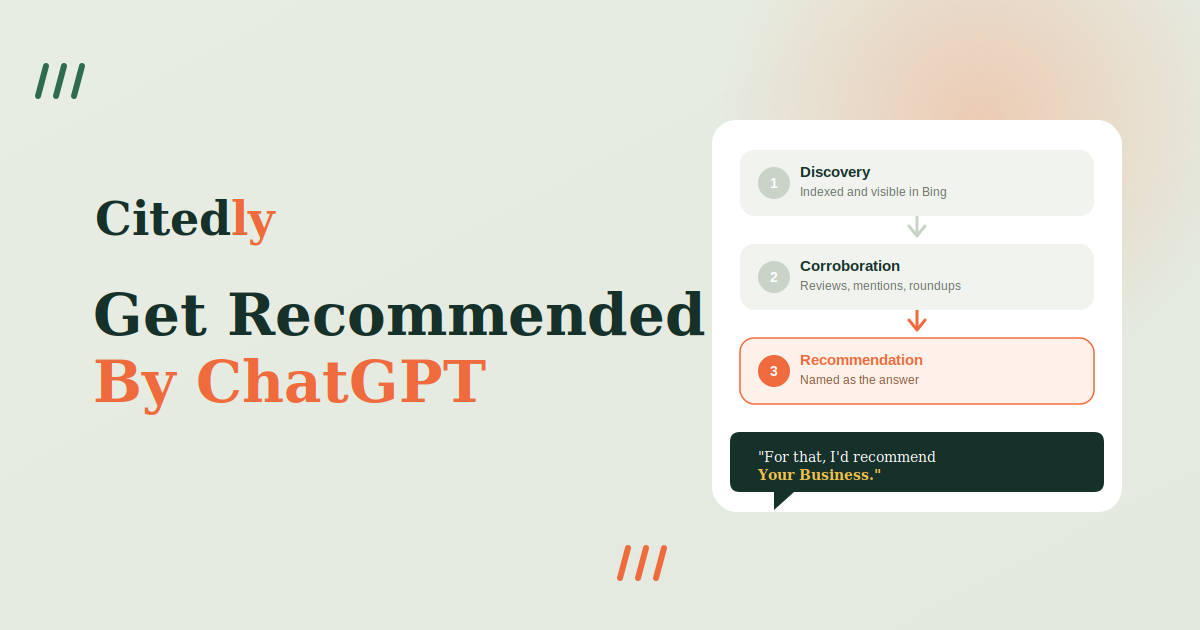
A useful way to think about ChatGPT recommendations is as a three-stage filter. Your business has to be discoverable, independently corroborated, and easy for the model to understand before it has a reason to include you in a shortlist.
| Stage | What ChatGPT Needs to See | What It Means for Your Business |
|---|---|---|
| 1. Discovery | Your business is visible in the sources ChatGPT can retrieve. | Be indexed in Bing and present on relevant third-party platforms. |
| 2. Corroboration | Independent sources repeatedly confirm what you do and that people trust you. | Build reviews, mentions, roundups, and consistent profiles. |
| 3. Recommendation | Your business clearly matches the user's category, location, need, or comparison. | Use precise positioning and answer-first pages that remove ambiguity. |
You do not need to be the biggest company in your category. You need enough consistent evidence for ChatGPT to be confident that you belong in the answer.
How to Get ChatGPT to Recommend Your Business
Getting recommended comes down to giving ChatGPT consistent, trustworthy evidence that your business exists, does what it claims, and is well regarded. Five moves build that, roughly in order of leverage.
1. Be Visible Where ChatGPT Looks
ChatGPT's live search runs largely on Bing's index, so if Bing can't find you, ChatGPT usually can't recommend you. Verify your site in Bing Webmaster Tools, submit your sitemap, and make sure your key pages are indexed there. This is the unglamorous first step most business owners skip, and it's the entry ticket to everything else.
2. Get Onto the "Best Of" Lists It Reads
When someone asks for the best option, ChatGPT leans on third-party roundups and comparison articles, not company websites. So your business needs to appear on the "best [your category]" and "top [your service] in [your city]" lists that already exist. Getting included in even a few of these does more for your recommendation odds than anything on your own site.
3. Build Reviews on the Sources It Trusts
Reviews are one of the strongest recommendation signals, because they're independent proof you're any good. Genuine reviews on Google, Trustpilot, G2, or Yelp (whichever fits your business) feed directly into whether ChatGPT names you. And it reads the tone, not just the star count, so responding to reviews matters as much as collecting them.
4. Make Your Brand Easy to Recognize
ChatGPT can only recommend a business it can clearly identify. If your name, category, and details vary across your site, LinkedIn, and directories, it gets unsure who you are and leaves you out. Lock one consistent name, one-line description, and set of details everywhere, add Organization schema, and consider a Wikidata entry. This is why mentions beat backlinks for AI, and it's the same reason your brand may show up on some engines but not others.
5. Give It a Clear Answer on Your Site
Once ChatGPT is considering you, it looks for a clean confirmation of what you do and who you serve. Pages that state that plainly, answer-first, are easy for it to use, so keep your key pages structured for AI to quote. Name your service, your specialties, and your city in plain language, so there's nothing left to guess.
A Simple Local Business Example
Imagine two HVAC companies serving the same city. Company A has a polished website but very few reviews, inconsistent directory information, and almost no third-party mentions. Company B has a simpler site, but its name, services, and location are consistent across Google, Yelp, local directories, review sites, and several "best HVAC companies in [city]" articles.
When a customer asks ChatGPT for the best HVAC company in that city, Company B gives the model far more independent evidence to work with. The difference is not necessarily website quality. It is corroboration. The full local playbook is in local business AI recommendations.
What Makes ChatGPT Recommend You vs. Skip You
A quick gut-check. If your business sits in the right column, that's your to-do list.
| ChatGPT Recommends You When... | ChatGPT Skips You When... |
|---|---|
| You're indexed and visible in Bing | You're absent from Bing's index |
| You appear on third-party "best of" lists | You only exist on your own website |
| You have genuine, recent reviews | You have few, old, or unanswered reviews |
| Your business details are consistent everywhere | Your name and details vary across the web |
| Your pages state clearly what you do and where | Your value is vague or buried in marketing copy |
| Competitors mention or compare you | The web is silent about you |
The pattern: recommendations are earned off your site, through consensus and reputation, then confirmed on it.
What Can Hurt Your Recommendation Odds
The same signals that build confidence can also weaken it. A few quiet problems can make ChatGPT less willing to include your business even when your website itself looks strong.
- Conflicting business information. Different names, categories, addresses, or service descriptions make the entity harder to trust.
- Weak or negative review sentiment. A strong star rating does not fully offset repeated complaints or unanswered negative reviews.
- Stale pricing or service information. Old pages and outdated third-party listings can cause ChatGPT to repeat incorrect facts or avoid recommending you.
- Spammy or low-quality mentions. Volume is not the same as authority. Mentions on weak, irrelevant, or obviously manipulated sites do little to build real consensus.
- No category fit. If the web never clearly connects your brand with the service or location the buyer asks about, ChatGPT has no reason to shortlist you.
What to Fix First
| Problem | Priority | First Action |
|---|---|---|
| Not visible in Bing | Highest | Verify indexing, sitemap, and crawlability. |
| Few independent mentions | High | Target relevant reviews, roundups, and comparison pages. |
| Inconsistent brand details | High | Standardize name, category, location, and description. |
| Poor review sentiment | High | Respond to reviews and resolve recurring customer issues. |
| Vague website positioning | Medium | State exactly what you do, who you serve, and where. |
| No tracking process | Medium | Create a fixed prompt set and test it regularly. |
Can You Pay ChatGPT to Recommend Your Business?
No. You cannot pay ChatGPT to recommend your business, and any service claiming to buy you a spot in its recommendations is misleading you. OpenAI has introduced ads in some parts of ChatGPT, but it has stated that its answers and the businesses it recommends aren't influenced by payment. There's no recommendation ad slot.
What you can do is influence the signals ChatGPT reads — reviews, mentions, consistency, visibility — so it naturally arrives at your business as a strong option. That's not paying for placement; it's earning the reputation the model reflects. It's slower than buying an ad, but it's also far more durable, because it's built on real credibility rather than a budget that runs out.
ChatGPT doesn't recommend whoever pays the most. It recommends whoever the web agrees is good. Your job isn't to buy a spot, it's to become the consensus answer.
How to Check Whether ChatGPT Recommends You
Before you change anything, find out where you actually stand. It takes five minutes:
- Ask it directly. In a fresh ChatGPT session, ask the questions your customers would: "best [your service] in [your city]," "who should I hire for [your service]," "[your service] near me." See whether you're named, and who is.
- Check the framing. If you're mentioned, is it as a top option or an afterthought? Are your details right?
- Note the competitors. The businesses ChatGPT names instead of you are your real benchmark — look at what the web says about them that it doesn't yet say about you.
- Test more than once. Phrasing changes the answer, so try a few variations before drawing conclusions.
This check is also the fastest way to see the gap between being invisible and being recommended, and to prioritize which of the five moves above matters most for you. For a repeatable version across every engine, see how to track your AI visibility.
Why This Is Worth Doing Now
Getting recommended by ChatGPT isn't a nice-to-have anymore, it's where a fast-growing share of customers start. Use of AI tools to find and choose local businesses jumped from 6% of consumers to 45% in a single year, according to BrightLocal's research. When nearly half your potential customers are asking AI who to hire, being the business it names is the difference between a steady flow of leads and quietly losing them to whoever ChatGPT recommends instead.
And because most of your competitors haven't done this work yet, the businesses that become the recommended answer now will be hard to displace later — the web's consensus compounds in their favor. For the full picture of how fast this is moving, see our AI search statistics.
Frequently asked questions
How do I get ChatGPT to recommend my business?
Make your business a trusted, consistent presence where ChatGPT looks: get indexed in Bing, appear on third-party "best of" lists, build genuine reviews, and keep your business details identical everywhere. ChatGPT recommends businesses the web agrees are credible, so the work happens mostly off your own site.
Can you pay ChatGPT to recommend your business?
No. There's no paid placement in ChatGPT's business recommendations, and OpenAI has said payment doesn't influence its answers. You earn recommendations by building the reputation signals — reviews, mentions, and consistency — that the model reflects.
How do I get ChatGPT to promote or suggest my business?
The same way you get it to recommend you — there's no separate "promote" lever. Build third-party proof (reviews and roundups), stay visible in Bing, and make your brand easy to recognize, and ChatGPT will surface you as a suggestion when it's confident you're a good fit.
Why does ChatGPT recommend my competitor and not me?
Because the web says more, and more consistently, about them. They likely appear on more lists, have stronger reviews, or a clearer brand identity. Look at the sources ChatGPT cites for them and work on matching that presence.
How do I add my business to ChatGPT?
There's no directory to submit to. ChatGPT learns about your business from the open web, so you "add" yourself by building a consistent, well-reviewed presence across the sources it reads — especially Bing, review sites, and third-party mentions.
Is getting recommended the same as getting cited?
No. Being recommended means ChatGPT names your business as an option; being cited means it uses your page as a source and links to it. They overlap but are earned a little differently — recommendations lean on reputation, citations lean on crawlability and structure.
See Where AI Puts Your Business Today
Run your real buyer prompts across five AI engines and find out whether you get named, free, in about 60 seconds. Or book a call and we'll walk you through it.
Keep exploring
Read More from Citedly