AI Visibility Guide
How to Track Your AI Citations (Share of Model): Free Methods, Tools, and the Metrics That Matter
What "Tracking Your AI Citations" Actually Means
Tracking your AI citations means measuring how often, and how prominently, AI engines name or link to your business when they answer a question. It is not the same as rank tracking, and treating it like rank tracking is why most dashboards disappoint. Three terms get tangled together, so it's worth separating them:
- A citation is a linked source an engine like Perplexity or Google's AI Overviews attaches under its answer.
- A mention is your brand name appearing in the answer text of ChatGPT or Claude, link or not.
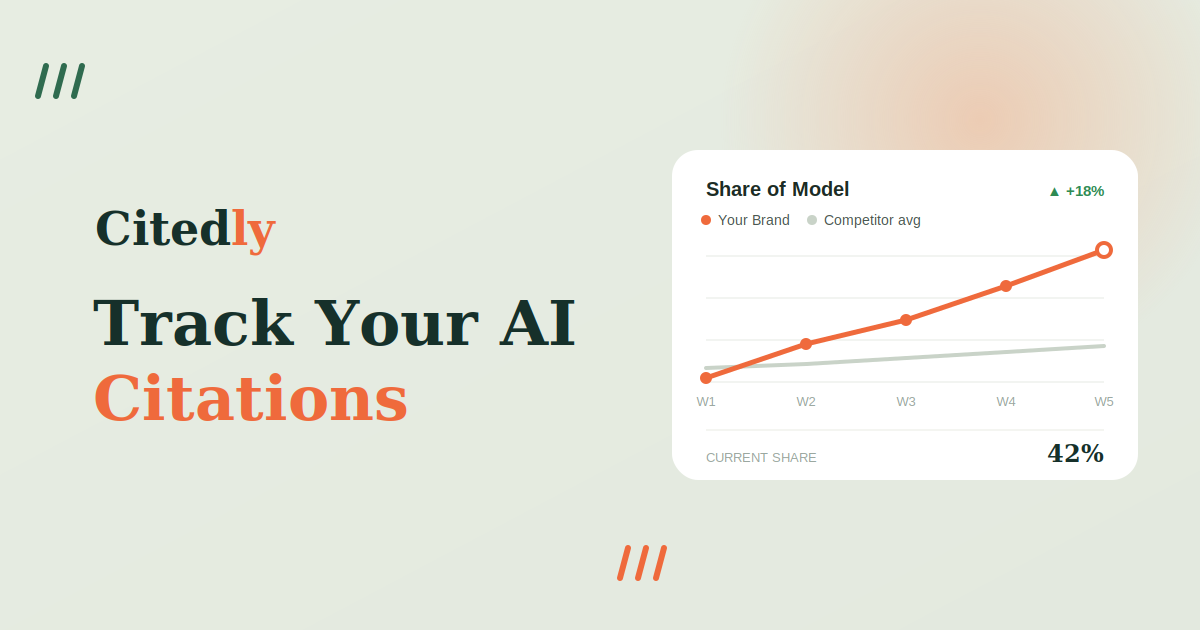
- Share of model (sometimes called share of voice) is the bigger picture: across all the questions your buyers ask, what fraction of the answers name you versus a competitor.
It also helps to know why some brands get named far more often than others: brand mentions now outrank backlinks as a predictor of AI visibility.
Citations and mentions are the individual data points. Share of model is the score you're actually trying to move. If you want the full breakdown of how those citations get earned in the first place, our guide on what AI citations are and how to get cited by AI covers it.
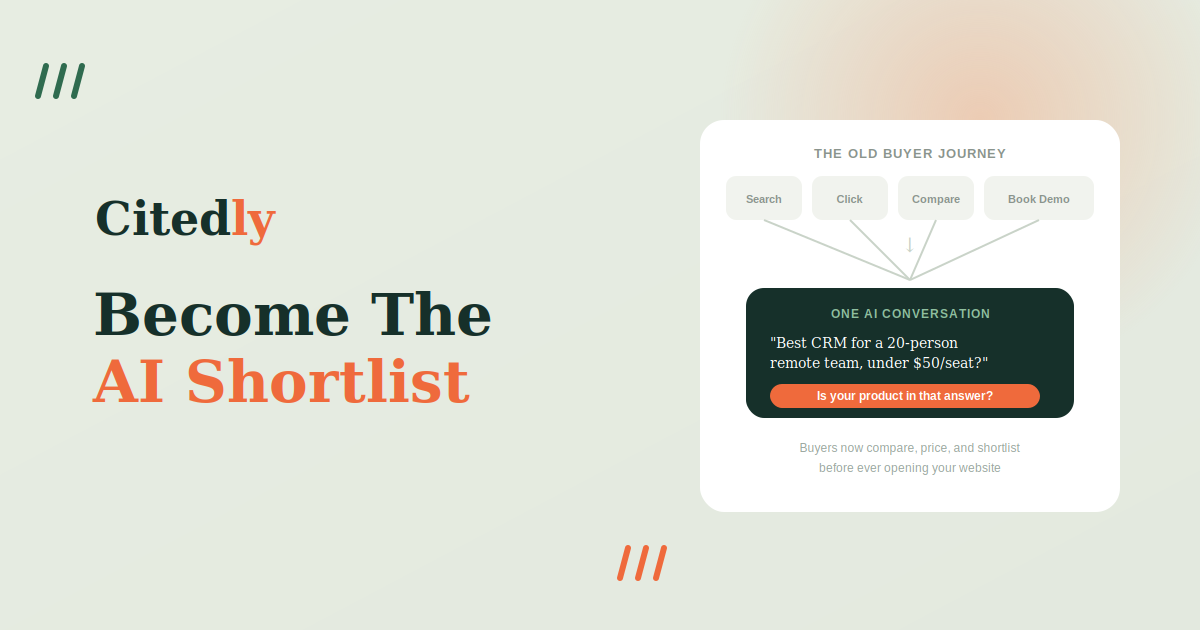
The reason this matters now is that the answer has become the destination. Roughly 68% of Google searches ended without a click in early 2026, according to analysis cited by Frase. When people stop clicking, your position in the blue links stops predicting your traffic. What predicts it is whether you're in the answer at all — and you can only manage that if you're measuring it.
Why You Can't Track AI Citations Like Google Rankings
A rank tracker records one clean number: you are position four for this keyword today. AI visibility refuses to be that tidy, and pretending otherwise leads you astray. An AI answer can:
- Synthesize several sources at once.
- Mention a brand without linking to it.
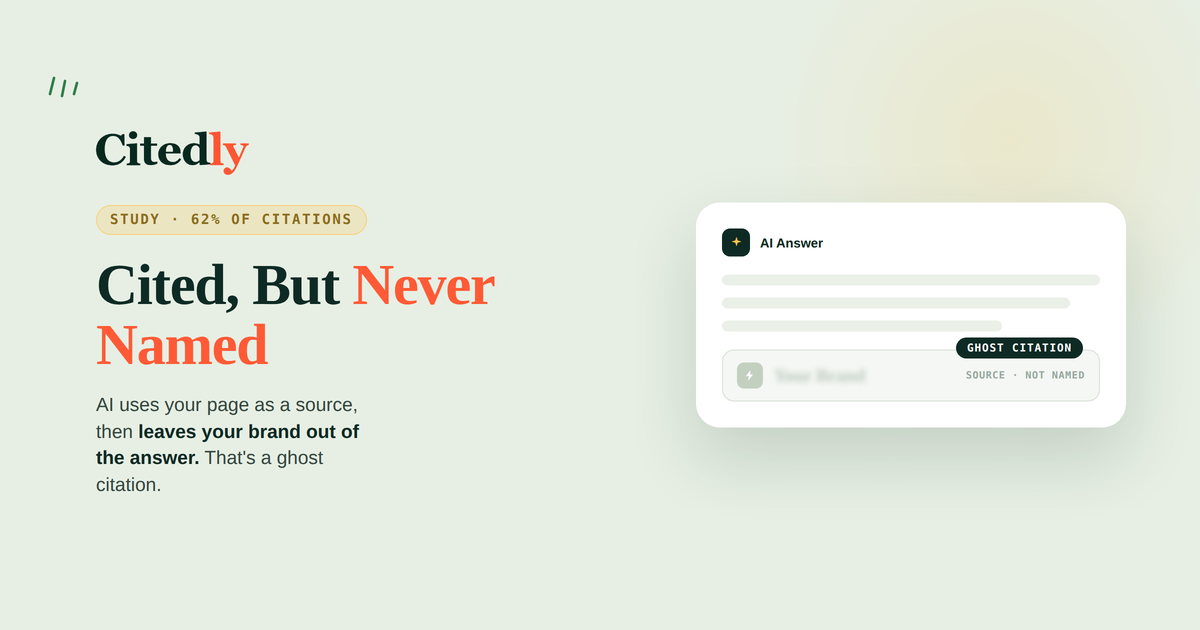
- Cite a page without recommending the company behind it — often because that page was simply the most extractable one, which is what structuring content so AI will quote it is about.
- Change entirely when the same question is phrased slightly differently.
There is no single "position." So the useful question is not "where do I rank," it's "across a representative set of buyer questions, how often am I the answer, and where am I trending." That shift — from a point measurement to a distribution — is the whole mental model.
"A model generates one answer per prompt, names a few brands inside it, and cites a few sources under it. Anyone promising a precise 'AI rank' is overselling — the honest metric is share across a prompt set, tracked over time."
— Paraphrased from the 2026 AI-visibility tool analysis by Karpi Studio, which found every product on the market is a repackaging of just three measurement methods.
The 4 Metrics That Define Your Share of Model
Four numbers cover almost everything worth tracking. If a tool reports more than these, it's usually slicing the same four more finely; if it reports fewer, it's leaving you blind somewhere. Track citations and mentions separately, or your ghost citation rate will hide inside a healthy-looking citation count.
| Metric | What It Measures | How To Read It |
|---|---|---|
| Share of voice | How often you're named across your prompt set, versus competitors | Rising share means you're winning more of your category's answers |
| Citation share | The portion of AI answers that link to your pages (retrieval engines) | Bing Webmaster Tools now reports this free for Microsoft's AI |
| Average position | Whether you're named first or buried third in the answer | Being named first carries far more weight than being named at all |
| Sentiment / accuracy | Whether the mention is positive, neutral, or simply wrong | Catches hallucinations about your pricing or features before they spread |
The one people forget is the last one. AI can name your business and get its facts wrong — outdated pricing, a wrong founding year, a feature you don't offer. Tracking sentiment and accuracy is how you catch that early, while it's still one bad answer and not a pattern repeated across the web.
How to Track Your AI Citations for Free
You can measure most of what matters without paying for anything. Two of the strongest signals come straight from first-party sources, and they cost nothing but the time to set them up. (If you're weighing paid tools instead, our GEO pricing guide breaks down what each tier actually buys.)
Build Your Prompt Set (15–20 Buyer Prompts)
Start by writing down the 15–20 questions a real buyer would actually type into an AI tool before hiring someone like you. Cover the three intent levels:
- Ready-to-buy — "best [your service] near me," "who should I hire for X"
- Comparison — "X vs Y," "alternatives to Z"
- Research — "how does X work"
This fixed list is your benchmark. The value is in keeping it stable, because a consistent prompt set run repeatedly is what turns scattered observations into a trend you can trust.
Run Them Across Every Engine, Weekly
Run your prompt set through ChatGPT, Perplexity, Gemini and Copilot every week, and log the result for each:
- Were you named?
- Was a competitor named instead?
- Where in the answer did you appear?
Keep it in a simple spreadsheet with a column per engine. Track them as four separate scoreboards, not one average, because the engines read different parts of the web. Only about 11% of domains get cited by both ChatGPT and Perplexity, per analysis from Radyant, so a blended score would hide exactly the gaps you need to see.
Use Bing Webmaster Tools' Free Citation Data
Set up Bing Webmaster Tools before you buy any dashboard. Its AI Performance report is the only free first-party citation counter available, and it shows real data from Microsoft's AI experiences:
- Grounding queries
- Query intent
- Topic clusters
- Citation share
- Period-over-period comparison
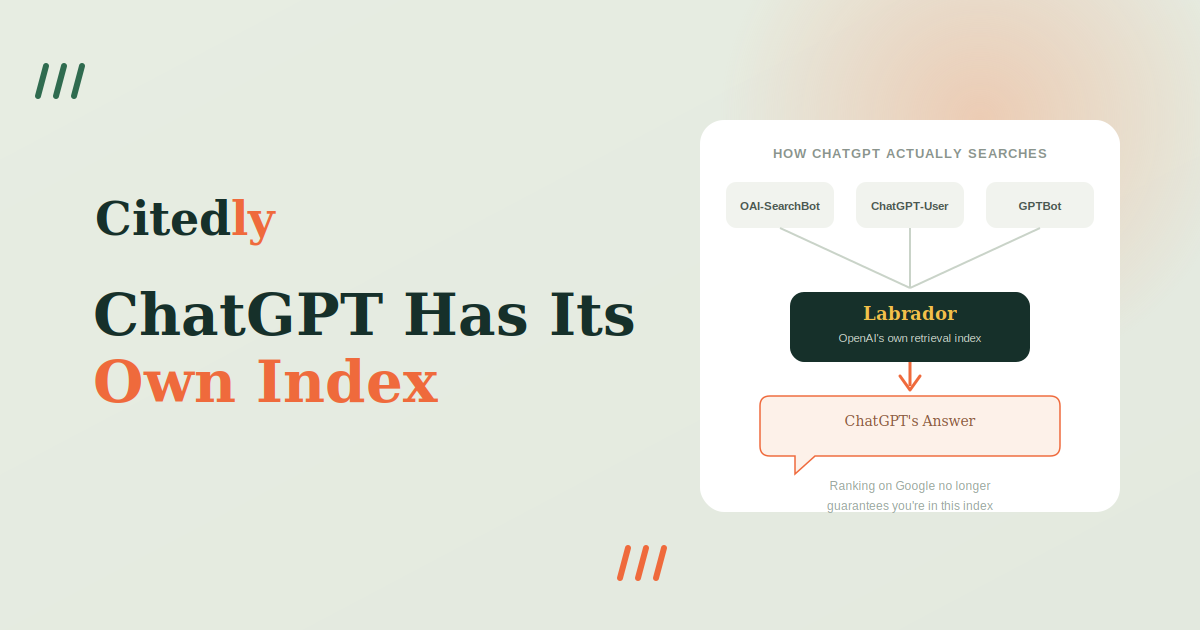
Given that ChatGPT's search runs on Bing's index, this is the closest thing to a direct window into why you are or aren't being cited — and our guide on how to get cited by ChatGPT covers what to do with what you find there. Track each engine separately, too — visibility differs by platform.
Segment AI Referral Traffic in GA4
Your analytics already hold part of the answer. In Google Analytics (GA4), filter your referral traffic for AI sources — ChatGPT passes a chatgpt.com referrer, and Perplexity and others pass their own. This tells you not just whether AI mentions you, but whether those mentions send people who convert.
Seer Interactive found AI-referred visitors convert at several times the rate of ordinary organic traffic, so even small numbers here are worth watching.
Those four moves — a prompt set, weekly engine checks, Bing's citation data and GA4 — cover the majority of what a small business needs, for free.
The 3 Types of AI Visibility Tracking Tools
When you're ready to pay, it helps to know that every tool on the market is one of three things. Understanding the categories keeps you from buying a competitive-intelligence platform when you needed a $29 monitor.
| Type | What It Does | Examples | Cost | Best For |
|---|---|---|---|---|
| First-party citation counter | Reports real citations from one engine's own data | Bing Webmaster Tools, GA4 | Free | Everyone — the starting point |
| Prompt-testing monitor | Runs scheduled question panels across multiple engines | Otterly.AI, Peec AI, ZipTie | $ | Small teams tracking several engines |
| Share-of-voice platform | Benchmarks your mentions against competitors at scale | Profound, Ahrefs Brand Radar, Semrush | $$$ | Agencies, enterprises, competitive markets |
For most small teams, the practical stack is Bing Webmaster Tools plus one affordable monitor.
- Otterly.AI runs from around $29 a month and turns your keywords into the prompts people actually ask across four engines.
- Peec AI covers ChatGPT, Copilot and Google AI Overviews on a budget.
- At the top end, Profound is built for enterprises — it raised a $96M Series C at a $1 billion valuation in early 2026, per Fortune, and serves hundreds of large customers. That's power most local businesses will never need.
When to Upgrade From Free Tracking to a Paid Tool
Upgrade when the manual method starts costing you more time than the data is worth, and not a moment before. Three specific triggers justify the spend:
Prompt Volume
When you need to track more than about 20 prompts across four or five engines every week, doing it by hand becomes the bottleneck. A monitor automates the panel.
Competitor Benchmarking
When you need to know your share of voice relative to named competitors over time, a share-of-voice platform measures that at a scale manual testing can't match.
Reporting to Someone Else
If you're an agency or answering to a boss, a tool's exported charts save hours you'd otherwise spend building them.
If none of those apply yet, the free stack is not a compromise. It's the right tool.
How Often Should You Track Your Share of Model?
Weekly for the fast signals, monthly for the slow ones. Checking daily wastes your time, because AI answers don't move that fast and the noise between runs will mislead you. This cadence keeps you honest without turning tracking into a second job.
| What To Check | How Often | Tool |
|---|---|---|
| Prompt set across all engines | Weekly | Manual testing or a monitor |
| Bing AI citation data | Weekly | Bing Webmaster Tools |
| AI referral traffic and conversions | Monthly | GA4 |
| Brand-fact accuracy (hallucination check) | Monthly | Manual ChatGPT + Claude prompts |
| Competitor share of voice | Monthly | Paid platform, if you use one |
The number that actually matters isn't any single week's citation. It's the direction of the line over a quarter. One appearance is luck; a climbing share of voice across twelve weeks is progress.
Turning Tracking Into Action (Don't Just Watch the Number)
Tracking is only worth doing if it changes what you build next. A dashboard you check and close has cost you time and returned nothing. The point of measurement is to turn each gap into a specific task. Read your log as a to-do list:
- A buyer prompt where a competitor is named and you aren't is a page you need to write or rewrite.
- A query where Bing shows low citation share is a page that needs its answer moved to the top.
- A wrong fact in a ChatGPT answer is an entity-consistency fix.
- If your tracking keeps surfacing prompts where you're absent, that's usually not a measurement problem — it's one of the fixable blockers we cover in why isn't AI citing my website.
Measure, find the gap, fix the gap, measure again. That loop is the entire discipline.
Track It Yourself vs. Let Citedly Do It
You can track AI visibility yourself by running the same buyer prompts across major AI engines, recording when your brand appears, comparing results against competitors, and fixing any gaps you find. The challenge is consistency: most teams update a tracking spreadsheet for a few weeks and then stop, which makes the data unreliable.
Citedly handles the ongoing process for you:
- Runs your prompt set across major AI engines each month
- Tracks share of model and citation share
- Flags competitor gains and inaccurate brand information
- Identifies where your business is missing
- Turns every visibility gap into a practical fix
Citedly is built for small and local businesses, starting at $299 per month with no contract. If you'd like to see how your visibility is tracking right now, book a free call and we'll walk through it, or read why teams choose us to run this instead of doing it in-house.
Frequently asked questions
What is share of model?
Share of model is the percentage of AI answers, across a set of buyer questions, that name your business rather than a competitor. It's the AI-era equivalent of share of voice, and it's the single most useful number for tracking whether your visibility is growing.
How do I track my AI citations for free?
Set up Bing Webmaster Tools, which reports real citation data from Microsoft's AI, and GA4 to see AI referral traffic. Then run a fixed set of 15–20 buyer prompts through ChatGPT, Perplexity, Gemini and Copilot each week and log when you're named. That covers the essentials at no cost.
How often should you check your AI visibility?
Weekly for your prompt set and Bing's citation data, monthly for referral traffic and brand-accuracy checks. Daily checking mostly adds noise, since AI answers don't change fast enough to justify it. What matters is the trend over a quarter, not any single result.
What are the best tools to track AI brand mentions?
Start with the free first-party sources (Bing Webmaster Tools and GA4). For paid monitoring, small teams tend to use Otterly.AI or Peec AI for affordable multi-engine tracking, while agencies and enterprises use share-of-voice platforms like Profound, Ahrefs Brand Radar or Semrush. Match the tool to your prompt volume and whether you need competitor benchmarking.
Can I track my competitors' AI visibility?
Yes. Add competitor names to your prompt-set log and note when they're cited instead of you — that's competitor tracking done manually and for free. Share-of-voice platforms automate the same comparison at scale if you need it across many prompts.
See Where AI Puts Your Business Today
Run your real buyer prompts across five AI engines and find out whether you get named, free, in about 60 seconds. Or book a call and we'll walk you through it.
Keep exploring
Read More from Citedly