AI Visibility Guide
AI SEO Explained: A Plain-English Guide to GEO, AEO and 40+ AI Search Terms
The Problem With AI SEO Jargon
AI search has its own vocabulary now, and much of it gets used loosely. One tool reports "visibility," another reports "share of voice," a third reports "citation share," and they don't always mean the same thing. If you are trying to understand AI SEO for your business, the jargon is often the first wall you hit.
This matters because more of the buying journey now happens inside AI answers (our roundup of AI search statistics tracks how fast that shift is moving). Below, you will find what each term means, how the pieces connect, and where to go deeper. Every definition is short on purpose, so you can scan for the one you need.
What Is AI SEO, and Why Does It Have So Many Names?
AI SEO is the practice of making your brand and content easy for AI systems to find, trust, quote and recommend. Where classic SEO aims for a blue link on page one, AI SEO aims for a place inside the answer itself: as a cited source, a named brand, or a recommendation.
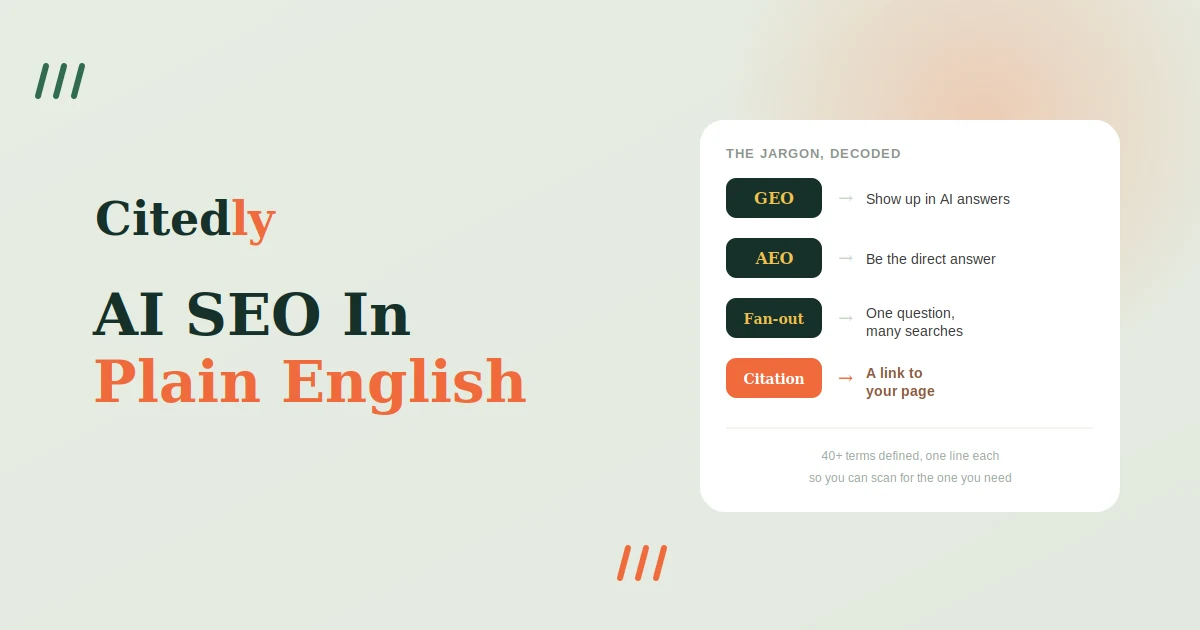
The name confusion comes from timing. Different groups started describing the same shift at the same time, and each label stuck somewhere. The table below shows how the main terms compare.
| Term | Stands for | Where it came from | What it focuses on |
|---|---|---|---|
| AI SEO | Artificial intelligence search engine optimization | Industry shorthand | The umbrella term for all of the below |
| GEO | Generative engine optimization | A 2023 Princeton-led research paper | Visibility inside AI-generated answers |
| AEO | Answer engine optimization | Older term from the featured snippet and voice search era | Being the direct answer to a question |
| LLM SEO | Large language model SEO | Developer and SaaS circles | Optimizing for ChatGPT, Claude, Gemini and similar models |
| AIO | AI optimization (sometimes AI Overviews optimization) | Mixed use | Often Google-specific; check what the speaker means |
In practice, you can treat these as one discipline. When a vendor says GEO and another says AEO, ask what they actually measure and change. That tells you more than the label.
How Do AI Search Engines Find and Choose Sources?
AI search engines follow a pipeline: they crawl the web, store pages in an index, expand your question into several searches, pull back the most relevant passages, and then write an answer grounded in those passages. Sources that survive every step get cited. The rest are invisible, even if they rank well on Google.
Here is each step in plain English:
Crawl. AI crawlers (bots such as GPTBot, OAI-SearchBot, PerplexityBot and Googlebot) visit pages and read their content.
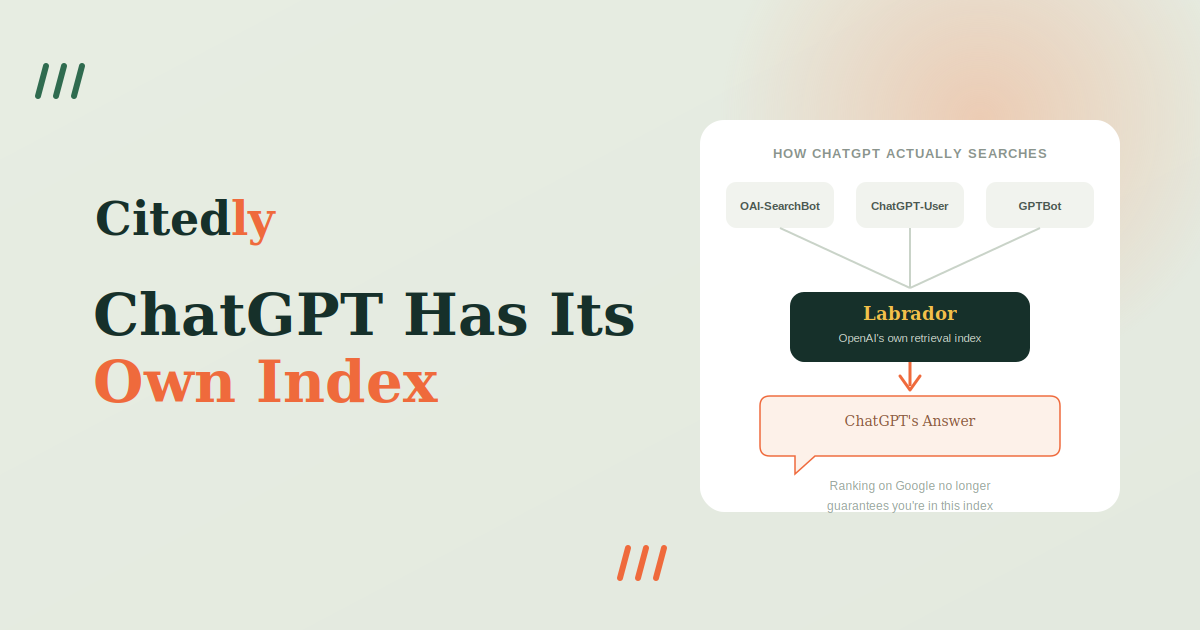
Index. Pages are stored in a search index so they can be retrieved later. OpenAI's own index work is a good example, which we covered in our post on the ChatGPT Labrador search index.
Fan out. The engine rewrites your question into several narrower searches (more on this below).
Retrieve. It pulls the passages that best match those searches.
Ground. It writes the answer using those passages as evidence.
Cite. It links or names the sources it relied on.
What Is the Difference Between Training Data and Live Retrieval?
Training data is what a model learned before its knowledge cutoff. Live retrieval is what it looks up at the moment you ask. A model answering only from training data cannot see your new pricing page or last month's case study.
Most AI search products now combine both. That is why fresh, crawlable pages matter, and why different platforms can give different answers about the same brand (we break that down in why AI cites you on some platforms but not others).
What Are RAG and Grounding?
RAG (retrieval-augmented generation) is the method of fetching documents first and then generating an answer from them. Grounding is the result: an answer tied to real sources instead of the model's memory alone.
What Is an AI Hallucination?
A hallucination is a confident answer that is false or unsupported. For brands, it shows up as wrong prices, discontinued products, or features you never offered. Clear, consistent facts on your own site and on third-party sites give models less room to guess.
What Is Query Fan-Out, and Why Does It Change SEO?
Query fan-out is the technique where an AI engine breaks one question into many smaller searches, runs them at the same time, and combines the results. Google describes AI Mode as "breaking down your question into subtopics and issuing a multitude of queries simultaneously on your behalf" in its AI Mode announcement.
This is the single biggest reason AI SEO differs from keyword SEO. You are no longer competing for one query. You are competing for the set of hidden searches behind it.
What Does Query Fan-Out Look Like in Practice?
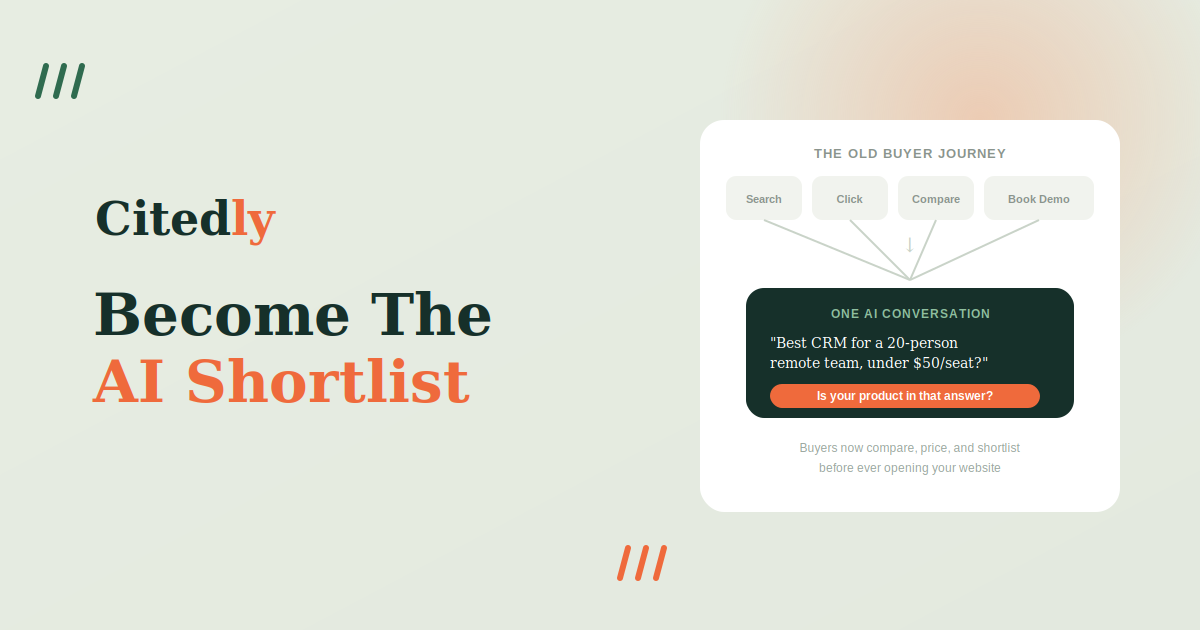
Take a buyer who asks: "What is the best CRM for a 10-person sales team?" An AI engine might quietly search for several things at once. The list below is an illustration of the pattern, not a log from a real system.
- best CRM for small sales teams 2026
- CRM pricing per user for small teams
- easiest CRM to set up without an admin
- CRM with built-in email sequences
- HubSpot vs Pipedrive for small teams
- CRM reviews from small business owners
A page that only targets "best CRM" may match one of these. A site that answers pricing, setup, comparisons and reviews can be retrieved for four or five of them, which raises the chance it gets cited.
How Do You Optimize for Query Fan-Out?
Start by listing the follow-up questions a real buyer asks. Then cover them on your site, either as sections of one strong page or as a cluster of linked pages.
- Answer each sub-question in its own clearly headed section
- Add comparison and pricing content, since fan-out often includes "vs" and "cost" searches
- Keep facts consistent across pages, so retrieved passages agree with each other
- Link related pages together, so engines can find the full cluster
What Is the Difference Between AI Citations, Mentions and Recommendations?
An AI citation is a source link the AI shows next to its answer. An AI mention is your brand name appearing in the answer text, with or without a link. A recommendation is when the AI suggests your brand as an option to choose. You can have one without the others.
These three are often lumped together as "visibility," but they behave differently and point to different fixes. The table below separates them.
| Signal | What it looks like | Why it matters | Learn more |
|---|---|---|---|
| AI citation | Your URL shown as a source | Sends traffic and proves the AI used your page | What are AI citations? |
| AI mention | Your brand named in the text | Builds awareness, even with no click | AI citations vs mentions |
| Recommendation | Your brand suggested as a pick | Closest to a buying decision | Get ChatGPT to recommend your business |
| Ghost citation | Your page used, but your brand not named | You did the work, a competitor gets the credit | What is a ghost citation? |
What Are Answer Position and Sentiment?
Answer position is where your brand appears in the response: first, in the middle, or at the end of a list. Sentiment is the tone the AI uses about you: positive, neutral or negative. A first-place recommendation with a positive description is worth far more than a passing mention at the bottom.
How Is AI Visibility Measured? Citation Share, Share of Voice and More
AI visibility is measured by running a fixed set of prompts through AI platforms on a schedule and counting how often your brand is cited, mentioned and recommended compared with competitors. The headline metrics are citation share, AI share of voice and mention rate.
Each tool calculates these a little differently, so always check the method before comparing numbers across platforms.
How Do You Calculate Citation Share?
Citation share is the percentage of all citations in a set of AI answers that point to your domain. AirOps defines it as "the percentage of all citations in a defined set of sources" that reference a specific brand or domain.
Citation share = (citations to your domain ÷ total citations across the prompt set) × 100
Here is a worked example with made-up numbers, to show the math:
| Domain | Citations across 50 prompts | Citation share |
|---|---|---|
| Competitor A | 60 | 15% |
| Competitor B | 44 | 11% |
| Your site | 28 | 7% |
| All other sources | 268 | 67% |
| Total | 400 | 100% |
In this example, you were cited 28 times out of 400 total citations, so your citation share is 7%. The useful question is not the number itself. It is which prompts Competitor A wins that you don't.
What Is AI Share of Voice?
AI share of voice is your brand's share of all brand mentions in AI answers for a topic. Citation share counts links; share of voice counts names. A brand can have strong share of voice and weak citation share if AI engines talk about it but source the facts from other sites.
What Other AI Visibility Metrics Should You Know?
These are the other numbers you will see in most AI visibility dashboards:
- Mention rate: the percent of tracked prompts where your brand appears at all
- AI visibility score: a tool's combined score from mentions, position and sentiment. Formulas vary by vendor
- Prompt coverage: how many of your target prompts return your brand in any form
- Source share (domain share): which outside domains AI engines cite most for your topic. These are your best outreach targets
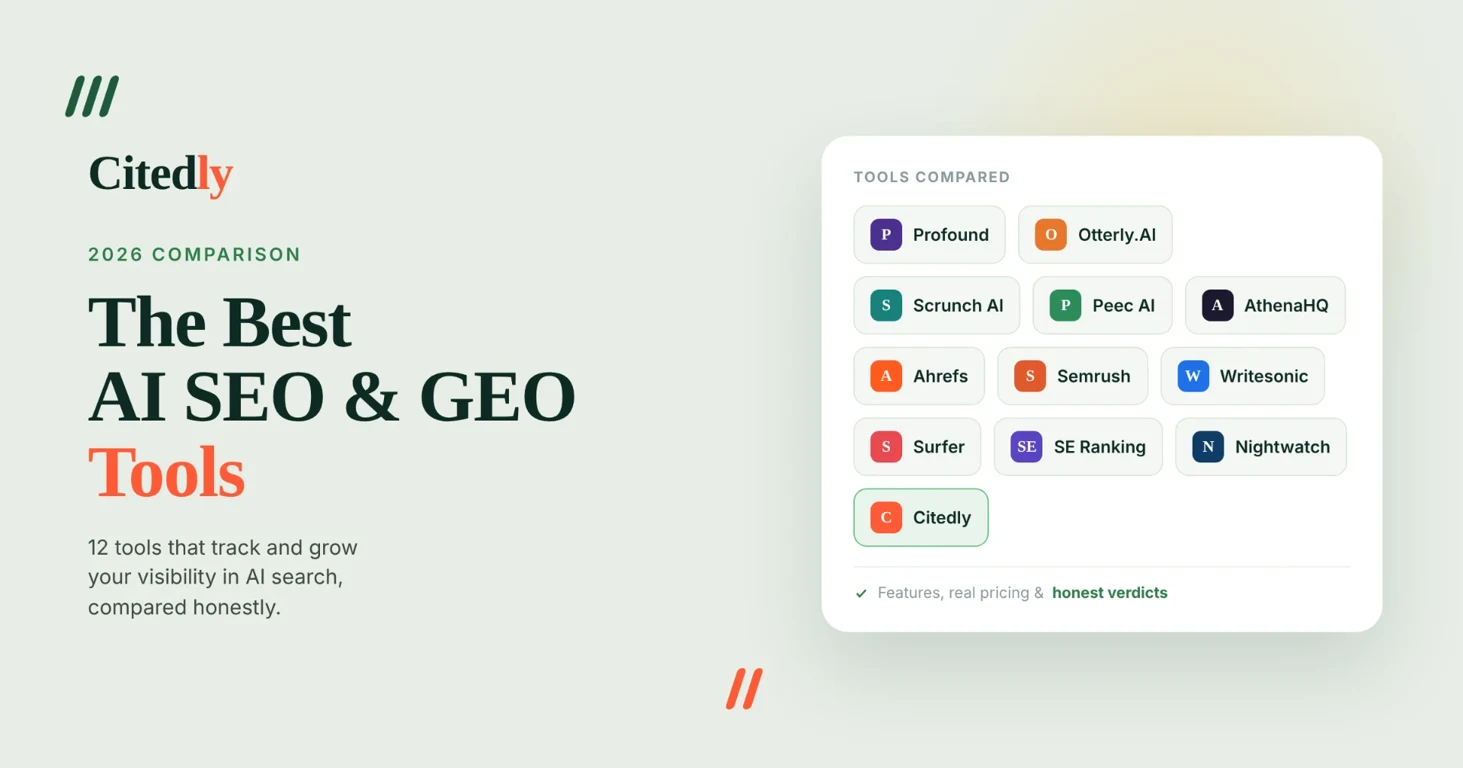
For a step-by-step setup, see our guide to tracking AI citations, and our honest comparison of the 12 best AI SEO tools if you want software to do the counting.
Where Do AI Answers Show Up?
AI answers now appear in search engines, chat apps and assistants. The main surfaces are Google AI Overviews, Google AI Mode, ChatGPT search, Gemini, Perplexity, Microsoft Copilot and Claude. Each one retrieves and cites sources a little differently.
The scale is no longer small. In July 2026, Alphabet said AI Mode has passed 1 billion monthly active users and the Gemini app has 950 million.
What Are Google AI Overviews and AI Mode?
AI Overviews are the AI summaries at the top of a normal Google results page. AI Mode is a separate, chat-style search tab that uses query fan-out for longer, multi-step questions. Both can cite your pages, and both pull from Google's index, so classic SEO still feeds them. Our Google AI Overviews guide covers how to appear in them.
What Is Zero-Click Search?
Zero-click search is a search that ends without the user clicking any result, because the answer was already on the page. AI summaries push this further.
A Pew Research Center study of 900 U.S. adults found users clicked a traditional result on 8% of visits with an AI summary, versus 15% without one (browsing data from March 2025).
In the same study, users clicked a link inside the AI summary on just 1% of visits.
An Ahrefs analysis of 300,000 keywords found that the presence of an AI Overview correlated with a 58% lower average clickthrough rate for the top-ranking page (published February 2026).
The takeaway is not that clicks are dead. It is that being named in the answer now does part of the job a click used to do.
What Are Local AI Recommendations?
Local AI recommendations are the businesses an AI suggests for "near me" or city-based questions. They lean heavily on Google Business Profile data, reviews and local directories. We cover this in detail in how local businesses get recommended by AI.
Which AI SEO Terms Describe What You Actually Do?
The optimization terms describe the actual work: making your site readable for AI crawlers, making your content easy to quote, and making your brand consistent across the web. Most of it builds on good SEO rather than replacing it.
Which Terms Cover On-Page Work?
These terms describe changes on your own pages:
- Answer-first structure: putting a direct 40 to 60 word answer right under each question heading
- Passage-level content (chunking): writing sections that make sense on their own, since AI retrieves passages, not whole pages
- Structured data (schema): code that labels your content (Organization, Article, FAQPage, Product) so machines read it correctly
- Entity SEO: making your brand a clear, consistent "thing" with the same name, description and facts everywhere
- Freshness: visible update dates and current facts, so retrieval systems trust the page is still right
Our guide on how to structure content for AI walks through each of these with examples.
Which Terms Cover Off-Site Work?
Off-site AI SEO is about what the rest of the web says about you. AI engines check whether other sources agree with your claims.
- Third-party mentions: your brand named in reviews, listicles, forums, news and directories
- Consensus: the same facts about you repeated across many trusted sources
- E-E-A-T: Google's framework of experience, expertise, authoritativeness and trust, shown through real authors and real credentials
- Topical authority: covering a subject deeply enough that engines see you as a go-to source
See our how to get your business mentioned in AI guide for the off-site playbook.
What Is llms.txt, and Does It Work?
llms.txt is a proposed text file at the root of a website that lists its key pages for AI systems, similar in spirit to robots.txt. It is easy to add, but there is no confirmed evidence it improves citations. In June 2025, Google's John Mueller wrote on Bluesky that "no AI system currently uses llms.txt." Add it if you like, but don't expect it to move your numbers on its own.
What Is a Prompt Library?
A prompt library is the fixed list of real buyer questions you track across AI platforms over time. It is the AI SEO version of a keyword list. The quality of your prompts decides whether your visibility numbers mean anything, so build them from real search queries, not guesses.
How Is AI SEO Different From Traditional SEO?
AI SEO keeps most of traditional SEO and changes what you measure. Crawlability, helpful content and authority still matter, because AI engines retrieve from indexes built on them. What changes is the goal: from ranking a page to being used and named inside an answer.
Research backs up the shift in what helps. The Princeton-led GEO paper presented at KDD 2024 found that adding citations, quotations and statistics to content boosted visibility in generative engine responses by up to 40%, while keyword stuffing gave little to no benefit. For the full comparison of link signals, read AI citations vs backlinks.
| Traditional SEO | AI SEO |
|---|---|
| Rankings for a keyword | Citation share and mentions across prompts |
| Clicks and click-through rate | Mentions, recommendations and answer position |
| Backlinks as the main authority signal | Citations, brand mentions and consensus across sources |
| One page per keyword | Topic clusters that cover fan-out searches |
| Monthly ranking reports | Repeated prompt runs, because answers change between runs |
Which AI SEO Terms Are Most Often Misused?
A handful of AI SEO terms get stretched past what they mean, usually to sell something. Here are the five we see most.
"AI SEO means AI-written content." It doesn't. AI SEO is about being cited by AI, not publishing text written by it. Thin, unchecked AI content is more likely to hurt you.
"llms.txt gets you cited." There is no public evidence for this yet (see above).
"You can buy AI citations." You can buy placements on sites that AI engines cite, but no one can guarantee an engine will cite them.
"One good answer means you're visible." One run proves little. Visibility is a rate across many prompts.
"AI visibility score is a standard." Every vendor builds it differently. Compare trends inside one tool, not scores across tools.
If your site is not showing up at all, the cause is often technical. Our checklist on why AI isn't citing your website covers the common blockers.
How Can You Start With AI SEO?
You can start AI SEO in five steps: check that AI crawlers can reach your site, build a prompt library, measure your baseline, fix your content structure, and earn mentions on the sources AI already trusts.
- Check access. Make sure your robots.txt and firewall don't block AI crawlers, and that key content isn't hidden behind scripts
- Build a prompt library. List 30 to 50 real questions your buyers ask, from search data, sales calls and forums
- Measure a baseline. Record citation share, mention rate and competitor share across those prompts
- Fix structure. Add answer-first sections, schema, clear facts and update dates to your most important pages
- Earn mentions. Find the domains AI cites most in your niche and get your brand on them
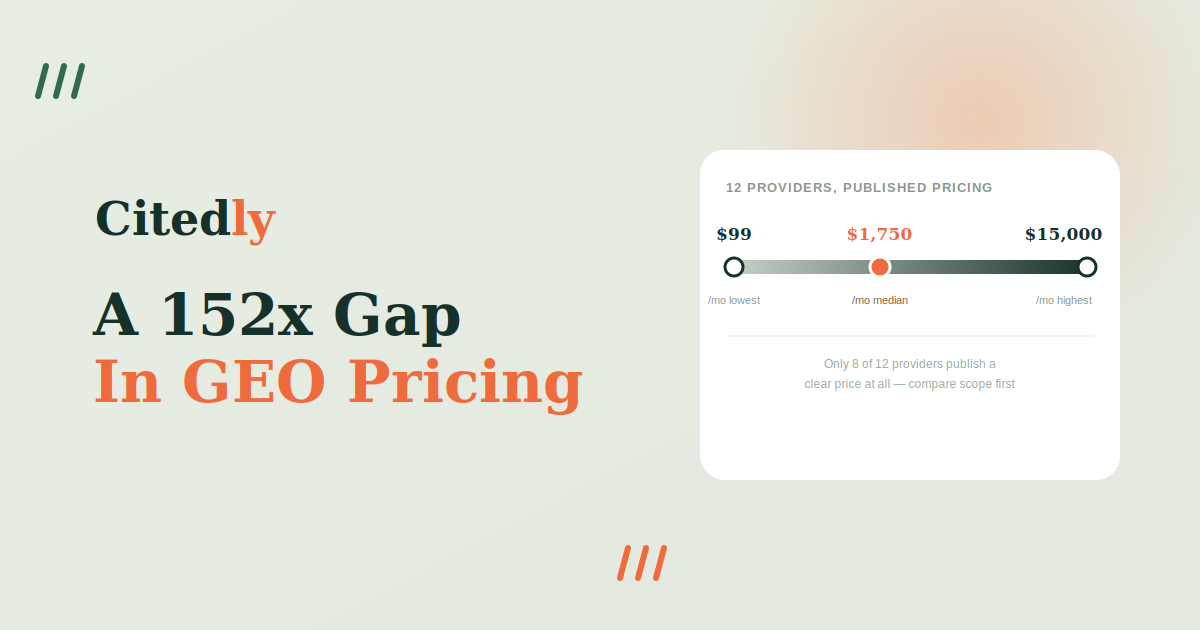
If you want to know what this costs to hand off, our breakdowns of how much GEO costs and the AI visibility pricing benchmark lay out real price ranges.
AI SEO Glossary: Quick Reference A to Z
| Term | One-line definition |
|---|---|
| AEO | Answer engine optimization: being the direct answer to a question |
| AI citation | A link to your page shown as a source in an AI answer |
| AI crawler | A bot that reads web pages for AI products, such as GPTBot or PerplexityBot |
| AI hallucination | A confident AI answer that is false or unsupported |
| AI mention | Your brand named in an AI answer, with or without a link |
| AI Mode | Google's chat-style search tab that uses query fan-out |
| AI Overviews | AI summaries shown at the top of Google search results |
| AI SEO | Optimizing to be found, cited and recommended in AI answers |
| AI share of voice | Your share of all brand mentions in AI answers for a topic |
| AI visibility | How often and how well your brand shows up in AI answers |
| AI visibility score | A tool-specific combined score of mentions, position and sentiment |
| AIO | AI optimization, sometimes meaning AI Overviews optimization |
| Answer position | Where your brand appears within an AI answer or list |
| Answer-first structure | A direct answer placed right under each heading |
| Chunking | Writing sections that stand alone, so AI can retrieve them as passages |
| Citation share | Your citations divided by all citations across a prompt set, as a percent |
| Consensus | The same facts about your brand repeated across trusted sources |
| E-E-A-T | Experience, expertise, authoritativeness and trust |
| Entity | A clearly defined person, brand, place or thing that machines can recognize |
| Entity SEO | Making your brand a consistent, recognizable entity across the web |
| Fan-out query | One of the hidden sub-searches an AI runs for a single question |
| Freshness | How current a page's facts and update date are |
| GEO | Generative engine optimization: visibility inside AI-generated answers |
| Ghost citation | Your content used by AI without your brand being named |
| Grounding | Tying an AI answer to retrieved sources instead of memory alone |
| Knowledge cutoff | The date after which a model has no training data |
| LLM | Large language model, the technology behind ChatGPT, Gemini and Claude |
| LLM SEO | Optimizing specifically for large language model answers |
| llms.txt | A proposed file listing key pages for AI systems; no confirmed impact |
| Mention rate | The percent of tracked prompts where your brand appears |
| Prompt | A question or instruction a user types into an AI tool |
| Prompt coverage | How many target prompts return your brand in any form |
| Prompt library | The fixed set of buyer prompts you track over time |
| Query fan-out | Splitting one question into many searches run at once |
| RAG | Retrieval-augmented generation: fetch documents, then write the answer |
| Recommendation | The AI suggesting your brand as an option to choose |
| Retrieval | The step where an AI pulls relevant passages from an index |
| Search index | The stored copy of web pages that search and AI systems retrieve from |
| Sentiment | The tone an AI uses when describing your brand |
| Source share | Which outside domains AI cites most for your topic |
| Structured data | Schema markup that labels content for machines |
| Third-party mention | Your brand named on someone else's site |
| Topical authority | Deep coverage that makes you a go-to source on a subject |
| Training data | The text a model learned from before its knowledge cutoff |
| Zero-click search | A search that ends without a click on any result |
Frequently Asked Questions About AI SEO
What Is Citation Share?
Citation share is the percentage of all citations in a set of AI answers that point to your domain. You run a fixed list of prompts, count every cited source, and divide your citations by the total. If you get 28 of 400 citations, your citation share is 7%. It shows how often AI engines actually rely on your pages compared with competitors.
What's the Difference Between Citations and Mentions in AI Search?
A citation is a source link to your page shown with the AI answer. A mention is your brand name appearing in the answer text, with or without a link. Citations prove the AI used your content; mentions show it knows your brand. You need both, and they often have different causes. Our post on being cited by ChatGPT shows how to earn the first.
Do AI Citations Replace Backlinks?
No. Backlinks still help pages rank and get crawled, and most AI answers retrieve from search indexes that backlinks influence. AI citations are a new outcome to measure on top of that, not a replacement. The strongest brands earn both: links that build authority, and mentions and citations across the sources AI engines trust.
Why Might AI Systems Skip Citing a Website?
AI systems usually skip a site because they cannot reach it, cannot understand it, or do not trust it. Common causes include blocked AI crawlers, content loaded only by JavaScript, vague pages with no direct answers, outdated facts, and no third-party sources backing up the brand's claims. Fixing access and structure is usually the fastest win.
What Is Query Fan-Out in SEO?
Query fan-out is when an AI search engine splits one question into many smaller searches and combines the results into a single answer. For SEO, it means you compete for a whole set of hidden sub-queries, not one keyword. Covering pricing, comparisons, how-to steps and reviews around a topic gives you more chances to be retrieved.
Is AI SEO the Same as GEO?
Yes, in practice. GEO (generative engine optimization) is the term from academic research, while AI SEO is the broader industry label. AEO and LLM SEO describe the same goal from slightly different angles. What matters more than the label is whether the work improves your citations, mentions and recommendations in real AI answers.
Can ChatGPT Recommend My Business?
Yes. ChatGPT recommends businesses when its search results and training data show clear, consistent and trusted information about them. That means an accessible website, direct answers to buyer questions, accurate listings and reviews, and mentions on third-party sites ChatGPT already cites. B2B teams can find a tailored plan in our guide to AI SEO for B2B.
How Do You Start With AI SEO on a Small Budget?
Start with what costs time, not money. Check that AI crawlers can access your site, rewrite your top five pages with answer-first sections, add basic schema, and manually test 20 to 30 buyer prompts in ChatGPT and Google each month. Paid tracking tools and outside help make sense once you know which prompts matter most.
What Should You Do Next With AI SEO?
AI SEO comes down to three things: be reachable, be quotable and be confirmed by others. The terms in this guide all fit somewhere in that chain, and once you know them, vendor reports and dashboards become much easier to read.
Related Citedly Resources
If you want to understand AI SEO beyond the definitions:
- Start with How Much Does GEO Cost? for budget context
- For implementation details, read How to Structure Content for AI
- For measurement, read How to Track AI Citations
- For a deeper dive on citations, read AI Citations vs. Backlinks
Ready to See Where Your Brand Stands in AI Search?
If you want a clear picture of where your brand stands today, Citedly runs AI visibility audits that measure your citation share, mentions and competitor gaps across real buyer prompts. Plans start at $299 per month.
Keep exploring
Read More from Citedly