ChatGPT Search
ChatGPT Has Its Own Search Index: What Labrador Means for SEO and AI Visibility
Why I Care About This
I come at this from a slightly different angle than most marketers. My background is in computer science, and my research focused on large language models and how they can arrive at incorrect answers. That changes how I read search news. I am less interested in the headline and more interested in the retrieval system underneath it: what the model can fetch, what it stores, what it trusts, and what ultimately gets surfaced to the user.
The most important detail in the Labrador research is not the codename. It is the distinction between crawling and indexing. If OpenAI is maintaining its own searchable and cached representation of the web, businesses are no longer optimizing only for Google and hoping that visibility carries over.
What Is "Labrador"?
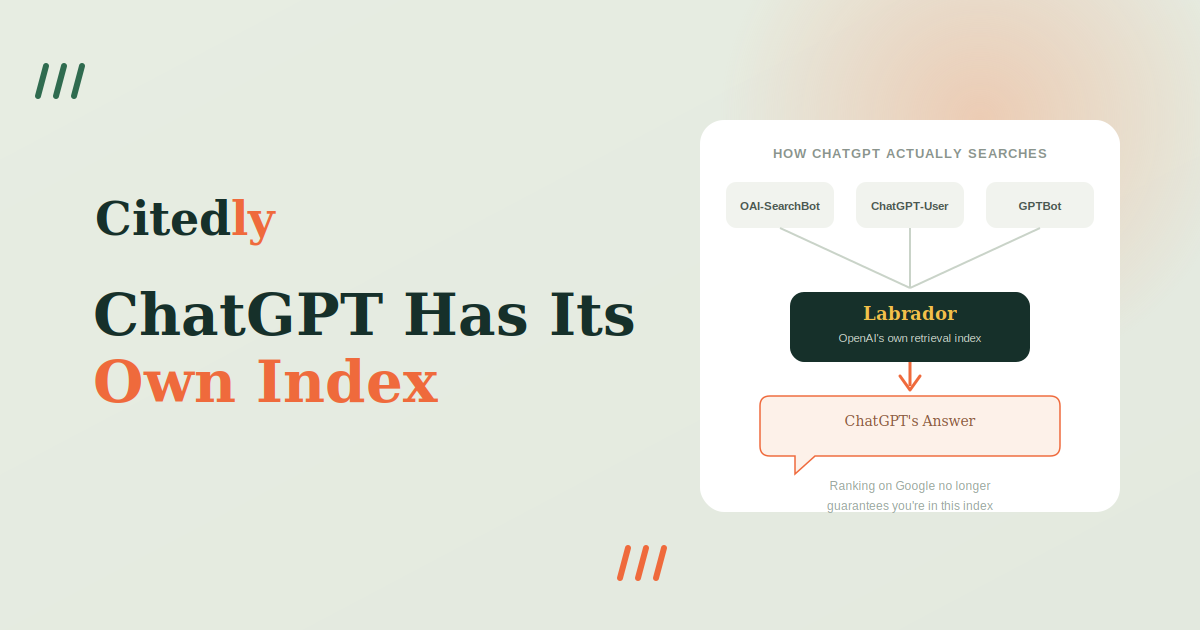
Independent researchers studying ChatGPT's server-side retrieval data found a source label called 'labrador' alongside external retrieval providers. Their work suggests Labrador is OpenAI's own retrieval hub or family of indexes covering general web content and multiple verticals.
Important evidence distinction: OpenAI has not publicly announced a product called Labrador. What OpenAI does publicly confirm is that ChatGPT can use OpenAI's indexed and cached web content. The Labrador name, sub-index structure and some of the observed retrieval behavior come from independent reverse engineering.
OpenAI's own documentation explains that eligible ChatGPT workspaces can use OpenAI's indexed and cached web content instead of live web search, while its publisher guidance says sites should allow OAI-SearchBot if they want content to be discovered, surfaced, cited and linked in ChatGPT Search.
Independent investigations from Peec AI and RESONEO's research published by Search Engine Land provide the strongest public evidence for the Labrador label and how the retrieval stack behaves.
Labrador Is the Index. The Crawlers Are Something Else.
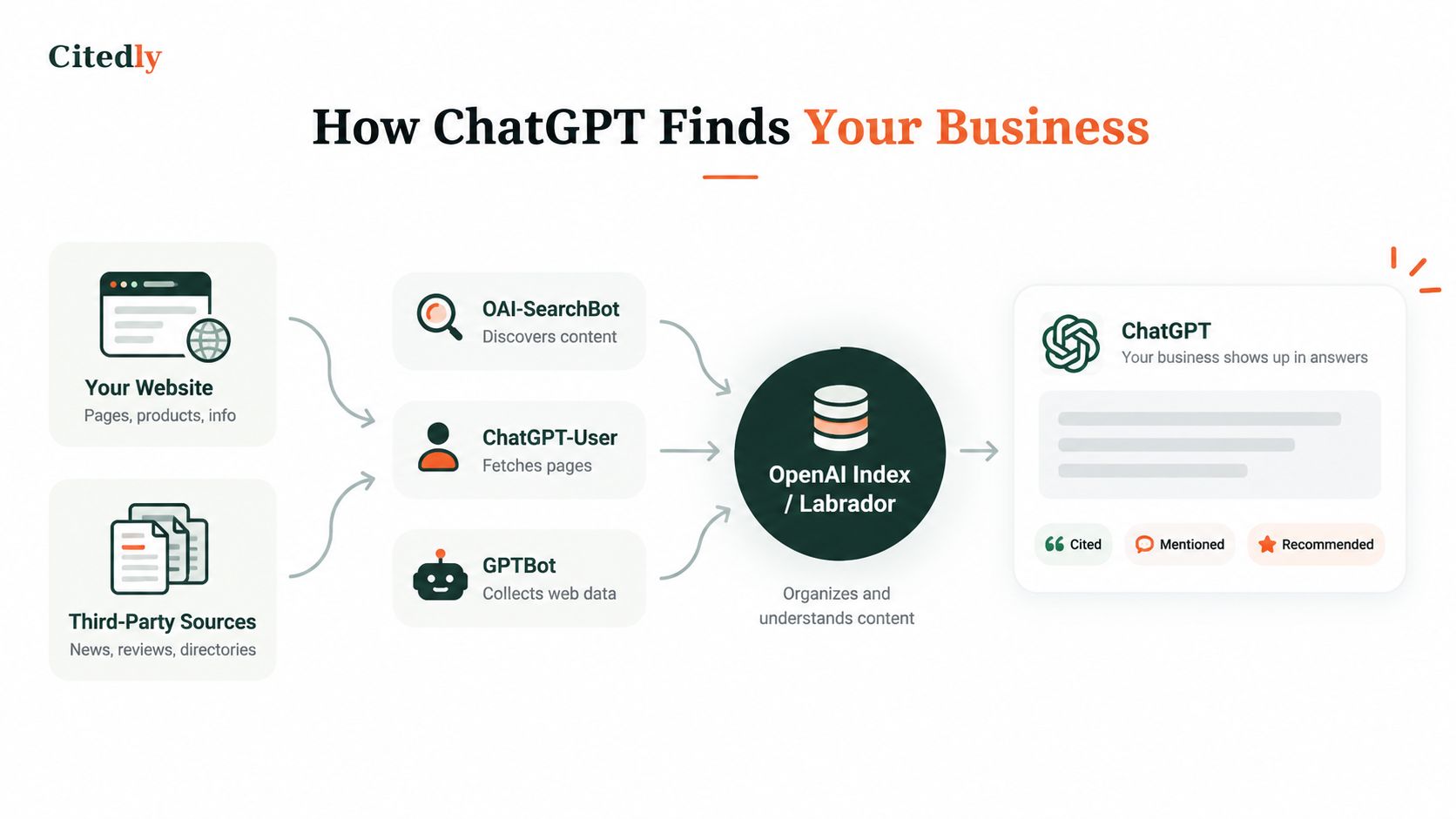
There is loose commentary online describing Labrador as 'ChatGPT's new crawler.' That confuses two different pieces of infrastructure.
| Component | Role | What a Business Can Influence |
|---|---|---|
| OAI-SearchBot | Search discovery crawler for ChatGPT Search | Allow access in robots.txt and through your CDN/firewall. |
| ChatGPT-User | Fetches pages in response to user-driven browsing/opening | Keep pages publicly accessible and technically readable. |
| GPTBot | Crawler associated with model-related web collection policies | Control access separately according to your content policy. |
| Labrador | Researcher-observed OpenAI retrieval/index layer | You do not submit to it directly; you improve crawlability, clarity and trust so your content can enter and be useful in OpenAI's retrieval systems. |
If your site is technically available to Google but blocked for AI crawlers, you can end up with a situation where traditional search works while AI visibility does not. That is one of the recurring reasons we see when diagnosing why AI is not citing a website.
What We Know for Certain vs. What Researchers Inferred
| Evidence Level | What We Can Say |
|---|---|
| Officially confirmed by OpenAI | ChatGPT can use OpenAI's indexed and cached web content; sites should allow OAI-SearchBot to improve eligibility for discovery and citation. |
| Strong independent evidence | Researchers observed an internal source labeled 'labrador' and documented different retrieval pipelines and cached/indexed behavior. |
| Researcher interpretation | Labrador appears to operate as a family/orchestrator of OpenAI-owned indexes and specialized retrieval sources. |
| Not publicly confirmed | The exact internal architecture, ranking formula, crawl schedule, inclusion criteria and whether every ChatGPT mode uses Labrador the same way. |
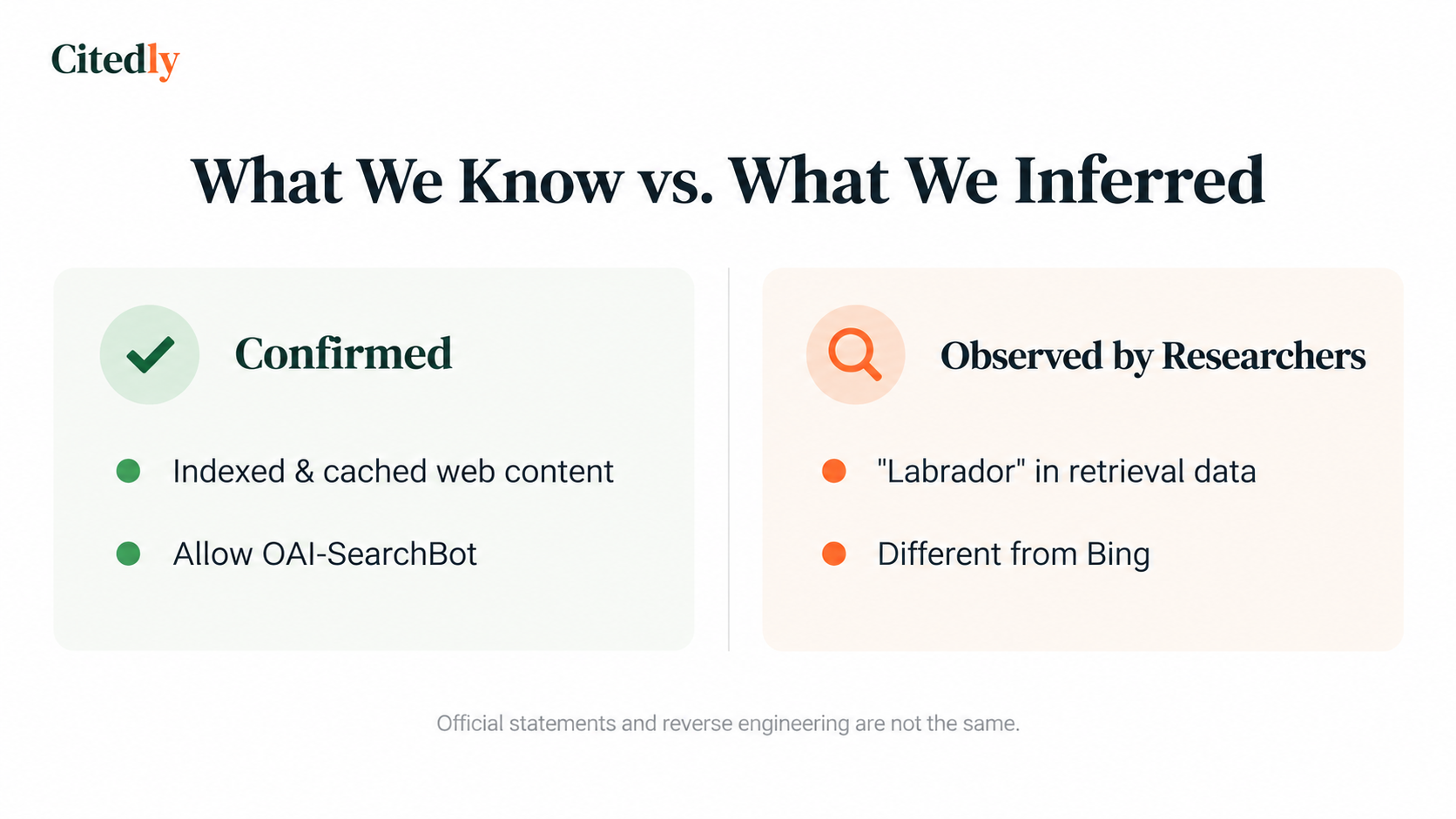
That evidence hierarchy is important because SEO advice should not depend on pretending we know more about a private system than we actually do. The strategic conclusion is still strong even with that caution: OpenAI is maintaining its own indexed web content, and businesses need to treat ChatGPT as a search ecosystem in its own right.
How Is This Different From Google's Index?
| Traditional Google Search | ChatGPT / AI Retrieval |
|---|---|
| Primary output is a ranked results page. | Primary output is a generated answer assembled from selected sources. |
| Users can scroll past many results. | The answer may name only a few brands or sources. |
| Ranking position is the dominant visible metric. | Citation, mention, recommendation and source selection matter. |
| Keywords and links remain central inputs. | Retrievability, passage clarity, entity signals, mentions and corroboration become more important. |
| Click-through is the normal next step. | A user may act on the answer without clicking any source. |
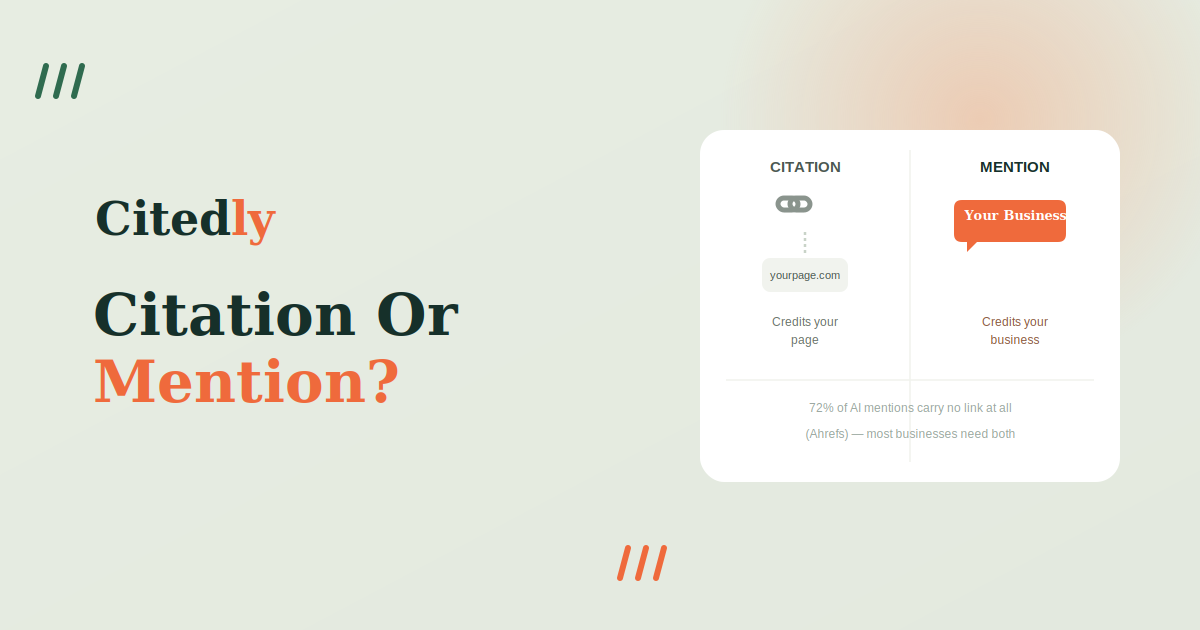
That last difference is commercially important. A business can receive value from an AI recommendation even without a click, and a publisher can receive a citation without its brand being prominently named. That is why a citation and a brand mention should be treated as separate outcomes.
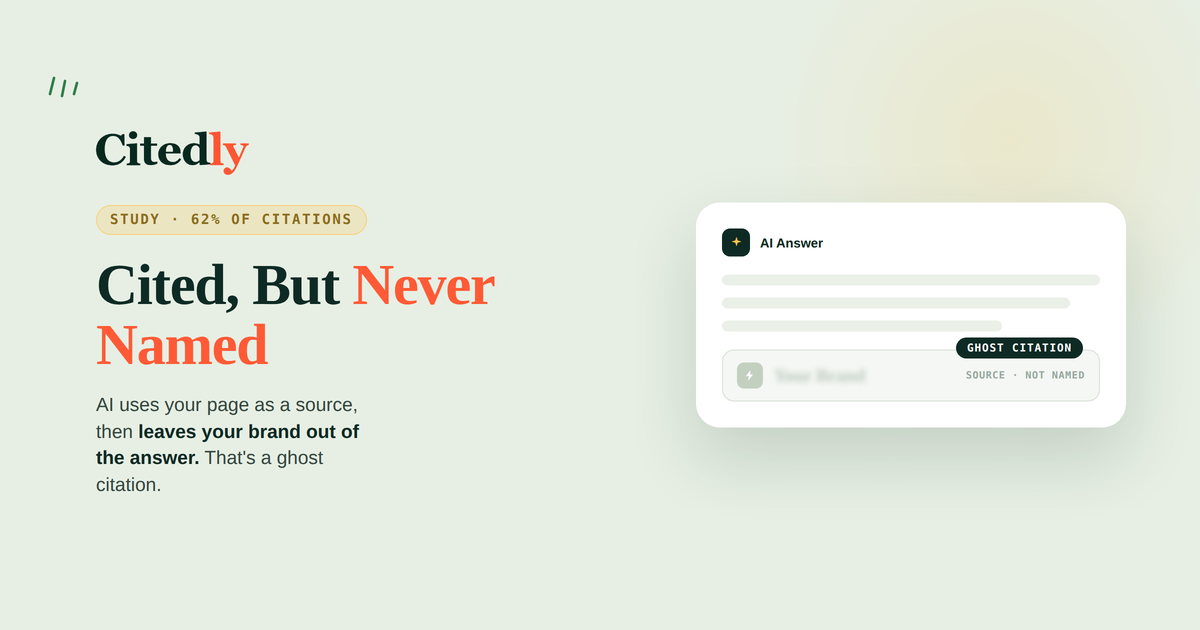
Citedly tracks the distinction between AI citations and brand mentions because a linked source can still become a ghost citation if the answer uses your information without naming your company.
The Retrieval Data Suggests ChatGPT Is Not Simply Mirroring Bing
The most interesting researcher finding is how different OpenAI's own retrieval set appears to be from Bing. RESONEO's analysis, published by Search Engine Land, compared the URLs attributed to Labrador with Bing's top results for the same search fan-outs and found only about 1.5% overlap with Bing's top 20.
The same research also found different retrieval behavior across ChatGPT modes. In its August update, the researchers reported that free Think pulled roughly three-quarters of its result set from Labrador, while paid Thinking leaned much more heavily on scraped Google-derived results. The exact mix will almost certainly keep changing, but the takeaway is durable: two people can ask the same question in ChatGPT and receive answers grounded in different source pools.
That makes 'rank on Bing and you rank in ChatGPT' an increasingly incomplete strategy.
What Labrador Means for the Future of SEO
For more than two decades, most SEO strategy rested on one dominant model: get crawled, get indexed, rank in Google, earn the click. AI search is fragmenting that model into multiple retrieval systems.
A business can now be discovered through Google Search, Bing, Google AI Overviews, Gemini, ChatGPT Search, Perplexity and vertical AI experiences. Those systems can use different crawlers, indexes, source pools and ranking or retrieval logic.
| Old SEO Question | New Multi-Index Question |
|---|---|
| Does this page rank? | Can each important search/AI system discover and retrieve this page? |
| What keyword position are we in? | Are we cited, named, recommended or absent for the buyer's question? |
| How many backlinks do we have? | Which links, mentions, reviews and third-party sources corroborate the business? |
| How much organic traffic did the page get? | How much search traffic plus AI referral and no-click brand visibility did we earn? |
| Is the page optimized for Google? | Is the business understandable and trusted across multiple retrieval ecosystems? |
SEO Is Moving From "Rank Once" to "Be Retrievable Everywhere"
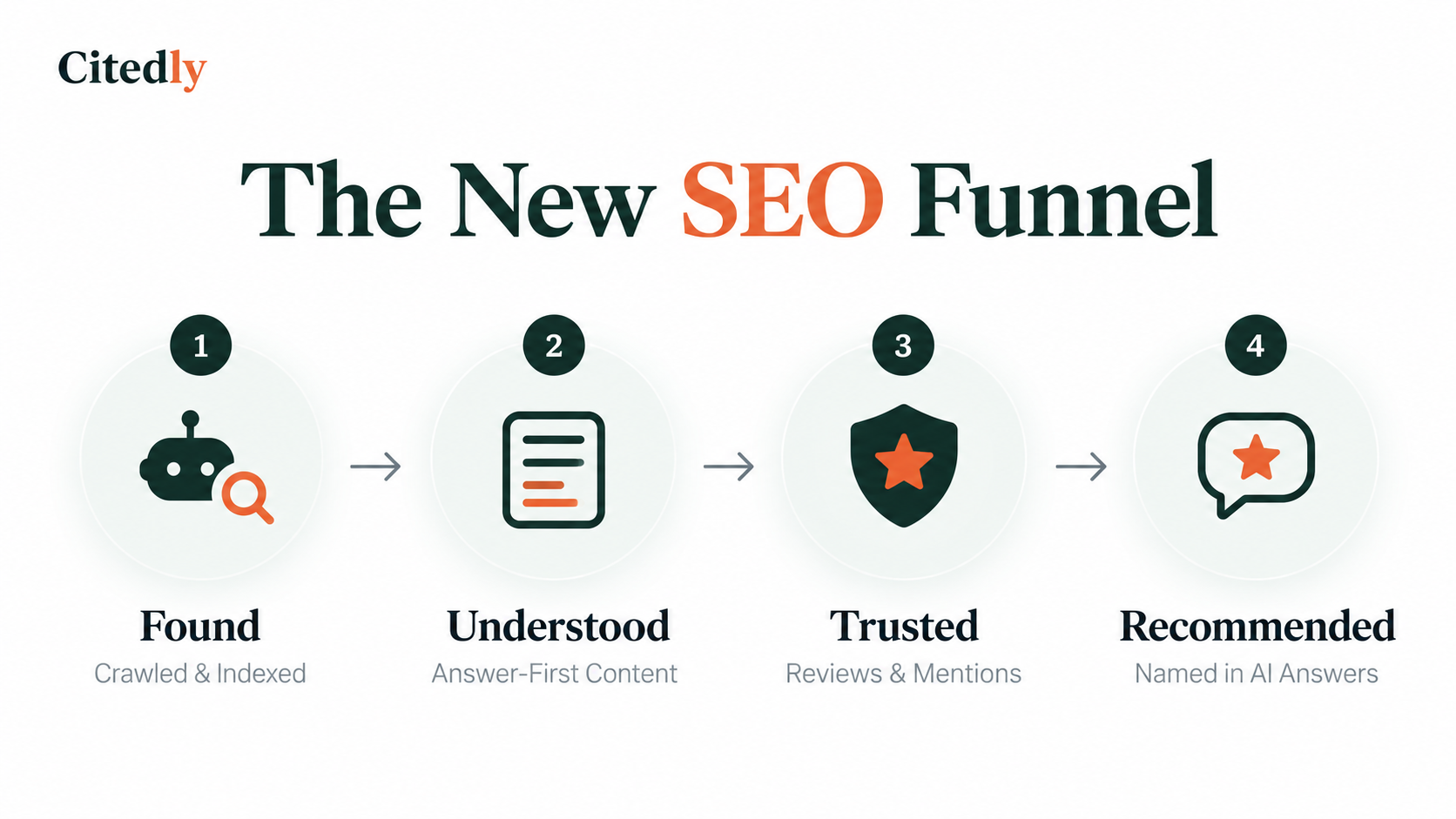
Discoverable: Search and AI crawlers need to be able to find the page.
Indexable: The page needs to enter the relevant search or AI index/cache.
Readable: The important content must be available in accessible page content, not hidden behind broken rendering or interaction.
Extractable: The page should contain concise, self-contained passages that can be lifted into an answer.
Trustworthy: Claims should be supported by real evidence and a credible wider-web footprint.
Entity-clear: The system should be able to connect the page, claim, service and location to the correct business.
Recommendation-worthy: For commercial queries, the wider evidence needs to justify naming the business as an option.
How to Make Sure AI Can Find and Recommend Your Business
1. Let OpenAI's Search Crawler Reach the Site
OpenAI's publisher documentation explicitly says not to block OAI-SearchBot if you want content eligible for summaries, snippets, citations and links in ChatGPT Search. Robots.txt is only one layer; CDN and bot-protection rules can block the same crawler even when robots.txt looks correct.
OpenAI: Publishers and Developers FAQ
2. Put the Important Answer Where the Retrieval Layer Can See It
The RESONEO research suggests that in some Labrador-driven modes, the retrieval representation can initially be surprisingly compact: a title plus roughly 200 characters anchored around the H1 and nearby visible text. That means a vague hero section, a table of contents before the answer, or decorative copy can waste the most valuable retrieval real estate.
Lead with a direct statement of what the page is about, who it is for, and the answer to the main question. Then support it with evidence, examples and detail.
This is the same principle behind structuring content so AI can quote it: make the answer easy to extract without making the content robotic.
3. Build Around Real Buyer Questions, Not Only Keywords
Traditional keyword research still matters, but AI interfaces encourage users to describe their situation in full sentences. A homeowner may type 'HVAC repair Dallas' into Google and ask ChatGPT, 'My AC runs all day but the house is still hot - who should I call near me?' The commercial intent is similar, but the language and context are much richer.
Pages should therefore cover the questions buyers actually use to decide: pricing, emergency service, repair versus replacement, service-area availability, financing, warranties, comparisons, alternatives and provider recommendations.
4. Make the Business Entity Obvious
Your company name, category, services, locations, leadership, pricing facts and contact details should be consistent across the site and major third-party profiles. Use Organization or LocalBusiness schema where appropriate, clear author/publisher information, and descriptive service/location pages.
For local companies this matters especially because the job is no longer only to rank in Maps; it is also to get the business recommended by AI when a user asks whom to hire.
5. Earn Third-Party Confirmation
Your website can state that you are the best option. The wider web provides the corroboration that makes that statement believable. Reviews, local directories, industry roundups, press mentions, expert quotes, forums, YouTube and other independent sources help reinforce the relationship between your brand and the category.
That is why brand mentions and AI citations behave differently from classic backlinks: the system is trying to understand what the web collectively knows about the entity, not simply count links.
6. Keep Critical Information Fresh
OpenAI's documentation for indexed and cached web search explicitly warns that coverage and freshness vary by page and site. Pricing, service areas, opening hours, product availability, statistics and staff information should be maintained so an older cached representation does not become the version AI keeps repeating.
7. Measure Buyer Queries, Not One Vanity Prompt
Build a stable test set around the questions that actually produce customers: best, near me, pricing, comparison, alternatives, emergency intent and recommendation queries. Then measure whether your company is named, cited, accurately described, recommended or replaced by a competitor.
The measurement layer should include AI citation tracking, mention rate, competitor recommendation share and engine-level gaps, not just keyword rankings.
Your Website Is Becoming Machine-Readable Business Infrastructure
For years, many local and small businesses treated the website as a brochure. That model is becoming outdated. The site increasingly acts as a structured evidence source for search engines, AI assistants, local systems, recommendation engines and knowledge graphs.
The clearer the site is about who you are, what you do, where you operate, what things cost, who you serve and why customers trust you, the easier it becomes for machines to reuse the information accurately.
That is the larger implication of OpenAI maintaining its own indexed web content: another major system is independently deciding whether it knows your company, understands it, trusts it and should surface it.
How Citedly Helps Businesses Compete in a Multi-Index Search World
This is the problem Citedly is built around. We do not treat AI visibility as a single technical checkbox or an llms.txt file. The job is to make the business discoverable to the relevant crawlers, understandable to retrieval systems, credible across the wider web, and measurable across the AI engines customers actually use.
Citedly Starts With Query Intelligence
Instead of beginning only with a list of SEO keywords, Citedly maps the conversational questions buyers ask before choosing a business. Our Query Intelligence System organizes real question patterns around intent such as research, pricing, comparison, emergency need, repair versus replacement, location and ready-to-hire recommendations.
That means an HVAC company is not optimized only for a keyword like 'AC repair Phoenix.' We also look at the questions an AI user actually asks: 'My AC is running but not cooling - who can come today?', 'Is this replacement quote too high?', or 'Which company near me is best for heat pumps?'
Then We Turn Every Visibility Gap Into a Specific Action
If a competitor is being recommended and you are not, the answer is not automatically 'publish another blog.' Citedly diagnoses the reason for the gap and maps it to a concrete fix.
| What We Find | What Citedly Can Execute |
|---|---|
| AI cannot retrieve an important page | Crawler access, indexing, internal-link and technical fixes. |
| The page is retrievable but not extractable | Answer-first restructuring, clearer H1/introduction, schema and content cleanup. |
| The business is unclear as an entity | Service/location clarity, Organization or LocalBusiness schema, profile consistency. |
| Competitors have stronger recommendation evidence | Reviews, third-party mentions, comparison visibility and authority work. |
| A buyer question has no strong page | Build or optimize service, location, pricing, comparison or FAQ content. |
| One engine sees the brand and another does not | Engine-specific source and citation-gap analysis. |
We Measure Whether the Business Is Actually Becoming the Answer
Citedly re-tests the same buyer questions and tracks whether the business becomes more visible over time. That means looking at citations, brand mentions, ghost citations, competitor recommendations, source influence and engine-level gaps - not only Google rankings.
If ChatGPT uses your content but never says your company name, that is still a visibility gap. We track that separately because ghost citations can make a business useful to AI while leaving the brand invisible to the customer.
For small and local businesses, the goal is simple: when a customer asks Google, ChatGPT, Gemini, Perplexity or another AI system who they should trust, your company should be discoverable, accurately understood and credible enough to be one of the names that survives into the final answer.
Citedly basic plans start at $299/month, with no long-term contract. See plans and pricing or book a free call to see where your business is currently being found, cited, mentioned or missed.
Frequently asked questions
Is Labrador a ChatGPT crawler?
No. In the independent research, Labrador appears to be an OpenAI retrieval/index layer. OAI-SearchBot, ChatGPT-User and GPTBot are separate bots with different purposes.
Has OpenAI officially confirmed Labrador?
OpenAI publicly confirms that ChatGPT can use OpenAI's indexed and cached web content, but it has not publicly announced a product or system named Labrador. The Labrador label comes from independent analysis of ChatGPT retrieval data.
Does this mean ChatGPT stopped using Bing or other providers?
No. Public and independent evidence indicates ChatGPT can use multiple retrieval sources depending on mode, query and configuration. The important change is that OpenAI now has its own indexed web content in the mix.
How do I make my website eligible for ChatGPT Search?
Do not block OAI-SearchBot, make sure your CDN or firewall also permits it, keep pages public and technically readable, and create content that directly answers the questions users ask. Eligibility does not guarantee placement.
Do I still need Google and Bing SEO?
Yes. AI search adds retrieval systems; it does not eliminate existing ones. The stronger strategy is multi-index visibility across Google, Bing, ChatGPT and other relevant AI engines.
What is the biggest SEO change caused by AI search?
The unit of competition is moving from a ranked URL to a selected answer. A page must still be discoverable, but the business also needs to be extractable, trusted, entity-clear and recommendation-worthy.
Why does this matter for a local business?
A local buyer may ask an AI system for one or two recommended providers instead of scrolling through ten blue links. If the business cannot be retrieved or trusted by that system, the recommendation can go directly to a competitor.
See Where AI Puts Your Business Today
Run your real buyer prompts across five AI engines and find out whether you get named, free, in about 60 seconds. Or book a call and we'll walk you through it.
Keep exploring
Read More from Citedly
AI Visibility Basics