AI Visibility Guide
The AI Visibility Ladder: Find, Cite, Mention, Recommend
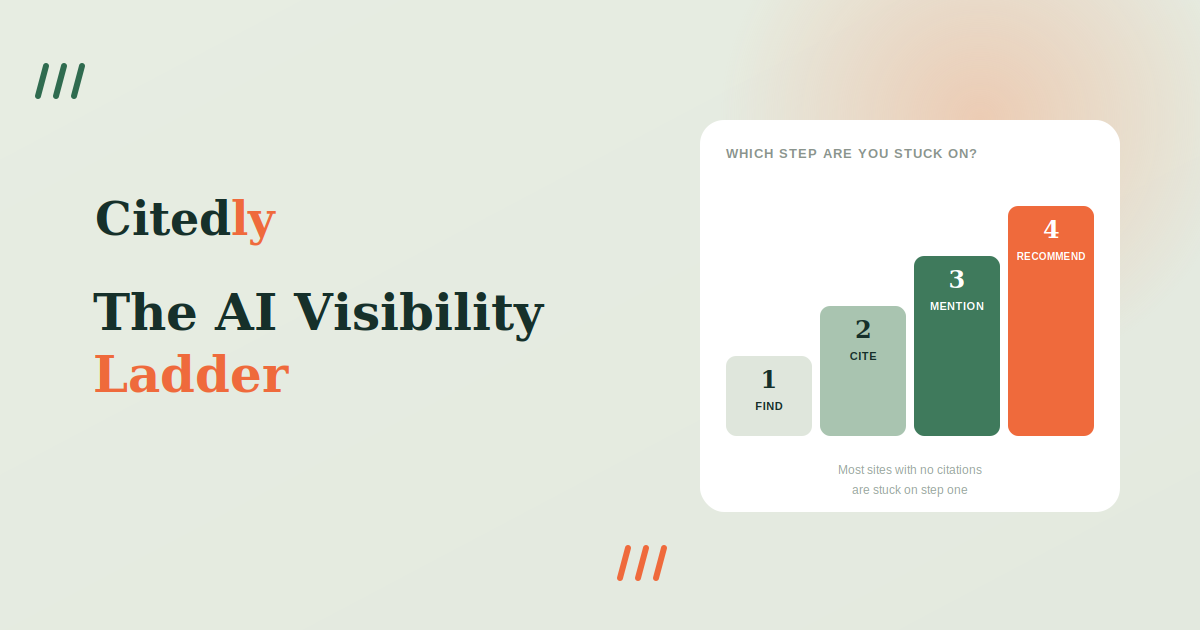
TL;DR: AI visibility is not one tactic, it is a progression through four stages: Find, Cite, Mention and Recommend. A brand rarely jumps from invisible to recommended. It gets stuck at a specific stage, and each stage has a different fix. Knowing which one you are stuck on is more useful than any single AI visibility score, because it tells you what to actually change.
Why I Stopped Thinking About AI Visibility as One Thing
Over the past year of working on this, one thing has become clear to me: AI SEO is not a single tactic you either do or do not do. It is a progression, and brands get stuck at different points along it.
A company almost never goes from invisible to being the one ChatGPT recommends. It moves through stages, and each stage fails for a different reason.
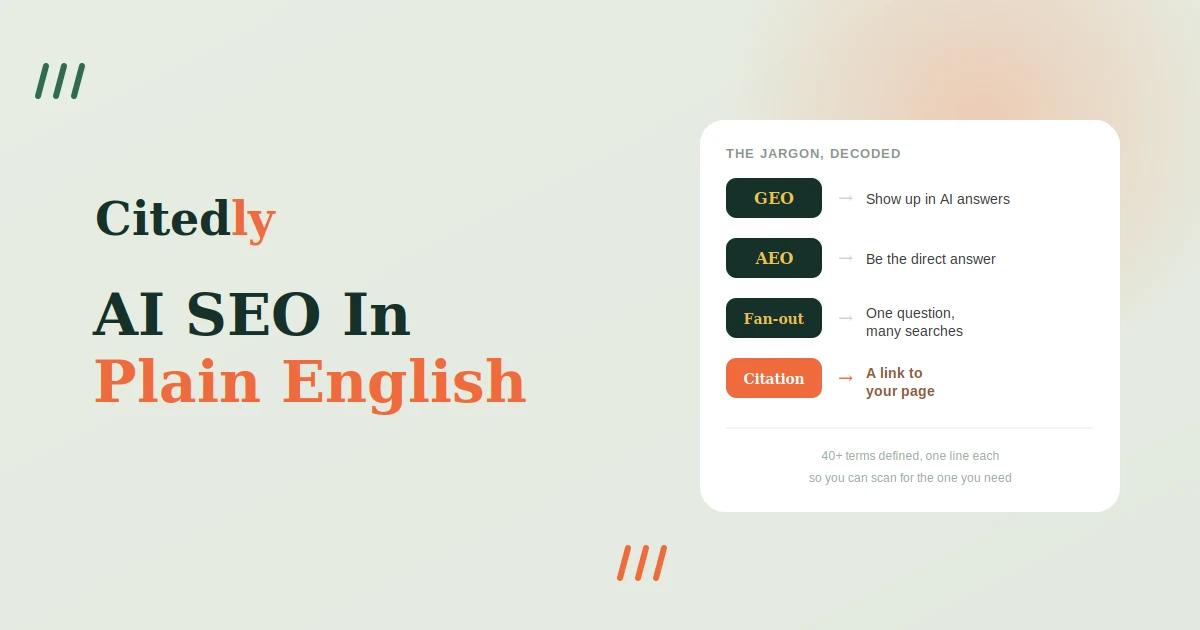
We have a separate guide that defines the vocabulary, from GEO and AEO to citation share. This piece is the other half of that: not what the words mean, but how I actually use them to work out what is wrong with a specific site. If the terminology is new to you, start with the AI SEO guide and come back.
I use four stages when I look at a site now:
Find → Cite → Mention → Recommend
The reason I find this more useful than a generic AI visibility score is simple. A score tells you that you are doing badly. The ladder tells you where, which is the only part that changes what you do on Monday.
If AI cannot find you, there is no point worrying about citations. If AI can find you but never cites you, you probably have a usefulness or extraction problem. If it cites your pages but never names your company, that is an attribution or entity problem. And if it names you but recommends someone else, the problem is usually trust and proof rather than content.
| Stage | What it means | The question it answers |
|---|---|---|
| Find | AI systems can discover and access your pages | Can the system reach and understand my site? |
| Cite | Your content is useful enough to support an answer | Is my content being used as evidence? |
| Mention | The system recognises your brand as an entity | Does AI know who I am and what I do? |
| Recommend | The system is confident enough to suggest you | Does AI trust me enough to choose me? |
One caveat before the detail. This is not a literal sequence that every AI system follows for every query. A brand can be mentioned from third-party sources without its own site ever being cited. I use the ladder as a diagnostic model because it separates problems that otherwise look identical from the outside.
Stage One: Can AI Actually Find You?
This is the foundation, and it is where most of the sites I look at are actually stuck. Before I think about content, brand or recommendations, I check whether the systems can reach the pages that matter.
When a company tells me they barely appear in AI answers, I do not start by suggesting twenty more articles. I check whether the existing pages can be crawled, rendered and understood.
What Breaks at the Find Stage?
The usual suspects are mechanical rather than strategic, which is why they get missed by people thinking about content strategy.
- AI crawlers blocked in robots.txt, often left over from a build.
- A CDN or firewall refusing those crawlers above robots.txt, which nobody thinks to check.
- Content that only appears after JavaScript runs, so the crawler sees an empty page.
- Missing or stale sitemaps, so new pages take weeks to be discovered.
- Canonical and duplicate-URL problems that split signals across two addresses.
The full list of which bots do what, and the exact robots.txt lines, is in our AI crawlers reference. If you are being skipped and cannot work out why, the diagnostic is in why AI isn't citing your website. When the underlying problem is crawling, rendering or indexation, that is what Citedly's technical SEO service exists to fix.
The Discovery Problem Nobody Sees
Here is the part that surprises people most. A lot of what looks like an AI visibility problem is not a visibility problem at all. It is a measurement problem, and the two are easy to confuse because both look like silence.
A Client Example: Months of Silence That Was Not Real
On one client site we work on, the AI citation reporting showed nothing for months. The obvious conclusion would have been that AI simply never cited them, and that the content needed rebuilding.
The actual reason was duller. Nobody had connected the site to Bing Webmaster Tools, so there was no report to read. Once the account was set up and the sitemap submitted, citation data started appearing within about a week.
What the Report Actually Showed
In the first days of reporting, that site logged 318 citations across roughly nine cited pages per day, peaking at 128 citations on a single day.
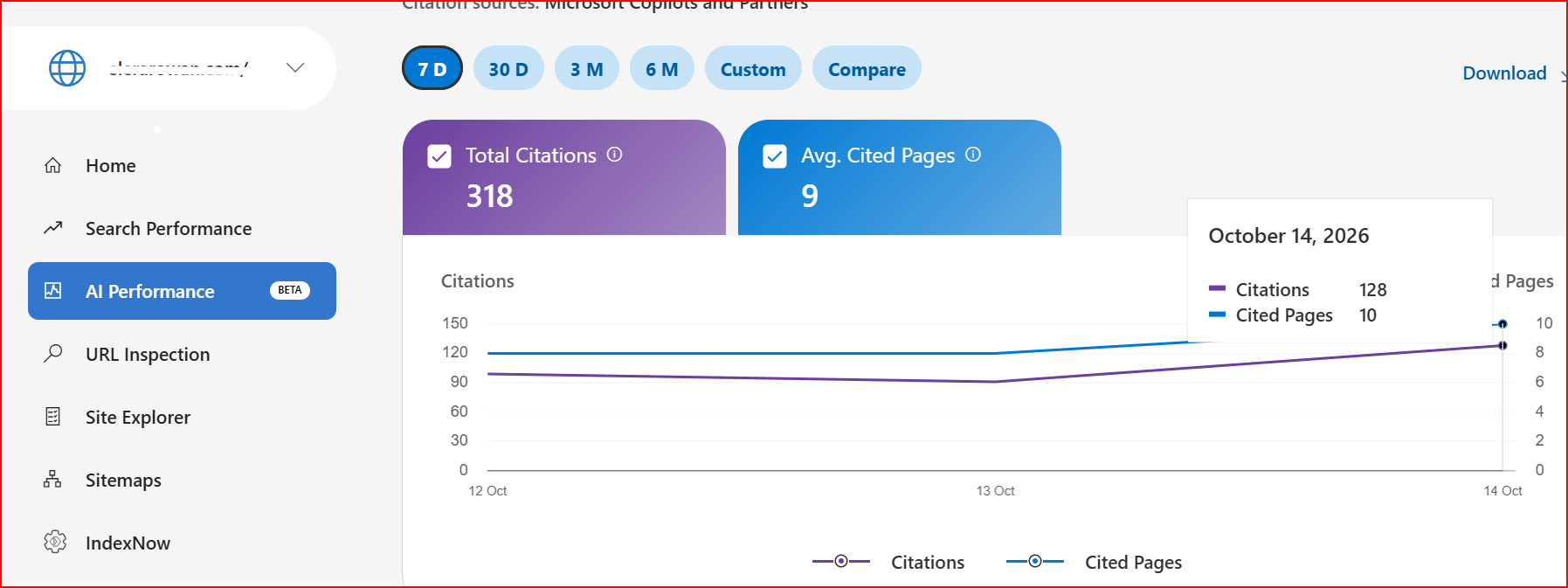
For a site whose owner believed AI had never cited them, that is a large gap between what was happening and what anyone knew about it.
What This Does and Does Not Prove
I want to be precise here, because this is the kind of story that gets oversold. Submitting a sitemap does not create citations. The brand did not become citable in seven days.
What setting up the account did was two things: it gave us sight of citations that were, in all likelihood, already happening, and it probably sped up discovery of newer pages. That is a reporting win plus a crawling win, not a ranking miracle. Anyone selling you the second version is selling you something.
The practical lesson is the one I would want a business owner to take away. Before you conclude that AI ignores you, check whether anyone has ever actually looked. It is free, it takes about twenty minutes, and our guide on tracking your AI citations covers how.
Stage Two: Is Your Content Useful Enough to Be Cited?
Once a site can be found, the next question is whether AI actually uses it. A citation means a model found a page useful enough to lean on as evidence for part of an answer.
Being indexed gets you into the library. Being cited means the system actually picked up your book.
What Makes a Page Citable?
This is the one stage with solid research behind it rather than just practitioner opinion. The Princeton-led team that introduced the term generative engine optimization tested nine content changes across roughly 10,000 queries, published at KDD 2024. Adding citations, quotations and statistics lifted visibility in AI answers by up to 40%. Keyword stuffing did nothing.
What I look for on a page now:
- A direct answer in the first one or two sentences under each heading.
- Clear definitions that can stand alone outside the page.
- Tables and comparisons, which are structurally easy to lift.
- Specific numbers, named sources, and dates rather than vague claims.
- Original data, which is the one thing a competitor cannot also supply.
- Passages that make sense without the surrounding context.
Across our own content, the pattern holds in a way I did not expect. The pages that earn the most citations are not the broadest ones. They are the narrow ones that answer a specific question cleanly, like the difference between AI citations and backlinks or what GEO actually costs. Breadth gets you traffic. Specificity gets you cited.
The formatting method is in how to structure content for AI.
Stage Three: Does AI Know Who You Are?
Here is where this model gets more interesting than most AI SEO advice, because citation and mention are not the same thing and almost nobody separates them.
A page can be cited without the company behind it being named. The model trusted the information, but the brand did not survive into the answer.
This is why I pay close attention to ghost citations. When a page gets used but the company is never credited, the content is working better than the entity behind it. That is a fixable problem, and it is a different fix from writing more content.
What Signals Help AI Recognise Your Brand?
The mention stage is about being a recognisable entity rather than a useful document. The things that move it:
- Consistent business name, URL and description across every profile.
- A real author identity with verifiable credentials, not a byline with no footprint.
- An About page that states plainly what the company is and does.
- Organization schema with a sameAs property linking your real profiles.
- Third-party references that describe you the same way you describe yourself.
Ahrefs studied 75,000 brands in May 2025 and found branded web mentions correlated with AI visibility at 0.664, against 0.218 for backlink counts. Correlation is not causation, and Ahrefs says so. But it matches what I see: the brands AI names confidently are the ones described consistently in several places.
The difference between the two signals, and what each is worth, is in AI citations vs mentions.
Stage Four: Does AI Trust You Enough to Recommend You?
Recommendation is the hardest stage, and the most commercially valuable. A model may know you exist. It may cite your content. Recommending you is a different level of confidence, because the model is putting its own credibility behind a name.
Why Is Recommendation Mostly a Trust Problem?
Because the strongest recommendation signals sit outside your own website, where you do not control them. That is exactly what makes them worth something.
- Reviews on platforms your buyers actually read.
- Inclusion in other people's comparison and "best of" pages.
- Genuine discussion in forums and communities.
- Customer stories published by the customer, not by you.
- Consistent category positioning, so it is obvious what you are a candidate for.
You can write the best page on the internet about your category and still not be recommended in it, because recommendation is not a content problem. It is an evidence problem. The practical playbook is in getting your business mentioned in AI, and the ChatGPT-specific version in getting ChatGPT to recommend your business.
This is also why the stage matters commercially. The gap between being mentioned and being recommended is the gap between someone knowing your name and someone being told to hire you.
Where Is Your Brand Stuck?
This is the part I actually use. Match the symptom to the stage, and the fix becomes obvious.
| If this is happening | Your likely problem | Where to start |
|---|---|---|
| You do not appear anywhere, in any engine | Find | Crawler access, rendering, sitemaps |
| Your pages are rarely used as sources | Cite | Answer-first structure, specifics, original data |
| Your pages are cited but your brand is absent | Mention | Entity consistency, author identity, schema |
| Your brand is named but competitors get recommended | Recommend | Reviews, third-party proof, category positioning |
| You cannot tell which of these applies | Measurement | Set up Bing Webmaster Tools and a prompt set |
That last row is more common than the other four combined, which is why I put the measurement story at the start of this article rather than the end.
I no longer ask only whether a brand is showing up. I ask four questions: are we being found, are we being cited, are we being mentioned, and are we being recommended. Each one has a different answer and a different fix.
What Changed in AI Visibility This Year?
Four things shifted in 2026 that change where the ladder is hardest, and most advice online has not caught up with any of them. Each one hits a specific stage.
| What changed | When | Which stage it affects |
|---|---|---|
| Bing began reporting AI citation data to site owners | February 2026 | Measurement, across all stages |
| ChatGPT leaned further into its own search index | Through 2026 | Find |
| Google's AI Mode passed one billion monthly users | Reported July 2026 | Recommend |
| CDNs added granular AI crawler controls | 2025 into 2026 | Find |
Why Does Bing's Citation Report Matter So Much?
Because until February 2026 there was no free, first-party way to see whether AI was citing you at all. Microsoft added an AI Performance report to Bing Webmaster Tools, which reports your total citations, your most-cited pages, and the queries AI used to retrieve your content.
That is the single most useful free thing available to a small business right now, and almost nobody has it switched on. It is also why the measurement row in the diagnostic table above is the most common answer I give.
Why Is the Find Stage Getting Harder, Not Easier?
Two reasons, pulling in the same direction. ChatGPT has been building out its own retrieval rather than relying on a single third-party index, which means the old advice to simply rank in Bing no longer describes how you get found. And CDNs have added far more granular AI crawler controls, which is good for publishers who want to opt out and quietly disastrous for businesses who do not realise a default setting is blocking them.
The practical consequence is that Find has become less about SEO and more about configuration. What ChatGPT's own index means for visibility is worth reading alongside this.
Why Does Scale Make Recommendation the Stage to Watch?
Because the volume is no longer marginal. Alphabet reported in July 2026 that AI Mode had surpassed one billion monthly active users, with the Gemini app at 950 million.
When that many questions are being answered conversationally, the difference between being named and being recommended stops being a nuance and starts being the whole commercial outcome. A year ago I would have told most small businesses to fix Find and Cite and worry about Recommend later. I would not say that now.
Does Any of This Replace Traditional SEO?
No, and I would be suspicious of anyone who says it does. Every stage of this ladder sits on top of work that looks like ordinary SEO: crawlable pages, clear structure, consistent information, and a reputation that exists somewhere other than your own marketing.
What changes is the goal. You are no longer optimising for a position in a list. You are optimising for whether a system can find you, use you, name you and vouch for you.
Pew Research tracked the browsing of 900 US adults in March 2025 and found people clicked a traditional result on 8% of visits where an AI summary appeared, against 15% where none did. Clicks roughly halve. That is the whole reason the ladder matters: when fewer people click, being named inside the answer does the job the click used to do.
Frequently Asked Questions
What Is the AI Visibility Ladder?
The AI Visibility Ladder is Citedly's diagnostic model for AI visibility, describing four increasing levels of machine confidence in a brand: Find, Cite, Mention and Recommend. Rather than producing a single score, it identifies which stage a brand is stuck at, because each stage fails for different reasons and needs a different fix.
What Is the Difference Between Being Cited and Being Recommended?
A citation means an AI used your page as evidence for part of an answer. A recommendation means it suggested your business as an option worth choosing. Citation is about your content being useful. Recommendation is about your brand being trusted, and it depends far more on evidence from sources other than your own website.
How Do I Know Which Stage I Am Stuck On?
Run a fixed set of 15 to 20 real buyer questions through the major AI engines and record what happens. No appearance at all points to Find. Pages used as sources with no brand named points to Mention. Brand named but a competitor chosen points to Recommend. Also check Bing Webmaster Tools, which reports citation data most people never look at.
Can a Brand Skip Stages?
Sometimes, which is why I call it a diagnostic rather than an algorithm. A brand with strong third-party coverage can be mentioned or even recommended before its own site is ever cited, because the model is drawing on other sources. The ladder describes states of confidence, not a fixed order every system follows.
How Long Does It Take to Move Up a Stage?
Find problems are usually same-week fixes, with citations following in a few weeks once pages are recrawled. Cite problems take as long as it takes to rewrite your important pages. Mention and Recommend compound more slowly, typically over two to three months, because they depend on sources you do not control.
Why Do I Get Cited but Never Named?
That is a ghost citation, and it usually means your entity signals are weaker than your content. The model trusted the page but either could not confidently identify the company behind it, or had no reason to name it. Fix it with consistent business details everywhere, Organization schema, a real author identity, and third-party references that describe you the same way.
Do I Need a Paid Tool to Track This?
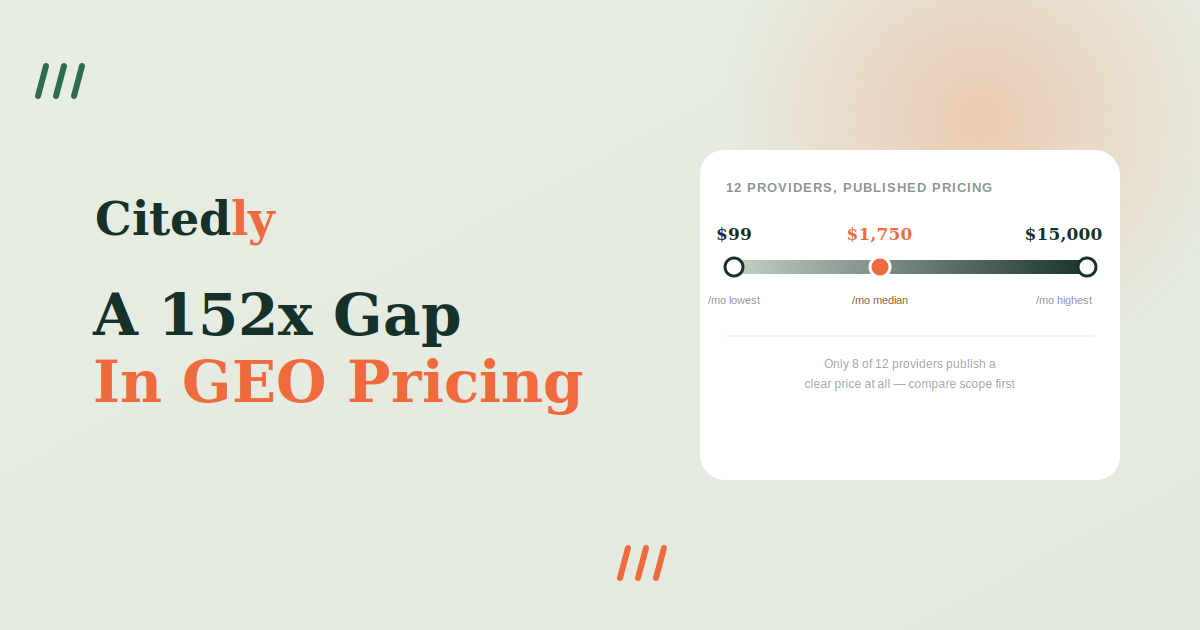
No. Bing Webmaster Tools reports real citation data free, GA4 shows AI referral traffic, and a spreadsheet of buyer prompts run weekly covers most of what a small business needs. Paid tools make sense once prompt volume or competitor benchmarking outgrows manual checking, not before.
Where to Start
If you take one thing from this: stop asking whether you are visible in AI and start asking which of the four stages you are failing at. The fixes are different, and working on the wrong one is how people spend three months and see nothing change.
The cheapest first move is measurement. Connect Bing Webmaster Tools, check its AI Performance report, and write down twenty questions your buyers actually ask. You may find, as that client did, that you were further up the ladder than you thought and simply could not see it.
Find Out Which Stage You're Stuck On
Run your real buyer prompts across five AI engines and see whether you are being found, cited, mentioned or recommended, free, in about 60 seconds. Or book a call and we will walk the ladder with you.
Keep exploring
Read More from Citedly
AI Visibility Guide
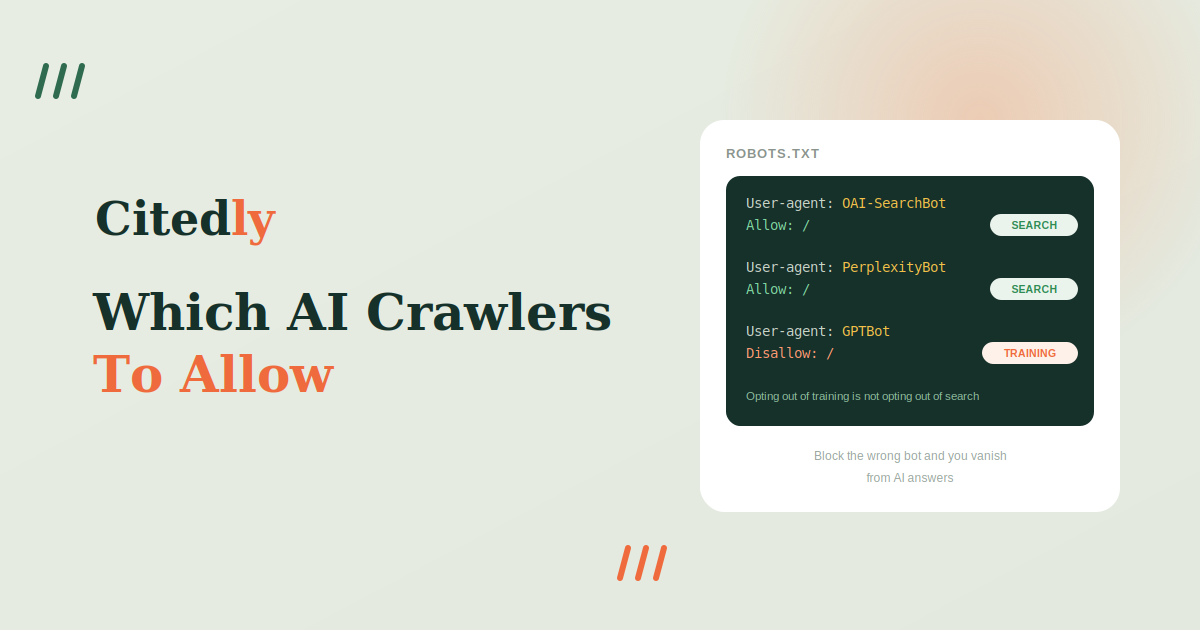
AI Crawlers: Complete List, Robots.txt Rules and Which Ones to Allow
Read article →