AI Visibility Guide
Why Isn't AI Citing My Website? 8 Reasons You're Getting Skipped (and How to Fix Each)
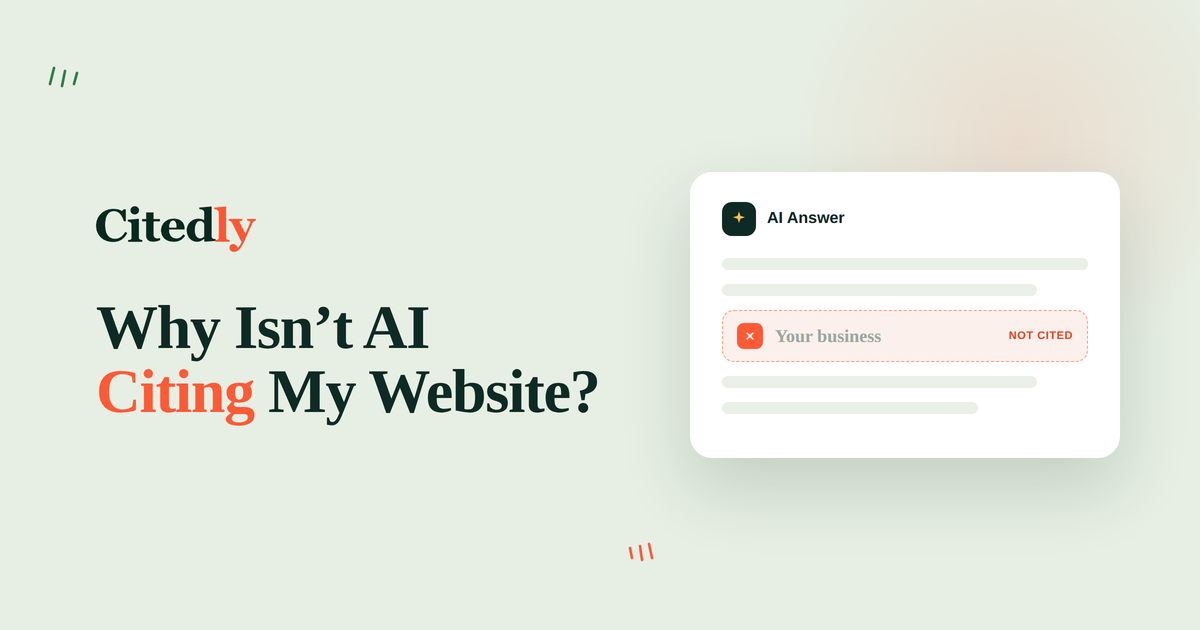
What "AI Isn't Citing My Website" Actually Means
Before you fix anything, it helps to name the gap precisely, because two different problems hide under the same complaint. A citation is a linked source an engine like Perplexity or Google's AI Overviews attaches to its answer, pointing back to your page. A mention is your brand name appearing in the answer text of a tool like ChatGPT or Claude, with or without a link. They're earned differently: citations come from content the engine can retrieve and extract cleanly, while mentions come from your brand being well-established across the web. (We cover the full distinction in our guide on what AI citations are and how to get cited by AI.)
For most businesses reading this, the complaint is both at once: AI never links to their pages and never says their name. The good news is that the same eight blockers explain nearly all of it, and none of them require you to be a bigger company. They require you to be a readable, trusted, well-structured one.
How to Diagnose Why AI Isn't Citing Your Website
Start by finding out which blockers are actually yours. Running the wrong fix is how people burn a month and see nothing change. This diagnostic takes about 20 minutes and points you straight at the culprit.
| Symptom You're Seeing | Likely Reason | 2-Minute Check |
|---|---|---|
| AI never links to your pages | Not indexed in Bing, or crawler blocked | Search site:yourdomain.com in Bing; open yourdomain.com/robots.txt |
| ChatGPT names competitors, not you | Weak entity + no third-party mentions | Search yourbrand site:reddit.com and check G2 / Trustpilot |
| Your page ranks but isn't cited | Answer buried, not extractable | Read your own page: is the answer in the first two sentences? |
| AI states wrong facts about you | Inconsistent business details | Check your name, URL, and description across every profile |
| You appear in Perplexity but not ChatGPT | Different source pools per engine | Normal — they read different parts of the web |
Run each check, write down which rows match you, and fix those first. Now the eight reasons in full.
The 8 Reasons AI Isn't Citing Your Website
If your website is not appearing in ChatGPT, Perplexity, Gemini, or Google AI Overviews, the problem is rarely limited to content quality. AI citation visibility depends on whether the engines can discover your website, understand your business, extract a clear answer, and verify your claims through trusted third-party sources.
The table below summarises the eight most common reasons a website is not being cited by AI and the primary fix for each issue.
| # | Citation Barrier | Recommended Fix |
|---|---|---|
| 1 | Limited visibility in Bing's search index | Verify the site in Bing Webmaster Tools, submit the sitemap, enable IndexNow, and import Google Search Console settings where appropriate. |
| 2 | AI search bots cannot access the website | Review robots.txt and permit OAI-SearchBot, PerplexityBot, ClaudeBot, Bingbot, Googlebot and GPTBot. |
| 3 | Core page content is hidden behind JavaScript rendering | Use server-side rendering, or ensure headings, answers, service details and body copy sit in the raw HTML. |
| 4 | Key answers are difficult for AI to extract | Place concise, self-contained answers directly below each heading and split long sections into labelled subsections. |
| 5 | The website lacks commercial comparison content | Publish credible "best", "alternatives" and comparison pages covering pricing, suitability, strengths and limitations. |
| 6 | The brand entity is inconsistent across the web | Standardise name, URL, description, services and profile details across the site, directories, social channels and schema. |
| 7 | Independent sources do not validate the brand | Build third-party mentions via reviews, Reddit, industry roundups, forums, directories, podcasts and publications. |
| 8 | Important pages have lost content freshness | Refresh statistics, examples, screenshots and schema dates while keeping an accurate visible "last updated" date. |
Reason 1: You're Not Indexed in Bing
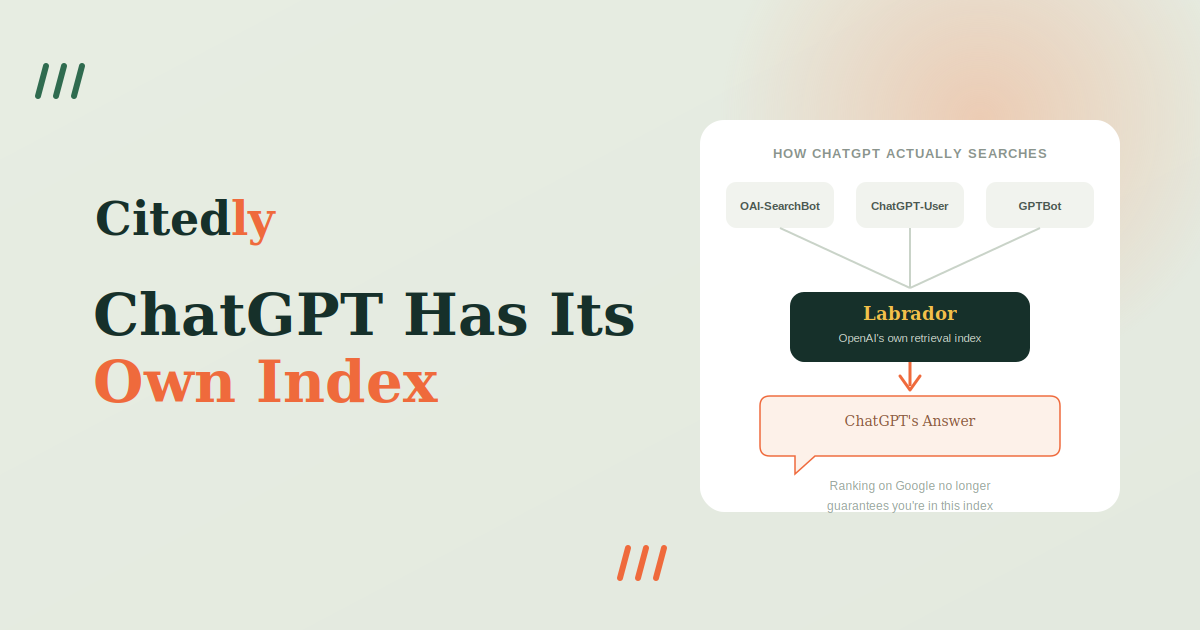
The most common cause is also one of the most overlooked. ChatGPT's live search pulls from Bing's index, not only Google's — the full Bing-first playbook is in how to get cited by ChatGPT. Seer Interactive found that 87% of ChatGPT citations matched Bing's top organic results for the same query.
If Bing has not indexed your website, a large share of AI search answers may not be able to discover or cite it, even when the website performs well in Google.
The fix
- Verify your website in Bing Webmaster Tools.
- Submit the XML sitemap.
- Turn on IndexNow so new and updated pages are crawled faster.
- Use Bing's Import from Google Search Console feature when available.
How to verify
Search site:yourdomain.com in Bing. Confirm that your important pages appear. After publishing a new page, check again within roughly 48 hours to confirm IndexNow is functioning.
Reason 2: AI Crawlers Are Blocked in Your robots.txt File
A fully indexed website can still be excluded from AI answers when its robots.txt file blocks the crawlers used by AI search engines. This often happens because restrictive rules were added during development and never removed before the website went live.
The fix
Open yourdomain.com/robots.txt and confirm that these crawlers are not blocked:
- OAI-SearchBot
- PerplexityBot
- ClaudeBot
- Bingbot
- Googlebot
- GPTBot
How to verify
Review the file for rules such as User-agent: OAI-SearchBot followed by Disallow: /. A Disallow: / instruction prevents that crawler from accessing the entire website. After updating the file, reopen it and confirm the restriction has been removed.
Reason 3: Your Content Only Loads With JavaScript
Some websites load their primary content through JavaScript after the initial page has opened. AI fetchers may not execute JavaScript the way a conventional browser does. As a result, the page may look complete to a visitor while appearing nearly empty to an AI crawler.
The fix
- Use server-side rendering for important pages.
- Ensure the main text is present in the raw HTML.
- Keep headings, definitions, answers, product details and service information accessible without requiring scripts to run.
How to verify
Right-click the page and select View Page Source, then search for a sentence from the main content. If that sentence does not appear in the source code, the content may not be accessible to some AI crawlers.
Reason 4: Your Answer Is Buried Too Deep on the Page
AI engines extract clear, self-contained passages. A page that delays the answer behind several paragraphs of background gives the model very little usable content near the top of the section. A competitor that answers the same question immediately is easier to cite. The formatting rules behind that are in how to structure content so AI will quote it.
The fix
- Put the direct answer in the first one or two sentences below each heading.
- Add supporting context after the answer.
- Use an answer capsule of fewer than 100 words.
- Break sections longer than roughly 300 words into smaller subsections.
- Include a clear number, example, definition or recommendation where relevant.
How to verify
Read only the first two sentences below each H2 heading. Those sentences should answer the heading without requiring the reader to continue. Then test the same question in Perplexity and watch whether the page begins appearing in its source panel after indexing.
Reason 5: You Have No Comparison or "Best Of" Pages
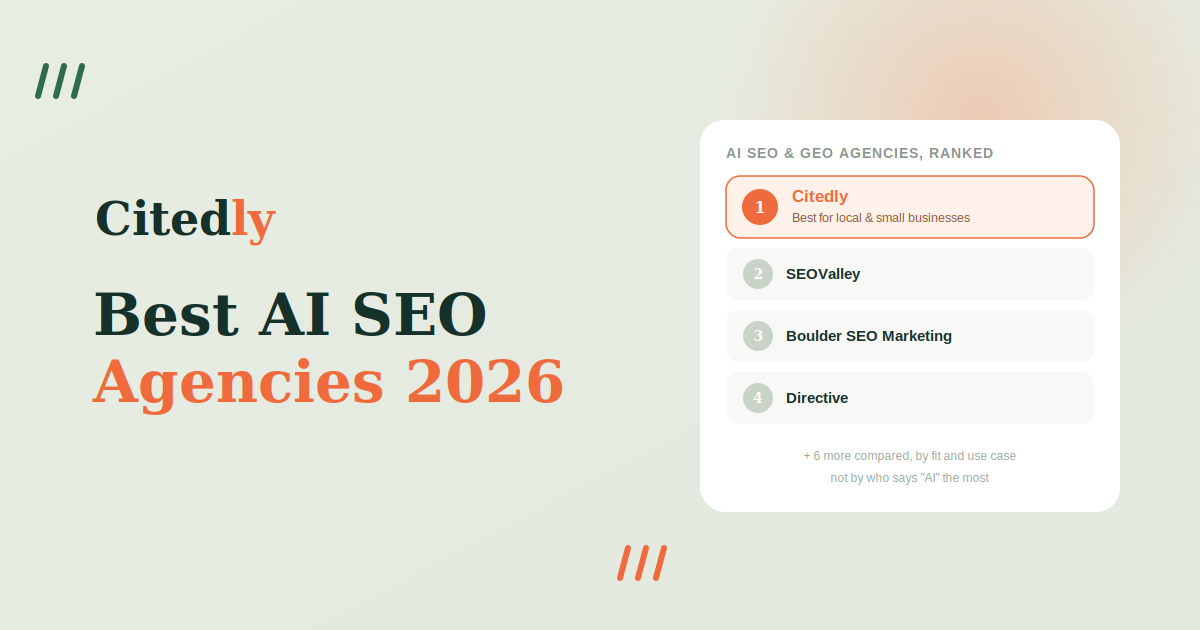
AI engines frequently name companies in commercial investigation queries such as "best AI SEO agencies", "best accounting software for startups", "Company A vs Company B", or "top alternatives to a specific platform". When your website does not address these queries, AI systems rely on the publishers and competitors that already created comparison content.
The fix
Publish useful, balanced pages covering:
- Best options in your category
- Competitor alternatives
- Product or service comparisons
- Pricing differences
- Ideal customer profiles
- Strengths and limitations
- Situations in which each option is most suitable
Your business can be included, but the comparison should stay credible and useful rather than reading like a promotional page.
How to verify
Ask ChatGPT and Perplexity: What are the best [your category] services for [your target customer]? Record the companies mentioned and repeat the test monthly after publishing and indexing your comparison pages.
Reason 6: Your Business Details Are Inconsistent
AI systems need to understand that references across your website, LinkedIn, directories, review platforms and other sources belong to the same company. Inconsistent names, URLs, descriptions, addresses or service information weaken that connection. That creates a weak brand entity and makes the model less confident about citing the business.
The fix
Standardise the following across all platforms:
- Official business name
- Primary website URL
- One-line company description
- Logo
- Address and service area
- Social profile URLs
- Product and service descriptions
Add Organization schema to the homepage and use the sameAs property to connect relevant social, directory and company profiles. A Wikidata entry may also provide a structured entity reference when the company meets the platform's requirements.
How to verify
Search your brand name in Google and see whether a Knowledge Panel appears. Then ask ChatGPT: What is [your brand]? Check whether the returned description, URL and category are accurate.
Reason 7: You Have No Third-Party Corroboration
Your own website is a first-party source that you control. AI engines often look for independent evidence before confidently recommending or citing a company. Ahrefs' analysis of approximately 75,000 brands found that branded web mentions, whether linked or unlinked, were strongly correlated with AI visibility — about three times more strongly than backlinks.
A business that appears only on its own website gives the model fewer sources through which it can confirm the brand's relevance and reputation.
The fix
Earn genuine mentions through:
- Relevant Reddit discussions
- G2, Trustpilot and other review platforms
- Industry roundups
- Specialist directories
- Quora and niche forums
- Podcast appearances
- Founder interviews
- Media and trade publications
- Customer case studies published by third parties
Prioritise platforms according to the AI engine. Perplexity frequently cites community-driven sources, while review sites and established publications help strengthen brand recognition across multiple engines.
How to verify
Search yourbrand site:reddit.com. You can also ask ChatGPT: What do customers say about [your brand]? Review whether the response references independent sources or relies only on your own website.
Reason 8: Your Content Is Stale
AI engines often prefer recently maintained content, particularly for topics involving products, pricing, technology, regulations, recommendations and market trends. Ahrefs' analysis of 17 million citations found that AI-cited pages were on average roughly 26% newer than conventional organic search results.
An older page may therefore lose citation opportunities to a more recently updated competitor, even when the older page is more detailed.
The fix
- Review important pages on a fixed schedule.
- Update outdated statistics and examples.
- Add the current year where it improves relevance.
- Refresh screenshots, pricing, product features and recommendations.
- Display an accurate "last updated" date.
- Update the
dateModifiedfield in Article schema. - Remove information that is no longer accurate.
How to verify
Run your target queries in Perplexity and review the publication or update dates of the cited sources. When most cited pages are recent and your page hasn't been updated for years, freshness is likely contributing to the citation gap.
"But I Rank #1 on Google" — Why Rankings Don't Guarantee AI Citations
This is the objection we hear most, and it deserves a direct answer: ranking on Google and getting cited by AI are two different games, won with different moves. You can hold position one and still never appear in an AI answer.
The data backs this up plainly. An analysis by seoClarity found roughly 25% of the URLs AI cites most have no Google organic visibility at all. Surfer's research put it another way: about 68% of AI-cited pages don't sit in Google's top ten for the query. And Semrush found that close to 90% of the pages ChatGPT cites rank position 21 or worse on Google. The engine isn't reaching for the top-ranked page. It's reaching for the most readable, extractable, well-corroborated one for that exact question.
"The question a model is really asking before it surfaces you is whether it can pull a clean, defensible answer from your page without guessing. Pages that answer directly get cited; pages that make the model infer across sections get skipped."
— Paraphrased from the extractability principle in the Princeton GEO study (Aggarwal et al., KDD 2024), which found that adding statistics, citing sources and including quotations lifted AI visibility by up to 40%.
So if you rank well but never get cited, don't add more backlinks — and that's not just a figure of speech, as the data in AI citations vs backlinks shows. Look at reasons 2, 3 and 4 first: the model probably can't fetch, read or extract your answer, even though Google can.
Fix It in Order: A Prioritized Action Plan
Not every fix is worth the same effort, and some unblock the others. Start at the top of this table and work down. Effort is your time and technical lift; impact is the expected change in whether AI cites you.
| Fix | Effort | Impact | How to Verify It Worked |
|---|---|---|---|
| Verify in Bing + submit sitemap | Low | High | site:yourdomain.com in Bing returns your pages |
| Unblock AI crawlers in robots.txt | Low | High | No Disallow for OAI-SearchBot / PerplexityBot |
| Move answers to the top (answer capsules) | Low | High | First two sentences answer each heading |
| Fix inconsistent business details + add Organization schema | Medium | High | Google Knowledge Panel appears; ChatGPT states correct facts |
| Fix JavaScript-only rendering | Medium | High | Content shows in "View Source" |
| Build comparison / "best of" pages | Medium | High | You appear for "best [category]" prompts |
| Earn Reddit + review-site mentions | Medium | High | Third-party threads surface in Perplexity |
| Refresh stale pages | Low | Medium | Updated dates; cited pages trend recent |
The first three rows are same-day changes that unblock everything else. Do them this week before touching content strategy. If you'd rather not work through the table yourself, our AI visibility plans run the whole list for you.
How to Confirm AI Is Actually Citing You Now
You can't manage what you don't measure, and AI visibility won't show up in your normal analytics. Keep score with a simple weekly routine:
- Run a fixed prompt set. Write 15–20 prompts a real buyer would ask, then run them across ChatGPT, Perplexity, Gemini and Google AI Mode each week. Log when you're named, when a competitor is, and where you're absent.
- Watch AI referrals in GA4. ChatGPT passes a
chatgpt.comsource, so you can filter for the traffic AI sends you. - Set up proper measurement. Our guide on how to track your AI citations covers the free first-party sources and the four metrics worth watching.
- Use Bing's AI-visibility metrics. Microsoft added these to Bing Webmaster Tools in June 2026 — free, and a useful proxy given Bing's role in ChatGPT.
- Track the trend, not the single hit. What matters is whether your share of the answers in your category climbs month over month.
When to Fix This Yourself vs. Let Citedly Do It
Every fix above is something a capable owner can do. The honest catch is that there are eight of them, each has a way to quietly go wrong, and they need re-checking every month as engines change. Doing it once is manageable. Keeping it working while you run the business is where most people stall.
That's what Citedly handles: we run the full diagnosis, fix all eight blockers, build the comparison pages and third-party presence, and track your citations every month so you can see it working. It's the same list on this page, run for you, from $299 a month with no contract. We built it for small and local businesses on purpose, because the agencies doing this priced it out of reach. If you want a human to walk you through your specific gaps, book a free call and we'll show you where you stand.
Frequently asked questions
Why doesn't ChatGPT recommend my business?
Usually one of a few fixable things: you're not indexed in Bing (which powers ChatGPT's search), an AI crawler is blocked in your robots.txt, your answer is buried below the top of the page, or you have no third-party mentions for the model to trust. Check those in that order — our full guide to getting cited by AI walks through each.
Why do I rank on Google but not in AI?
Because they're separate systems. seoClarity found about a quarter of the URLs AI cites most have zero Google organic visibility, and Semrush found roughly 90% of ChatGPT-cited pages rank position 21 or worse. Ranking proves Google can read you; it doesn't prove an AI engine can fetch and extract your answer.
Why is AI showing wrong information about my business?
Your entity signals are inconsistent. When your name, pricing or details differ across the web, AI fills the gap with whatever it's most confident about, right or wrong. Fix it by standardising your details everywhere, adding Organization schema, and creating a Wikidata entry.
Can a brand-new website get cited by AI?
Yes. Because AI rewards clean structure and usefulness over domain age, a new site that answers a specific question well and earns a few third-party mentions can get cited while older, less focused competitors are skipped.
How fast can I fix this?
The technical blockers (Bing, crawlers, buried answers) are same-week fixes, and citations for specific questions can follow within a few weeks once pages are re-crawled. Entity and third-party authority compound more slowly, over two to three months.
See Where AI Puts Your Business Today
Run your real buyer prompts across five AI engines and find out whether you get named, free, in about 60 seconds. Or book a call and we'll walk you through it.
Keep exploring
Read More from Citedly