AI Search Data
AI Search Statistics 2026: The Data Behind AI Citations, Mentions & Visibility
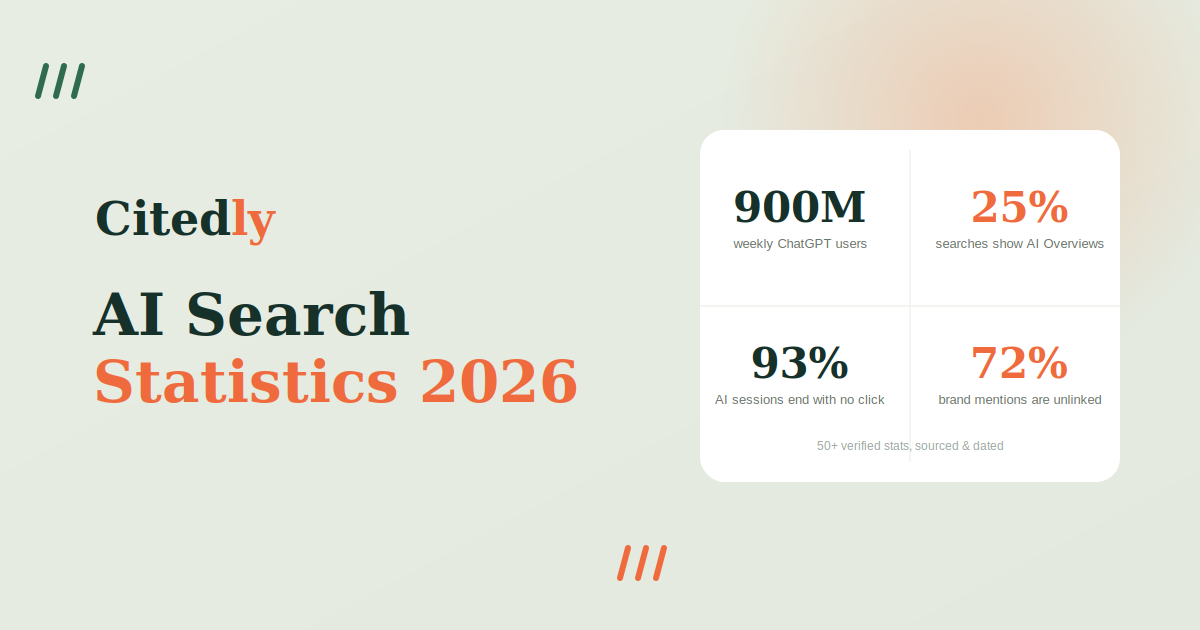
The through-line: attention has moved into the answer, and the answer rewards being mentioned and well-structured over being ranked. Everything below expands on that.
AI Search Adoption and Usage
Adoption stopped being a forecast and became the baseline. Hundreds of millions of people now start their research inside an AI tool rather than a search box.
| Statistic | Source |
|---|---|
| ChatGPT reached ~900M weekly active users (Feb 2026), up from 400M a year earlier | OpenAI |
| Google's AI Overviews reach roughly 1.5 billion monthly users | |
| ChatGPT Search handles an estimated 250–500M queries per week | Axis Intelligence |
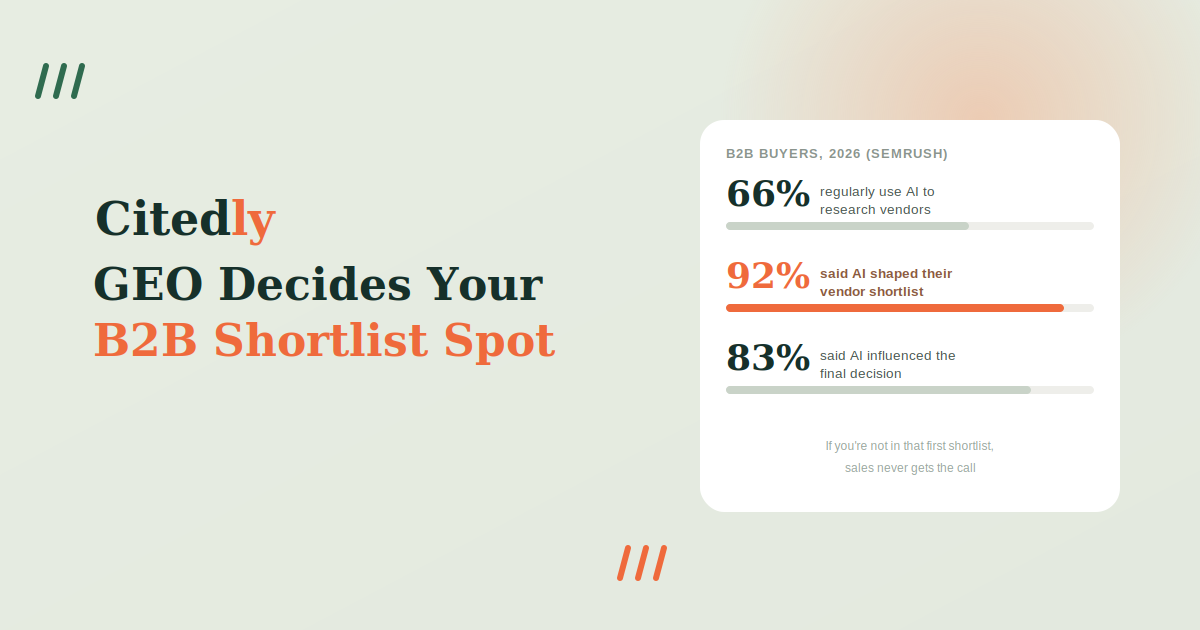
| 94% of B2B buyers used generative AI during their purchase process | 6sense |
| Gartner projected traditional search volume could fall ~25% by 2026 as AI tools absorb queries | Gartner |
For a small business, the takeaway is simple: a growing share of your future customers are asking an AI who to hire before they ever open Google. If you're not sure what "being the answer" even means yet, start with what AI citations are and how to get cited by AI.
AI Search Market Share: Usage vs Referral Traffic
Here's where a lot of "market share" claims get sloppy. There are two different numbers, and they don't agree: usage share (where attention is) and referral share (which engines actually send traffic to websites).
| Platform | Usage share (StatCounter, Apr 2026) | Notes |
|---|---|---|
| ChatGPT | ~77% | Dominant, but down from ~84% a year earlier |
| Gemini | ~9% | Growing on the back of Google integration |
| Perplexity | ~7.7% | Punches above its weight for research queries |
| Copilot | ~3.8% | Microsoft ecosystem |
| Claude | ~2.7% | But ~18.5% of B2B referral traffic (Goodie) — a big overperformance |
The honest read: ChatGPT leads by a wide margin, but it's now a multi-platform world, and the engine that matters most depends on your audience. That's exactly why single-engine tracking under-serves you, and why we recommend measuring across all of them in how to track your AI citations.
Google AI Overviews: How Common They've Become
AI Overviews are the most consequential shift, because they sit inside the search results your customers already use.
- They appear on roughly 25% of US Google searches as of late 2025 / early 2026, up from about 13% a year earlier (Conductor put it at 25.11%; Ahrefs at 25.8% across 300,000 keywords).
- They trigger on an estimated 40% of local-intent queries — "best plumber near me" increasingly returns a summary, not just a map (industry analysis).
- The keywords that trigger them have shifted from mostly informational toward commercial and buying queries over the past year (Semrush).
If you rank on Google but never appear in these summaries, that gap has a specific set of causes — we break them down in how to show up in Google AI Overviews.
The Zero-Click Reality
This is the stat set that scares publishers, and it's worth being precise about because the figures vary by how they're measured.
| Statistic | Source |
|---|---|
| ~93% of AI search sessions end without a click to a website | Superlines |
| AI Overviews cut click-through to the top result by 34.5% | Ahrefs |
| A randomized 2026 field experiment measured a ~38% drop in clicks | Pew Research |
| Some measurements put the CTR drop closer to 58% when an Overview appears | Seer Interactive |
The exact number depends on the study, but the direction is unanimous: when an AI answer appears, far fewer people click through. The visibility didn't vanish, it moved into the answer. If AI is skipping your business entirely, here's why that happens.
Who Gets Cited: The Source Winners
AI engines lean heavily on a handful of trusted platforms, and it's not who most business owners assume.
| Source | What the data shows |
|---|---|
| Wikipedia | Holds ~48% of ChatGPT's top-10 citation share (Profound, 680M citations) |
| ~21% of Google AI Overview citations (QuickSEOanalysis) | |
| YouTube | Overtook Reddit as the most-cited source across LLM answers overall (Adweek) |
| The most-cited domain for professional and B2B queries (Profound) | |
| G2 | The dominant source for software/tool queries in AI Overviews (Radix) |
Two findings reframe everything
- Only 17% of AI Overview citations come from pages in Google's organic top 10 (BrightEdge), and 80% of URLs ChatGPT cites don't appear in Google's top 100 at all.
- Ranking first no longer means being cited first. Citation is also concentrated: the top 1% of domains capture 64% of all citations (BrightEdge) — which is exactly why third-party presence on the platforms above matters more than another blog post on your own site.
For the ChatGPT-specific version of this, see how to get cited by ChatGPT.
Citations vs Mentions vs Backlinks
This is the shift most SEO advice hasn't caught up to, and it's the one that matters most for getting your name into AI answers.
- AI mentions a brand without a hyperlink about 72% of the time, so most brand visibility is unlinked.
- Unlinked brand mentions correlate with AI visibility at 0.664, versus just 0.218 for backlinks — roughly a 3x gap.
- YouTube mentions correlate even higher, at 0.737.
- 84% of AI citations come from earned media, not brand-owned pages (Muck Rack).
The plain-English version: being talked about now beats being linked to. We unpack what that means for your strategy in AI citations vs backlinks, and the practical playbook is in how to get mentioned in AI.
What Actually Earns AI Citations
The good news for a small business: these are things you can control, and none require a big domain.
| Statistic | Source |
|---|---|
| Adding statistics, citations, and quotations lifts AI visibility by up to 30–40% | Princeton GEO study (KDD 2024) |
| 44.2% of AI citations come from the first 30% of a page | SparkToro / Kevin Indig |
| 71% of AI-cited pages use structured data (schema) | Ahrefs |
| ChatGPT cites pages that are, on average, ~458 days fresher than organic results | Ahrefs |
| Heavily cited passages average ~20% named-entity density, 3–4x normal writing | Industry analysis |
Notice the pattern: front-load your answer, be specific, cite sources, add schema, keep it fresh. That's a formatting discipline, not a budget — and we turn it into a checklist in how to structure content so AI will quote it. One nuance worth flagging: Google's AI Overviews are the exception on freshness, slightly favoring older, more established pages, so "newest wins" isn't universal.
AI Traffic Is Smaller but Converts Harder
If you're tempted to dismiss AI traffic because the volume is still low, look at the quality.
- AI referral traffic is still only about 1% of all website traffic, but growing roughly 1% month over month (Conductor).
- Visitors from AI search convert far better than standard organic — Similarweb clocked AI referral conversion at ~7.1%, second only to paid search and several times the organic rate.
- They also spend ~68% more time on-site than traditional organic visitors (SE Ranking).
- During the 2025 holiday season, AI referral traffic to US retail sites grew 693% year over year (Adobe).
Small channel, high intent. Someone arriving because AI recommended you is much closer to buying than a random search click.
How Businesses Are Responding (the Opportunity Gap)
Here's the stat that should make you move: most of your competitors aren't doing this yet.
- Only about 23% of marketers currently invest in measuring AI visibility (Incremys).
- But 54% of US marketers plan to start on GEO within 3–6 months (eMarketer).
The window where being early is cheap is closing. The businesses that show up in AI answers now, while most are still ignoring it, are the ones that will be entrenched when everyone else piles in.
What These Numbers Mean for a Small Business
Strip away the noise and the data points one direction:
- Being named beats being ranked: Ranking #1 on Google no longer guarantees a mention, so optimize for the answer, not the results page.
- Mentions beat links: Spend your effort on reviews, roundups, and being talked about, not just on backlinks.
- Structure beats size: Answer-first, well-sourced, schema-marked pages get cited even from small sites.
- Early beats perfect: With most competitors not yet measuring AI visibility, showing up now is disproportionately valuable.
5 AI Search Trends Shaping 2026 (and Where Things Are Heading)
The statistics above are the current state. These five trends are the shifts underneath them, each backed by rising search demand and industry data from Ahrefs' 2026 analysis. If the numbers tell you where things stand, these tell you where they're going.
1. From "Am I Cited?" to "Does It Actually Convert?"
The shift: The first wave was about getting mentioned at all. The second is about whether those mentions do anything.
Searches for AI visibility tracking are climbing fast (Ahrefs clocked "ai search tracking" up 184%), and Google shipped a long-requested AI performance report in Search Console. But the harder question now is what a citation is worth — one SEO logged a 1,900% jump in ChatGPT citations to a page that drove almost no business.
Do this: Chase citations that send traffic and convert, not vanity mentions. Start by tracking your AI citations properly.
2. Optimizing for AI Agents, Not Just AI Answers
The shift: A growing share of your "readers" are AI agents acting on someone's behalf.
Cloudflare reported bot and agent traffic passed 50% of all internet traffic in mid-2026, spawning a fast-growing "agentic SEO" search cluster. Agents parse clean, structured text far more reliably than they render JavaScript.
Do this: The same answer-first, well-structured pages that win citations also make you readable to agents — no separate playbook needed yet.
3. Traffic Loss Is Turning From Panic Into a Plan
The shift: Zero-click isn't news anymore; diagnosing and recovering from it is.
AI Overviews are estimated to cut clicks to the top result by ~58%. The tell in your own data is the "crocodile mouth" — impressions holding steady while clicks fall away — which signals an AI Overview absorbing your traffic rather than a ranking drop.
Do this: If you see that pattern, don't build more backlinks. Understand why AI is intercepting your clicks and rebuild around answers you can still win.
4. Nobody Agrees What to Call This Yet
The shift: GEO, AEO, AI SEO, "agentic engine optimization" — the vocabulary is still splintering.
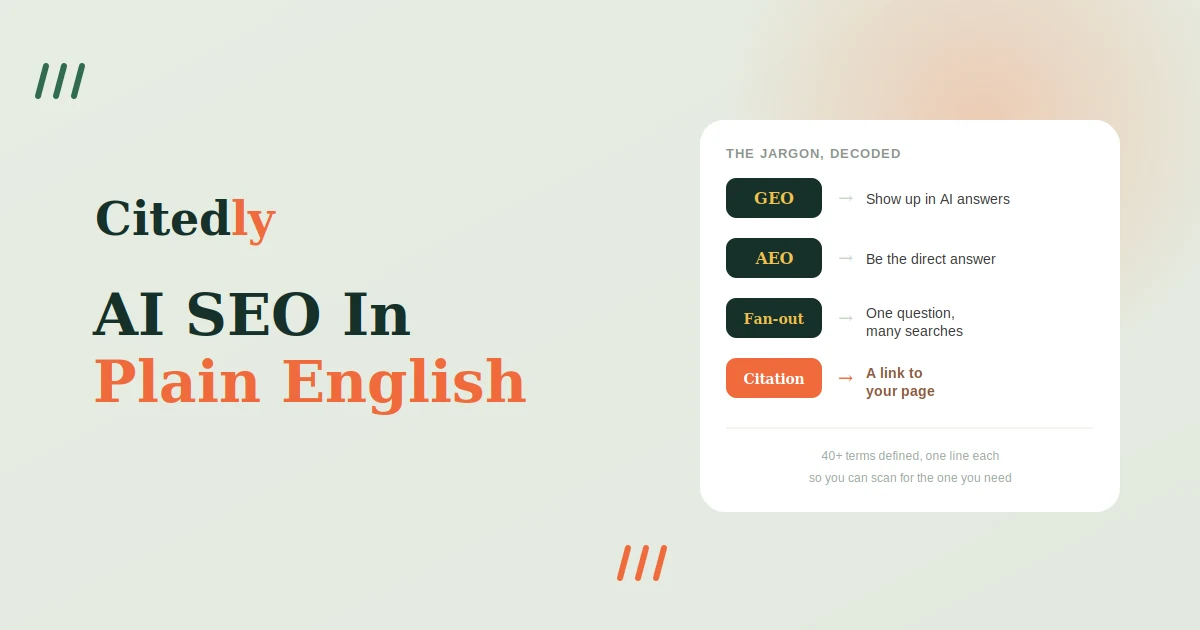
Demand for the whole cluster is climbing ("generative engine optimization" up nearly 1,000% over 18 months). Underneath the naming war is a real debate: genuinely new, or SEO repackaged? The honest answer is both — old fundamentals, new delivery protocols.
⚠️ Reality check: Not every "GEO tactic" survives testing. One study cited by Ahrefs ran a page through a standard GEO checklist — statistics, quotations, citations — and on one model it got cited less than the untouched version. Structure still matters; blind checklists don't. Measure your own results.
5. Programmatic Content Is Back — and Riskier Than It Looks
The shift: AI made scaled content cheap, so programmatic strategies are surging, along with the penalties. Multiple SEOs have traced Google penalties to sites that scaled into thousands of thin, AI-generated pages during early-2026 spam updates. The safer play is scaling tools and utilities — things people use rather than read, which AI can't summarize out of existence.
Do this: For a small business, a few genuinely useful pages beat a hundred generated ones. Quality over volume, every time.
Frequently asked questions
How often do Google AI Overviews appear?
On roughly 25% of US Google searches as of early 2026, up from about 13% a year earlier, and on an estimated 40% of local searches. Different studies report figures between 18% and 26% depending on the keyword set, but the trend is consistently upward.
Do AI search referrals actually convert?
Yes, and better than most channels. Similarweb measured AI referral conversion around 7.1%, second only to paid search, and AI visitors spend roughly 68% more time on-site than traditional organic visitors. The volume is small but the intent is high.
Do I need to rank #1 on Google to be cited by AI?
No. Only about 17% of AI Overview citations come from Google's organic top 10, and 80% of ChatGPT-cited URLs aren't even in the top 100. Clear structure and third-party mentions matter more than raw ranking. See how to get cited by ChatGPT.
Are brand mentions really more important than backlinks now?
For AI visibility, yes. Brand mentions correlate with AI visibility about three times more strongly than backlinks, and AI names brands without a link roughly 72% of the time. Links still help you rank on Google; mentions help you get named in AI answers — the full comparison is in AI citations vs backlinks.
Where do AI engines pull most of their citations from?
Wikipedia, Reddit, YouTube, and LinkedIn dominate, with G2 leading for software queries. Community and reference platforms carry disproportionate weight, which is why off-site presence matters as much as your own content.
See Where AI Puts Your Business Today
Run your real buyer prompts across five AI engines and find out whether you get named, free, in about 60 seconds. Or book a call and we'll walk you through it.
Keep exploring
Read More from Citedly