SaaS AI SEO
AI SEO for SaaS: The Citedly Query Intelligence Playbook for Getting Recommended in AI Search (2026)
AI SEO for SaaS Is Really a Product-Discovery Problem
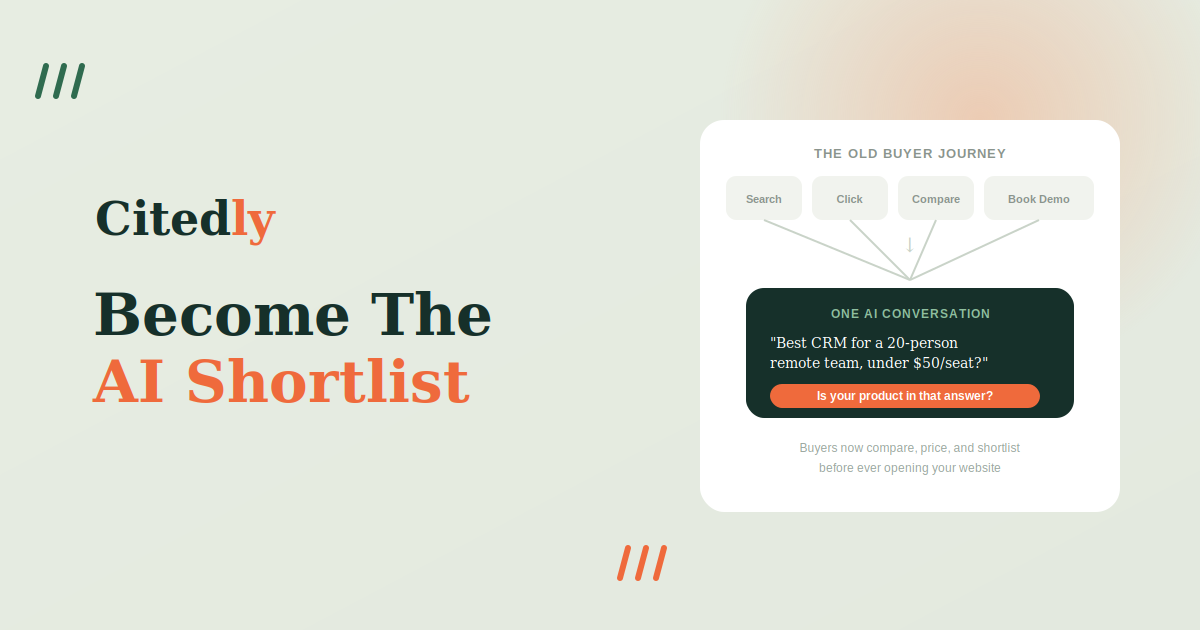
Traditional SaaS SEO was built around a fairly predictable journey: rank for a category keyword, attract the click, move the visitor into a comparison page, product page or demo flow. AI search compresses several of those steps into one conversation.
A prospect can now ask an AI system to define the category, identify the leading products, compare two vendors, explain pricing, surface alternatives, evaluate integrations and recommend a shortlist before ever opening a vendor website.
That is why AI visibility should be treated as an additional acquisition layer rather than a replacement for SEO. A SaaS company still needs crawlable, useful pages, but it also needs enough clarity and authority for AI systems to confidently include the product in the answer.
Google makes the same foundational point in its own guidance: SEO remains relevant for generative AI features because AI Overviews and AI Mode rely on Google's core Search ranking and quality systems. The new layer is how content is retrieved, synthesized and presented inside a generated answer.
Google Search Central: Optimizing for generative AI features
Why SaaS Needs a Different AI SEO Strategy
You may see this category described as SaaS AI SEO, SaaS GEO, LLM SEO, AEO, AI search optimization or generative engine optimization. The terminology overlaps, but the business objective is the same: make your product easier for AI systems to retrieve, understand, verify, compare and recommend.
SaaS is unusually exposed to AI-assisted discovery because software buyers naturally ask comparison-heavy questions. They do not only search for a category. They ask what product is best for a team size, workflow, budget, integration stack or industry.
| Buyer Stage | Traditional Search Example | AI-Style Buyer Question |
|---|---|---|
| Category Discovery | project management software | What are the best project management tools for a 20-person remote team? |
| Use Case | CRM for agencies | Which CRM is best for a small agency that needs proposals, follow-ups and pipeline reporting? |
| Alternatives | HubSpot alternatives | What are cheaper HubSpot alternatives that still have automation and reporting? |
| Comparison | Notion vs ClickUp | Should a product team choose Notion or ClickUp if documentation matters more than task automation? |
| Pricing | intercom pricing | What will Intercom actually cost for a support team with 15 agents? |
| Integration | Slack CRM integration | Which CRMs work best with Slack and Zapier without a complicated setup? |
| Ready to Buy | best email marketing tool | I run a B2C subscription business. Which email platform should I choose if retention matters more than newsletters? |
Those questions contain more context than a normal keyword. They reveal company type, team size, constraints, budget, desired outcome and purchase stage. That is exactly why Citedly does not start AI SEO with a keyword list alone.
How SaaS AI SEO Is Different From Other Niches
SaaS has a different AI-search problem from local services, ecommerce, publishing or broad B2B because the product is usually evaluated through a chain of comparisons before purchase. The buyer often needs to understand category fit, integrations, implementation, pricing, security, alternatives and use-case suitability in one research session.
| Niche | Typical AI Question | What Drives the Recommendation | Most Important Asset |
|---|---|---|---|
| SaaS | Which tool is best for my workflow? | Fit, features, integrations, pricing, proof, comparisons | Use-case, alternatives, comparison, integration and pricing pages |
| Local services | Who should I hire near me? | Location, reviews, availability, reputation, service coverage | Location/service pages, GBP, reviews and local authority |
| Ecommerce / B2C | Which product should I buy? | Product fit, reviews, availability, price, merchant/reputation signals | Product pages, category pages, reviews and comparison content |
| B2B services | Which company can solve this business problem? | Expertise, case studies, category authority, proof and fit | Service pages, case studies, POV content and third-party authority |
That is why SaaS GEO should not be copied from a local-business or ecommerce playbook. A SaaS company has to win not just entity recognition, but also the comparison logic that determines whether a product fits a particular team, workflow, budget and technical stack.
The Direct SaaS Questions AI Engines Need to Answer About You
A useful SaaS AI SEO strategy should be able to answer questions like these clearly enough that an LLM can reuse the facts without guessing:
What category does this SaaS actually belong to?
Who is the product best for, and who is it not built for?
What are the strongest alternatives to this product?
How does it compare with the category leader?
What does it cost at the team size I have?
Which integrations are native, and which require a workaround?
How difficult is implementation or migration?
Does it support my industry, workflow or compliance requirement?
What do customers consistently like or dislike about it?
Why should an AI recommend this product over three close competitors?
If your website, documentation and third-party footprint do not answer those questions consistently, the model will often fill the gap with competitor pages, review sites, community discussions or outdated information.
“SaaS AI SEO is different because a software buyer is rarely asking only whether your company exists. They are asking whether your product fits a specific workflow better than the alternatives. That means the real SEO asset is not just visibility. It is enough structured evidence for an AI system to make the comparison correctly.”
— Hadeel Yousaf, Founder of Citedly and LLM researcher
Citedly's Query Intelligence System for SaaS
Citedly's proprietary Query Intelligence System is built to map the conversational demand that sits around a SaaS product. The system draws on a prompt library built from thousands of aggregated real-user search-style conversations and buyer questions, then organizes that language into query families that correspond to how a SaaS purchase actually develops.
The Citedly SaaS Query Map
| Query Family | What the Buyer Is Trying to Decide | Typical Content Asset |
|---|---|---|
| Category | What products exist? | Category / best-software page |
| Problem-Solution | What kind of software solves this problem? | Problem-led use-case page |
| Use Case | Which product fits my exact workflow? | Persona / industry / workflow page |
| Alternatives | What should I consider instead of a known vendor? | Alternatives page |
| Comparison | Which of two or more products should I choose? | Versus / comparison page |
| Pricing | What will this really cost me? | Pricing explainer / total-cost page |
| Integration | Will it work with my stack? | Integration / compatibility page |
| Risk & Trust | Is this secure, proven and reliable? | Security, proof, case-study, FAQ pages |
| Recommendation | Which product should I buy? | Evidence-rich product and third-party recommendation footprint |
The point is not to create nine pages for every keyword variation. The point is to see which decision states your current site does not answer well, and which of those gaps are already being won by competitors inside AI answers.
The Citedly SaaS AI Visibility Stack
We use a five-layer model for SaaS because a product cannot be recommended if it fails earlier in the chain.
| Layer | Question We Ask | What Usually Needs to Be Fixed |
|---|---|---|
| 1. Retrieval | Can the engine access and retrieve the right product information? | Indexing, crawler access, Bing/Google visibility, rendering, internal links |
| 2. Understanding | Does the engine clearly understand the product, category, use cases and ICP? | Entity clarity, product copy, schema, consistent positioning |
| 3. Evidence | Is there enough proof to support the claims? | Reviews, case studies, documentation, third-party mentions, original data |
| 4. Comparison | Can the engine explain why this SaaS fits a specific buyer better than alternatives? | Comparison, alternatives, use-case and pricing content |
| 5. Recommendation | Does the brand actually survive into the final shortlist? | Prompt coverage, mention rate, source influence, competitor gaps |
This stack is deliberately broader than content production. A SaaS company can have excellent blog content and still fail because the product category is unclear, integrations are poorly documented, pricing is ambiguous, or third-party evidence points more strongly to a competitor.
Why Mention Rate Matters as Much as Citation Rate
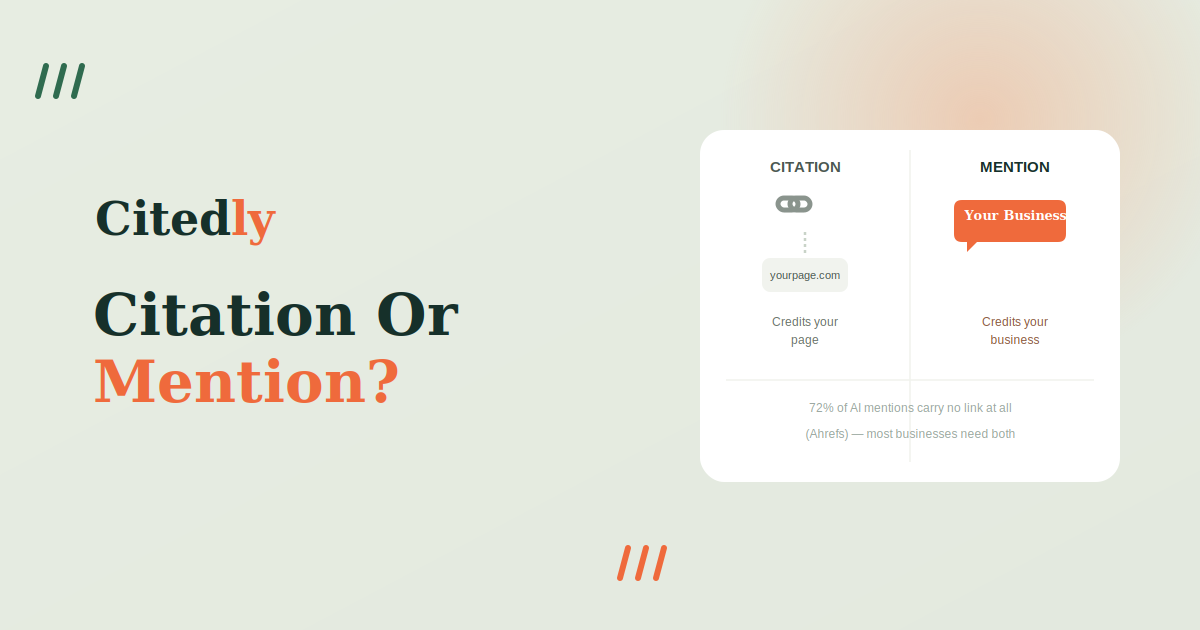
A SaaS brand can become a source without becoming part of the shortlist. That distinction is easy to miss if AI visibility reporting focuses only on citations.
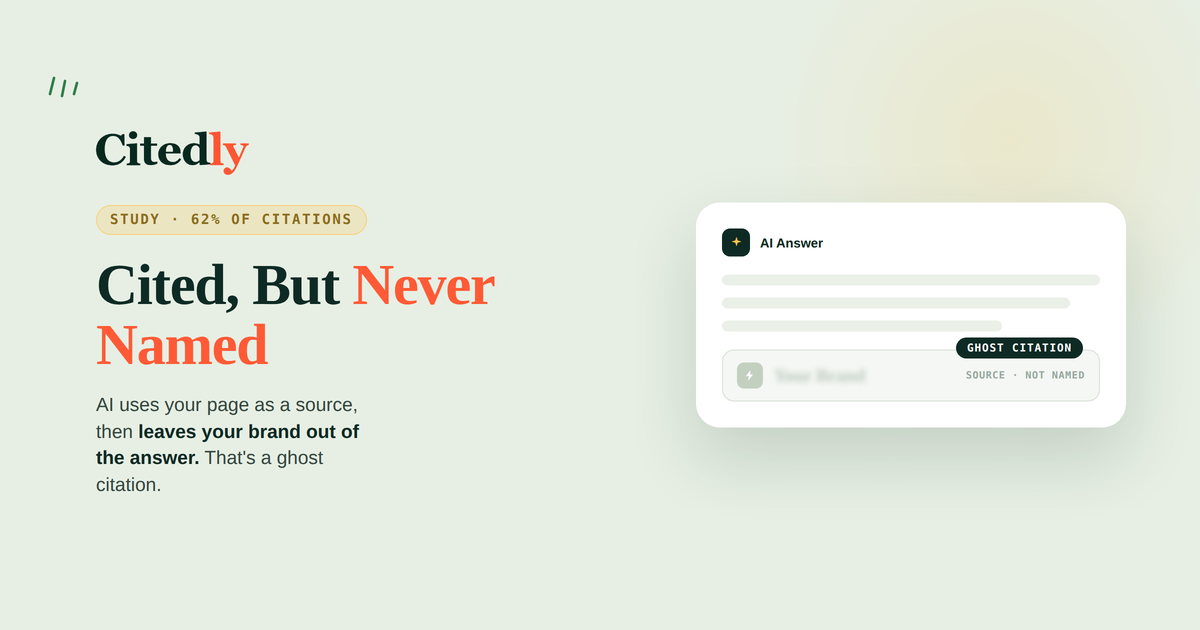
Semrush's 2026 ghost-citation study found that roughly 62% of AI citations in its dataset did not produce an explicit brand mention in the answer. That means a model can use your page as evidence while the buyer never meaningfully sees your brand.
For SaaS, that is why Citedly separates AI citations from brand mentions. A documentation page earning citations is useful; appearing by name when the buyer asks 'which tool should I choose?' is a different and often more commercially valuable outcome.
The SaaS Pages Most Likely to Influence AI Recommendations
The best AI-search content is usually not another generic top-of-funnel article. It is content that reduces uncertainty at a buying decision.
1. Alternatives Pages
Alternative queries are explicitly shortlist queries. A buyer already knows one vendor and wants options. Build pages that explain who the alternatives are for, where they differ, and when your own product is or is not the right fit.
2. Comparison Pages
Versus pages should answer real decision criteria rather than simply declaring your product the winner. Compare pricing model, implementation, integrations, ideal user, limitations, support and switching cost. Balanced comparison is easier for a model to reuse because it contains decision-ready facts.
3. Use-Case and Persona Pages
A category page tells AI what the product is. A use-case page tells it when to recommend the product. That distinction matters for prompts like 'best analytics tool for a seed-stage SaaS' or 'best CRM for a consulting firm.'
4. Pricing and Total-Cost Pages
AI buyers ask direct pricing questions. If pricing is hidden, ambiguous or only available after a sales call, third-party sources may become the model's main evidence. Clear pricing logic, plan differences and cost drivers give the engine stronger first-party information.
5. Integration and Compatibility Pages
For SaaS, integrations can determine the recommendation. Pages should state what the integration does, setup requirements, supported objects or workflows, limitations and who it is useful for.
6. Trust and Evidence Pages
Security pages, customer evidence, benchmark data, case studies, documentation and transparent product information give AI systems evidence beyond promotional claims.
The common thread is structure: direct answers, clear headings, named entities, comparison tables and concise passages make information easier for AI systems to extract. Citedly's guide to structuring content for AI goes deeper into that page-level layer.
What Not to Do: Publish Generic 'AI SEO' Content at Scale
SaaS teams are at risk of recreating the worst part of programmatic SEO: producing hundreds of thin pages that say the same thing with a different product name. That gives AI engines plenty of text to summarize but very little distinctive evidence to attribute.
Do not create comparison pages that hide every competitor advantage.
Do not generate 'best software' listicles without a clear methodology.
Do not repeat the same product positioning across every use-case page.
Do not rely only on your own website to prove claims buyers expect third parties to validate.
Do not treat llms.txt or schema as a substitute for useful content and brand authority.
Do not measure success using one prompt; AI answers vary, so visibility needs a stable query set and repeated testing.
“The question I would ask every SaaS team is simple: if a buyer gave ChatGPT their budget, team size, current stack and exact problem, would the model have enough accurate information to put your product on the shortlist? If the answer is no, that is not just a content gap. It is a product-discovery gap.”
— Hadeel Yousaf, Founder of Citedly and LLM researcher
How Citedly Executes AI SEO for SaaS
Citedly's job is not to hand a SaaS team another visibility dashboard and leave the execution to them. The workflow connects query research directly to the pages, technical fixes and authority signals needed to compete.
| What Citedly Finds | What We Do Next |
|---|---|
| Your SaaS is absent from high-intent category prompts | Build or improve category, use-case and product positioning pages. |
| Competitors dominate alternatives queries | Create evidence-led alternatives pages and strengthen third-party corroboration. |
| AI describes the product incorrectly | Fix entity clarity, product copy, schema and external inconsistencies. |
| Your docs are cited but the brand is not named | Strengthen attribution, brand-to-topic association and recommendation-oriented authority. |
| Pricing questions are answered by third parties | Improve first-party pricing and cost-explanation content. |
| One engine sees the product and another does not | Analyze engine-specific source patterns and retrieval gaps. |
| The site ranks on Google but disappears in AI answers | Audit crawlability, prompt coverage, answer structure, mentions and citations across engines. |
The Citedly Measurement Loop
We re-test the same buyer-query families instead of changing the benchmark every month. That makes it possible to see whether the business is actually moving into the answer.
Prompt Coverage: percentage of tracked buyer questions where the SaaS appears.
Brand Mention Rate: how often the product is named in the generated answer.
Citation Rate: how often the company's pages are used as sources.
Recommendation Share: how often the SaaS survives into a shortlist or direct recommendation.
Competitor Capture: which competitors repeatedly appear when the client does not.
Source Influence: which third-party pages or domains are shaping the answer.
Engine Gap: where the brand appears in one AI engine but not another.
This is the same reason our broader AI citation tracking framework treats AI search as an engine-by-engine visibility problem rather than one universal ranking.
Does SaaS Still Need Traditional SEO Alongside GEO and LLM SEO?
Yes. SaaS GEO, LLM SEO and AEO should sit on top of strong traditional SEO rather than replace it. Google's official guidance is explicit that core SEO remains foundational for AI Overviews and AI Mode. The same practical logic applies more broadly: if search systems cannot discover, crawl and trust your pages, there is less reliable material for AI systems to retrieve.
The mistake is assuming the traditional SEO scoreboard is sufficient. A SaaS brand can have rankings, traffic and backlinks while still being missing from the conversations where buyers ask for recommendations.
| Traditional SaaS SEO | AI SEO / GEO for SaaS |
|---|---|
| Keyword rankings | Prompt coverage and recommendation share |
| Organic sessions | AI referrals + no-click brand exposure |
| Backlinks | Links + unlinked mentions + third-party corroboration |
| SERP competitors | Brands actually recommended by AI |
| Blog traffic | Buyer-query coverage across category, comparison, alternatives and pricing |
| Google-first reporting | Engine-specific ChatGPT, Gemini, Perplexity and Google AI visibility |
Why You Should Measure ChatGPT, Gemini, Perplexity and Google AI Separately
AI search, GEO and LLM discovery do not behave like one universal results page. The same SaaS can appear in one engine and disappear from another because each system can retrieve from different source pools and weigh evidence differently.
That cross-engine inconsistency is already visible across categories, which is why Citedly tracks why AI cites brands differently across platforms rather than blending every engine into one opaque score.
Semrush's AI Visibility Toolkit follows a similar principle by separating mentions, cited pages, citations and platform distribution, while Google says its own generative search features remain grounded in core Search systems.
A Practical Starting Point for a SaaS Team
If your SaaS already has a functioning SEO program, do not rebuild everything around AI. Start by identifying the buying conversations you are currently losing.
Choose 20-30 high-intent buyer prompts across category, use case, alternatives, comparison, pricing and integrations.
Run the same prompt set across the AI engines your customers actually use.
Record whether your brand is mentioned, cited, recommended or missing.
Identify which competitor is winning and what sources support that answer.
Fix the smallest set of pages, technical issues or authority gaps that explain the loss.
Re-test the same prompt set after the changes.
Citedly can run this process for you. We map the buyer-query universe, identify where competitors are being recommended, execute the content and technical work, and track whether your SaaS moves into the answer.
See Citedly plans · View pricing · Book a free AI visibility review
Frequently asked questions
What is AI SEO for SaaS?
AI SEO for SaaS is the process of improving how often a software brand is accurately mentioned, cited and recommended in AI-generated answers for the questions prospective customers ask. It combines normal SEO foundations with prompt research, entity clarity, comparison content, third-party authority and AI visibility tracking.
Is GEO different from SaaS SEO?
GEO overlaps heavily with SEO but measures a different output. Traditional SaaS SEO focuses on rankings and organic traffic. GEO focuses on whether generative engines retrieve your information and include your brand in generated answers. A strong SaaS strategy usually needs both.
How do I get my SaaS recommended by ChatGPT?
Make the product easy to understand, cover high-intent category and comparison questions, ensure important pages are crawlable and indexable, build credible third-party mentions and reviews, and track the prompts where competitors are being recommended instead. There is no guaranteed #1 ChatGPT ranking because generated answers can vary between runs.
What content should a SaaS company create for AI search?
Prioritize decision content: category pages, use-case pages, alternatives, comparisons, pricing explainers, integrations, customer evidence, documentation and original research. Generic informational volume is less valuable if it does not help the buyer or distinguish the product.
Can a SaaS rank well on Google but still be invisible in AI search?
Yes. AI visibility and Google rankings overlap, but they are not identical outcomes. A brand can rank strongly and still be absent from a generated shortlist, which is why AI mentions, citations and recommendation share should be tracked separately.
Should B2B SaaS and B2C SaaS use the same AI SEO strategy?
They share the same retrieval and authority foundations, but the buyer questions can differ significantly. B2B SaaS tends to have deeper comparison, implementation, security and integration intent, while B2C SaaS can depend more heavily on reviews, pricing, ease of use, app-store signals and consumer recommendation queries. Those deserve separate content strategies rather than one generic SaaS template.
Citedly's Point of View
“SaaS companies should stop asking only, ‘What keywords do we rank for?’ and start asking, ‘When a buyer explains their exact problem to an AI, does our product make the shortlist?’ That is the shift from search ranking to recommendation visibility, and it is the problem Citedly's Query Intelligence System is built to measure.”
— Citedly
See Where AI Puts Your Business Today
Run your real buyer prompts across five AI engines and find out whether you get named, free, in about 60 seconds. Or book a call and we'll walk you through it.
Keep exploring
Read More from Citedly
AI Visibility Basics