ChatGPT Playbook
How to Get Cited by ChatGPT: A 2026 Guide to Ranking in ChatGPT Search
What "Getting Cited by ChatGPT" Actually Means
Getting cited by ChatGPT means your business is named in an answer, or your page is linked as a source, when someone asks ChatGPT a question in your category. There are no positions and no results page. ChatGPT pulls from a small set of sources and synthesizes one answer, so citation, citation position, and share of voice replace keyword rankings as the metrics that matter.
There are two distinct ways to appear in ChatGPT answers, and they're earned a little differently:
- A citation is a linked source — the footnote or reference ChatGPT attaches to a claim, pointing back to your page. It comes from content the model can retrieve and quote.
- A mention is your brand name written into the answer text itself, with or without a link. To get mentioned in ChatGPT this way, your brand has to be well-established across the web, not just on your own site.
For a service business, the mention is often worth more, because the reader takes your name as a recommendation.
Why Each ChatGPT Citation Is High-Value
The field is smaller than Google's, and that's the opportunity. On Google you compete to be one of ten links; in ChatGPT you compete to be one of the two or three sources the model actually reads and quotes.
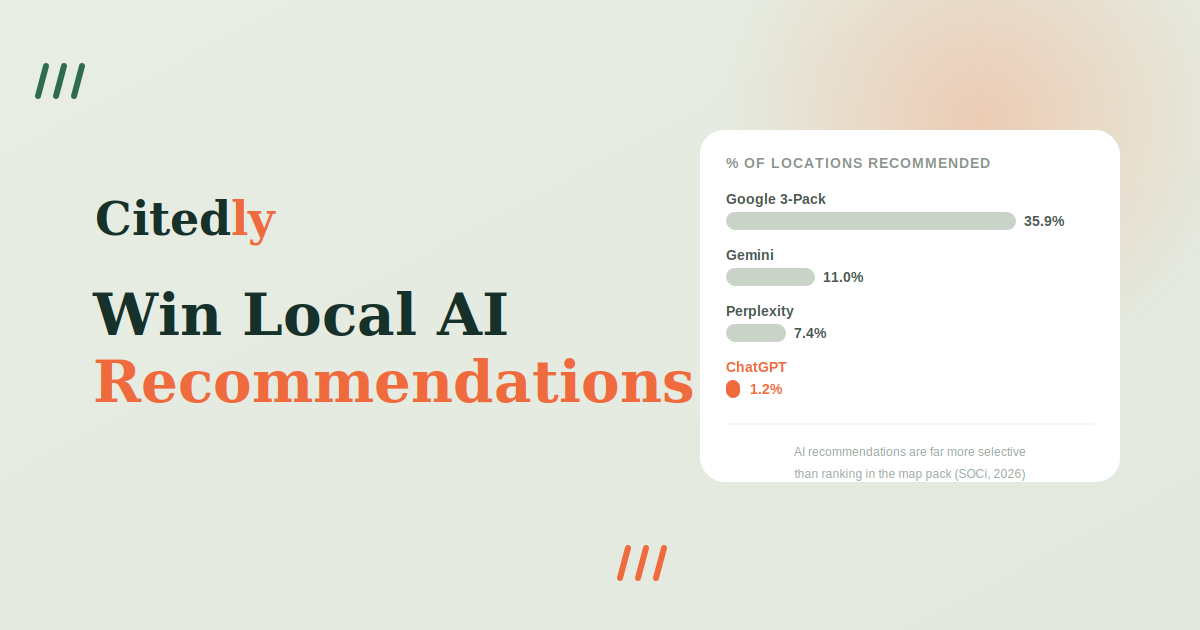
Shadow's data puts ChatGPT at roughly 87% of all AI referral traffic, yet its per-query citation rate sits under 1%. So appearing in ChatGPT answers is scarce and disproportionately valuable, and every citation counts. If you want the broader foundation on how these mentions work across every engine, our guide on what AI citations are and how to get cited by AI covers it. This post is the ChatGPT-specific playbook; if Google is your priority instead, see how to show up in Google AI Overviews.
How ChatGPT Chooses What to Cite
ChatGPT decides what to cite in two stages: which knowledge source it draws on, and which pages it pulls from a live search. Knowing the difference tells you exactly what you can influence.
The Two Engines Behind Every Answer
- Parametric memory is the fixed knowledge baked in during training. ChatGPT uses it for general questions. You can't edit it directly, though a strong long-term brand presence shapes it over time.
- Live search fires when a question needs current or specific information. This is where citations — the linked and named sources — come from, and it's the part you can actually move this month.
The Three Gates Your Page Must Pass
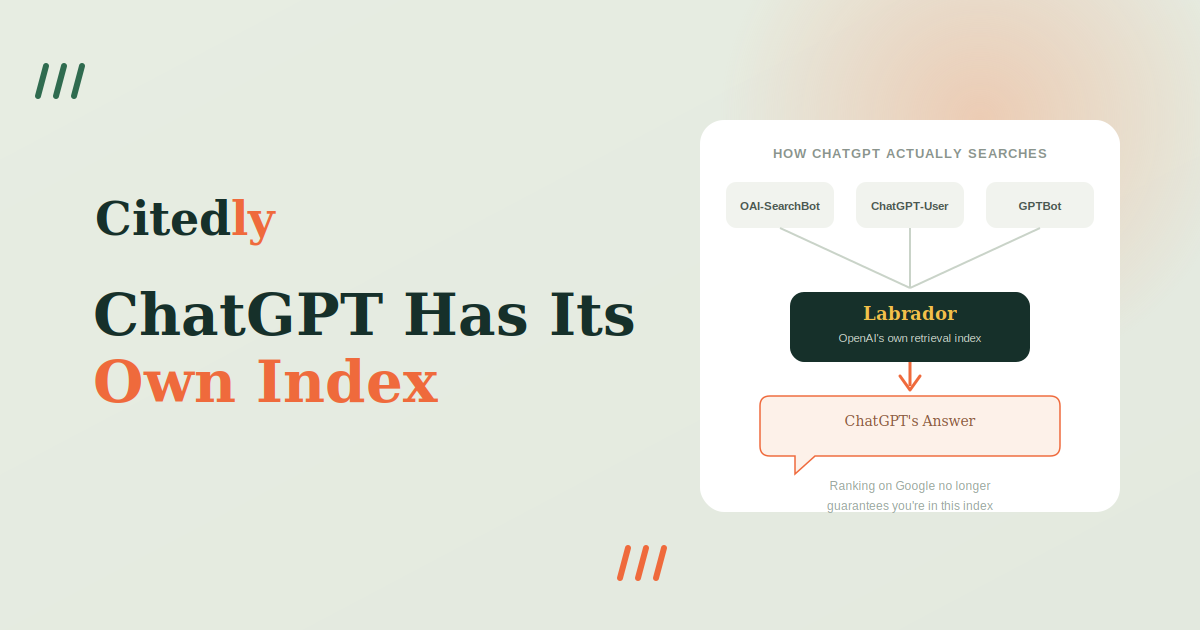
When ChatGPT Search runs, it queries Bing's index, retrieves a candidate set of pages, and a reranker picks the passages worth quoting. Three things have to be true, in order:
- Findable — your page is in Bing's index. Miss this and nothing else happens.
- Fetchable — ChatGPT's crawler can reach and read the page.
- Extractable — the model can lift a clean, self-contained passage. This is how you get quoted by ChatGPT instead of skimmed and skipped.
Because the gates run in sequence, the unglamorous parts — indexing and crawler access — come before any clever content work.
Why Getting Cited by ChatGPT Starts With Bing, Not Google
Getting cited by ChatGPT starts with Bing because its live search retrieves through Bing's index, not Google's. The most expensive misconception in 2026 is that strong Google rankings carry over. They don't.
The Data: Google Rankings Don't Transfer
- Ahrefs (August 2025) found 80% of the URLs ChatGPT cites don't appear in Google's top 100 for the same query.
- A separate 2026 analysis found only 12% of pages ranking number one on Google get cited by ChatGPT at all.
Google rank is neither necessary nor sufficient.
What Actually Predicts a ChatGPT Citation
What predicts citation is Bing. Seer Interactive found 87% of ChatGPT's citations matched Bing's top organic results, and Perkins Growth Systems reports pages on Bing's first page are about 3x more likely to be cited. If you rank well on Google but aren't indexed in Bing, you're invisible to ChatGPT regardless of content quality. That exact scenario — strong on Google, absent from AI — is the most common one we see, and it's the subject of our post on why AI isn't citing your website.
Your First Move
The fix is unglamorous and free:
- Verify your site in Bing Webmaster Tools and submit your sitemap.
- Fix any Bing-specific crawl errors.
- Check your top-10 share for your seed queries on Bing, not Google.
The ChatGPT Crawlers You Must Allow
Before content matters at all, ChatGPT has to be allowed to read you. OpenAI runs several named crawlers, and your robots.txt (and your CDN's bot rules) decide which can reach your site. Get this wrong and nothing else you do can rescue you.
| Crawler | What It Does | Recommended Setting |
|---|---|---|
| OAI-SearchBot | Powers ChatGPT Search visibility — the one that gets you cited | Allow (this is the official lever) |
| ChatGPT-User | Fetches your page live when a user's question needs it | Allow |
| GPTBot | Collects data for model training; independent of search citations | Optional — allowing helps long-term brand memory |
| OAI-AdsBot | New in 2026; validates ad landing pages, doesn't affect citations | Allow if you run ads |
Two traps catch people here.
- First, OpenAI's own crawler documentation is the source of truth for the exact user-agent names, so check them against your file rather than guessing.
- Second, and this is the one that quietly kills citations, Cloudflare has blocked AI crawlers by default since July 2025. So even a clean robots.txt can be overridden by your CDN or firewall. Check both.
One more technical must: server-side rendering. Third-party testing consensus is that OAI-SearchBot doesn't execute JavaScript, so if your content only appears after a script runs in the browser, the crawler sees a blank page. Confirm your main content is in the raw HTML by using "View Source" and searching for a sentence from the middle of your page.
How to Get Cited by ChatGPT: An 8-Step Framework
With indexing and access handled, here's the sequence that actually earns citations. It's ordered roughly by leverage, based on the patterns across cited pages.
| Step | Focus Area | Brief Description |
|---|---|---|
| 1 | Bing Search Visibility | Get indexed, resolve crawl issues, and improve rankings for buyer-focused queries. |
| 2 | Crawler Accessibility | Allow OAI-SearchBot and ChatGPT-User, check CDN rules, and use server-side rendering. |
| 3 | Answer-First Content | Place a direct, self-contained answer in the first two sentences of every section. |
| 4 | Structured Data | Add relevant Article, FAQPage, Organization, and Product schema markup. |
| 5 | Brand Entity Consistency | Keep business details identical across profiles and strengthen the entity with Wikidata and sameAs. |
| 6 | Third-Party Authority | Build genuine mentions and reviews across Reddit, Wikipedia, G2, Trustpilot, and other trusted sources. |
| 7 | Original Data Assets | Publish surveys, benchmarks, client insights, and proprietary research with clear statistics. |
| 8 | Topical Depth | Build pillar pages supported by focused cluster content instead of publishing isolated posts. |
1. Rank on Bing for Your Buyer Queries
Because retrieval runs through Bing, Bing rankings are your foundation. Treat Bing as its own SEO surface: submit your sitemap, fix its crawl errors, and work your priority pages toward Bing's first page for the questions your buyers ask. Everything downstream depends on this.
2. Allow the Crawlers and Render Server-Side
Confirm OAI-SearchBot and ChatGPT-User are allowed in both robots.txt and your CDN rules, keep your sitemap accessible, and make sure your content is server-side rendered. This is the "can it even read me" gate, and it's a same-day fix.
3. Answer the Question in the First Two Sentences
ChatGPT's reranker lifts self-contained passages. Put the direct answer at the top of the page and under each heading, then add the detail. Format headings as the questions people actually ask, and answer each one immediately below, so your page can get quoted by ChatGPT rather than passed over. Cited pages consistently share this answer-first structure — the full set of rules is in how to structure content so AI will quote it.
4. Add Schema Markup
Structured data makes your page machine-readable at the moment the reranker is deciding whether it understands you. Ahrefs found 71% of ChatGPT-cited pages include schema. Add Article, FAQPage, Organization, and Product schema where relevant, and make sure the FAQ schema matches your visible text.
5. Build a Consistent Brand Entity
ChatGPT strongly favors well-established, reference-grade sources. Profound's analysis of 680 million citations found Wikipedia alone holds nearly 48% of ChatGPT's top-10 citation share. You won't outrank Wikipedia, but you can borrow the same signals: a Wikidata entry with a complete sameAs graph is the fastest realistic win, plus identical business details across every public profile so the model reads you as one confident entity.
6. Earn Third-Party Mentions on Sources ChatGPT Trusts
Brand authority — mentions, reviews, and multi-platform presence — carries more weight than backlinks for ChatGPT, and the citations vs backlinks data shows just how wide that gap has become. Wikipedia and Reddit lead US citations (13.2% and 12% respectively, per 5W Research in May 2026), so genuine Reddit presence and reviews on platforms like G2 and Trustpilot feed directly into your citation odds.
A word of caution: these sources are volatile. Reddit's share of ChatGPT responses swung from about 60% to 10% in two weeks in September 2025, so treat the mix as something to re-measure, not set and forget.
7. Publish Original Research and Proprietary Data
Original data is one of the most reliable citation triggers, because it gives the model something it can't find anywhere else. A small survey, benchmark, or analysis from your own work, summarized answer-first with clear stats, becomes a magnet for citations. This is where your real client results are an asset no competitor can copy.
8. Build Topic Clusters, Not One-Off Posts
ChatGPT prefers sources that have written deeply on a topic over isolated pages. A pillar page plus eight to twelve supporting posts measurably outperforms scattered content, which is exactly why the smart way to attack this is a cluster. (If you're planning yours, our guides on why AI isn't citing your website and tracking your AI citations are two spokes of the same wheel, along with cross-engine citation gaps.)
Most public advice treats ChatGPT citation like classic SEO with a fresh coat of paint. The data says it's closer to PR plus structured data plus a deliberate off-site footprint. Get those three right and the citations follow; skip them and no amount of blog-post optimization moves the needle.
— Paraphrased from Perkins Growth Systems' 2026 analysis of ChatGPT citation patterns.
What ChatGPT Cites vs What It Skips
If you want a quick gut-check on a page, this is the pattern that separates cited pages from ignored ones.
| ChatGPT Tends to Cite | ChatGPT Tends to Skip |
|---|---|
| Answer-first paragraphs that resolve the question up top | Pages that bury the point under a long intro |
| Content dense with named entities and statistics | Vague, opinion-only copy with no specifics |
| Comparison tables and listicle structure | Walls of unstructured text |
| Pages indexed and ranking on Bing | Pages strong on Google but absent from Bing |
| Recent, maintained pages (fresh dateModified) | Stale content last touched years ago |
| Brands corroborated on Wikipedia, Reddit, reviews | Businesses that only appear on their own site |
The throughline is that ChatGPT rewards being fetchable and quotable more than being ranked in the old sense. Structure and corroboration beat authority-by-links.
How to Track Whether ChatGPT Is Citing You
You can't improve this blind, and it won't show up in normal analytics. Keep a simple scoreboard: write 15 to 20 real buyer prompts and run them through ChatGPT (free, Plus, and Search) each week, logging when you're named, when a competitor is, and where you appear.
One detail worth knowing, from Profound: first-turn questions trigger citations about 2.5x more often than follow-ups, so test your prompts as opening questions. Pair that manual testing with Bing Webmaster Tools' AI data and GA4's AI-referral traffic. Our full method lives in how to track your AI citations, and because these sources shift monthly, the habit matters more than any single check.
Get Cited by ChatGPT Yourself vs. Let Citedly Do It
Everything above is doable in-house, and if you have the time to work Bing, wire up crawlers, restructure pages, build a Wikidata entity, and maintain a Reddit and review presence, you should. The honest catch is that it's eight moving parts, several are technical, and the source mix changes month to month, so it needs maintaining rather than a one-time fix.
That's what Citedly runs for you:
- Bing Webmaster and Google Search Console indexing
- Crawler and CDN access
- Answer-first pages
- Schema implementation
- Brand entity consistency
- Third-party mentions and authority signals
- Monthly ChatGPT citation tracking
It's built for small and local businesses, from $299 a month with no contract, which is a fraction of what traditional agencies charge for the same work. You can see what's included in each plan, read why businesses hand this to us, or book a free call and we'll show you exactly where ChatGPT does and doesn't mention you today.
Being named as a suggestion is its own discipline — once your pages are quotable, the next step is getting recommended, not just cited.
Frequently asked questions
Does ChatGPT use Bing?
Yes. ChatGPT Search retrieves through Bing's index, layered with OpenAI's own crawling to fetch pages. That's why Bing indexing is the prerequisite for being cited, and why Google rankings don't transfer — an Ahrefs study found 80% of ChatGPT-cited URLs aren't even in Google's top 100.
How do I appear in ChatGPT answers?
Get indexed and ranking in Bing, allow OAI-SearchBot so ChatGPT can read you, answer each question in your first two sentences so a clean passage can be quoted, and build third-party corroboration on Wikipedia, Reddit, and review sites. Those four moves cover the technical, content, and authority sides of appearing in ChatGPT answers.
Can you pay to appear in ChatGPT?
No. There's no paid placement in ChatGPT's citations. OpenAI introduced ads on some tiers in 2026, but it has stated that answers and citations are unaffected, and there's no publisher revenue share. You earn citations through indexing, structure, and authority, not payment.
Why doesn't ChatGPT mention my business?
Usually because you're not indexed in Bing, OAI-SearchBot is blocked in your robots.txt or CDN, your content only renders in JavaScript, or your answer is buried too far down the page. Work through those four to get mentioned in ChatGPT, then strengthen your third-party corroboration.
How long does it take to get cited by ChatGPT?
Once you're indexed in Bing and crawlable, citations for specific, lower-competition questions can appear within a few weeks. ChatGPT favors fresh content, so new answer-first pages can move faster than traditional SEO, while entity and third-party authority build over two to three months.
See Where AI Puts Your Business Today
Run your real buyer prompts across five AI engines and find out whether you get named, free, in about 60 seconds. Or book a call and we'll walk you through it.
Keep exploring
Read More from Citedly