B2B AI SEO
AI SEO for B2B Companies: How to Get Recommended by ChatGPT & Google AI in 2026
B2B Search Is Becoming a Shortlist Problem
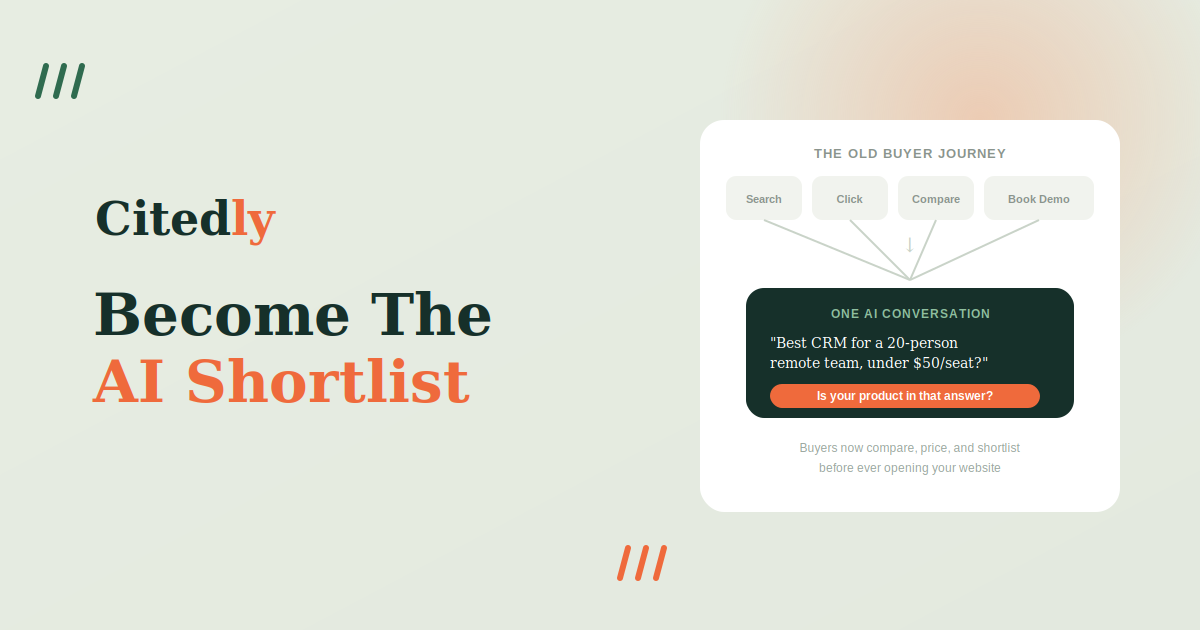
Traditional B2B SEO was designed around getting a buyer onto your website. AI search can influence the buyer one step earlier: before your site is ever opened.
A prospect can now ask ChatGPT, Gemini, Perplexity or Google AI to explain a category, identify suitable vendors, compare providers, surface risks and summarize which company appears to fit the requirement.
That changes the practical goal of AI SEO. A B2B company does not only need a page that can rank. It needs enough consistent evidence across the web for an AI system to understand what the company does, which problems it solves, who it is appropriate for and why it deserves to be considered.
The Research: B2B Buyers Are Already Using AI to Evaluate Vendors
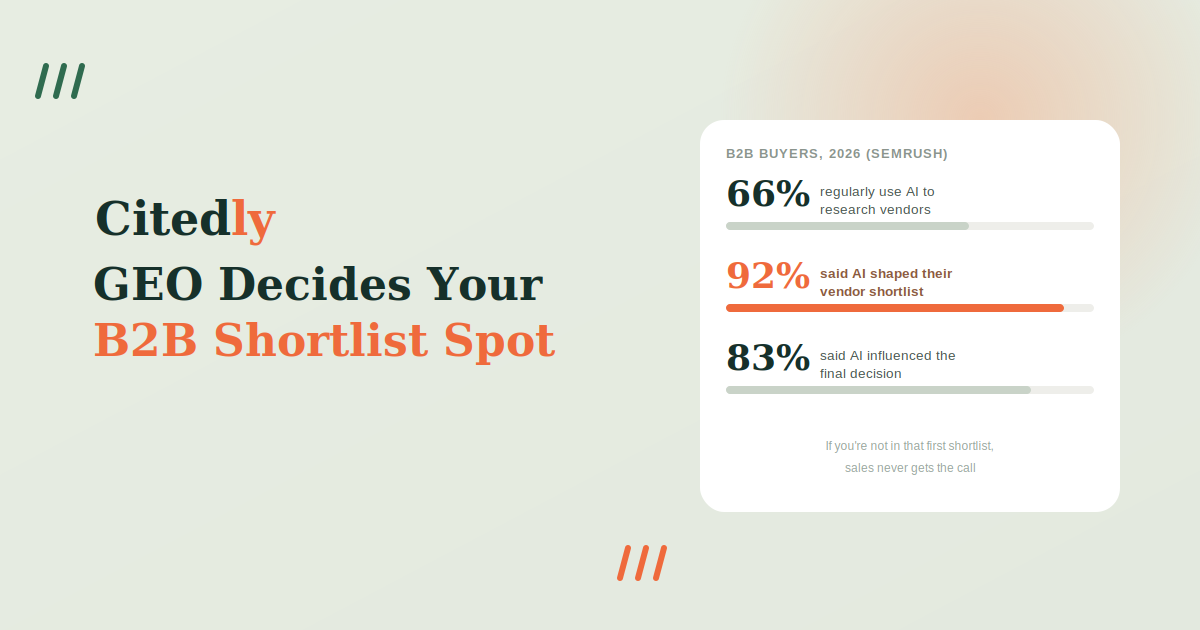
Semrush surveyed 622 U.S. B2B professionals in March-April 2026. Among respondents who use AI for work, 66% said they regularly use AI specifically to research products, vendors or solutions, with another 29% doing so occasionally.
The same survey found that 72% use AI during early category research, 62% use it while actively comparing vendors, 48% use it to narrow a shortlist and 45% use it to support the final decision. Ninety-two percent said AI had shaped their vendor shortlist and 83% said it influenced the final vendor decision.
This does not mean AI replaces every other channel. Gartner's May 2026 report, based on a survey of 645 B2B buyers, found that buyers used an average of seven information sources during a recent purchase and 45% used generative AI. It also found that 69% preferred to validate AI-generated insights with sales representatives.
The Direct B2B Questions AI Engines Need to Answer About Your Company
A useful B2B GEO or LLM SEO strategy starts with questions that resemble an actual buying committee, not a list of abstract SEO keywords. The goal is to understand the questions a buyer asks before they ever reach a contact form.
Which companies are best suited to solve this exact business problem?
Which providers have experience in my industry or company size?
Who has evidence of delivering this outcome before?
Which company can work with our existing systems, team or operating model?
What is the likely budget or engagement model?
Which provider is a better fit: a specialist or a larger generalist?
What are the risks, limitations or common complaints about each vendor?
Which provider can support multiple locations, regions or business units?
Which companies have credible case studies, reviews or independent mentions?
Who should make the final shortlist and why?
These are fundamentally different from simple ranking queries. They combine category understanding, proof, reputation, commercial fit and recommendation intent.
That is why AI citations and brand mentions need to be measured separately. Your website can be used as a source while another company is still the one explicitly recommended to the buyer.
If your website and third-party footprint cannot answer those questions consistently, the model has to rely on competitors, directories, industry publications, customer reviews and other sources to fill the gap. That is also one of the reasons a company can rank well traditionally but still wonder why AI is not citing or recommending its website.
How B2B AI SEO Is Different From SaaS, Local and B2C
B2B AI SEO has a different recommendation problem from SaaS, local search and consumer ecommerce.
A SaaS buyer often compares features, integrations, pricing and workflow fit. A local buyer usually cares about proximity, availability and reviews. A consumer buyer may focus on product quality, price and sentiment.
A B2B buyer is usually evaluating delivery risk:
Can this company solve a complex problem, in my industry, under my operating constraints, with enough evidence that I can justify putting them on the shortlist?
That difference changes what should be optimized.
For B2B services, the strongest assets are usually:
detailed service pages
industry and use-case pages
quantified case studies
pricing or engagement-model clarity
founder or expert point of view
customer proof
independent mentions
comparison-ready information
The goal is not merely to make the company visible to an LLM. It is to make the recommendation defensible.
This is also why getting a business recommended by AI requires more than publishing content around keywords. The model needs enough evidence to understand what you do, who you are best suited for, and why you should be considered instead of another provider.
For B2B companies specifically, third-party evidence becomes especially important. Case studies tell the model what you have achieved. Reviews and independent mentions help corroborate those claims. Industry-specific pages clarify fit. Expert commentary strengthens your association with the problem you solve.
That broader evidence layer is one reason AI citations can behave differently from traditional backlinks. A backlink may help search authority, while an independent mention can also give an AI system direct evidence about your expertise, positioning or reputation.
B2B GEO should therefore not be copied from a SaaS, local or ecommerce playbook. The technical foundation overlaps, but the evidence required for recommendation is different. A model needs to understand not just what you sell, but whether your team has the experience, credibility and operating fit to handle the buyer's situation.
Citedly's B2B Query Intelligence Framework
Most B2B keyword research begins with category terms.
Query Intelligence goes further by mapping the actual questions a buying committee asks before contacting a vendor.
Those questions reveal:
urgency
company size
industry context
budget expectations
implementation complexity
existing systems
perceived risk
the evidence required before making a shortlist
That distinction matters because two companies can rank for the same keyword while only one is consistently recommended by AI.
The deciding factor is often whether the web contains enough clear evidence to connect that company to the buyer's exact situation.
Citedly starts B2B AI search optimization with the buyer's decision language, not simply a keyword database. Our Query Intelligence System groups real search-style and conversational questions into the stages where a B2B vendor can either enter or fall out of consideration.
For example, instead of stopping at a term such as:
“B2B SEO agency”
we also map questions such as:
“Which SEO agency has experience helping B2B companies show up in ChatGPT?”
“What GEO agency is best for a B2B company that already has an internal SEO team?”
“Which AI SEO provider can handle content, technical SEO and third-party citations together?”
“What should a B2B company expect to spend on GEO?”
“Which provider has evidence that AI-search visibility actually produces pipeline?”
These are the queries where recommendation visibility becomes commercially meaningful.
The framework also connects naturally with how Citedly tracks AI citations. We do not only ask whether a company appeared. We look at whether it was mentioned, cited, accurately described, recommended, or replaced by a competitor.
And when the content itself becomes the bottleneck, the same query map informs how we structure pages so AI systems can extract and reuse the answer.
The objective is not simply to create more B2B content.
It is to create the specific evidence AI systems need at each stage of vendor selection, then measure whether that evidence is actually changing which companies appear in the answer.
| Query Family | What the Buyer Wants to Know | Example |
|---|---|---|
| Problem Definition | What kind of provider or solution is needed? | What type of agency can reduce paid-social creative bottlenecks? |
| Category Discovery | Which companies operate in this category? | Best outsourced creative teams for performance marketing |
| Use-Case Fit | Who is right for my exact situation? | Which marketing agency is best for a multi-location healthcare brand? |
| Industry Fit | Who understands my sector? | Best SEO agency for industrial manufacturers |
| Proof | Who has actually delivered this before? | Which firms have case studies with enterprise B2B clients? |
| Comparison | Which of these vendors is the stronger fit? | Agency A vs Agency B for international expansion |
| Commercial Fit | What will this cost and how does the engagement work? | Typical retainer for a B2B demand generation agency |
| Risk & Validation | What could go wrong? | Reviews, complaints and weaknesses of Vendor X |
| Recommendation | Who should make the shortlist? | Which 3 agencies should a $20M company speak with? |
The Citedly B2B Recommendation Evidence Stack
We use the evidence stack as a diagnostic, not as another content checklist. If a brand is missing from AI recommendations, we first identify which layer is failing. Sometimes the problem is crawlability. More often in B2B, it is weak positioning, thin proof, inconsistent third-party corroboration or a lack of content that explains fit for a specific use case.
For B2B companies, we look at five layers of evidence because being crawlable is necessary but rarely sufficient for recommendation-style queries.
| Layer | Question | Typical Fix |
|---|---|---|
| 1. Retrieval | Can the AI system access and retrieve the right information? | Indexing, crawlability, rendering, internal links, technical SEO |
| 2. Positioning | Is it obvious what the company does and who it is for? | Service copy, vertical pages, entity clarity, structured data |
| 3. Proof | Is there evidence the company can deliver? | Case studies, quantified outcomes, customer evidence, credentials |
| 4. Corroboration | Does the wider web support the company's claims? | Reviews, directories, partner pages, industry mentions, expert coverage |
| 5. Recommendation Fit | Does the company match the buyer's exact constraints? | Use-case content, industry evidence, pricing/engagement clarity, comparison-ready information |
“The B2B brands that win in AI search will not necessarily be the brands that publish the most content. They will be the brands with the clearest trail of evidence: what they do, who they do it for, what results they have produced and what independent sources confirm those claims.”
— Founder, Citedly
What B2B Companies Should Build for AI Search
1. Service Pages That Explain Fit, Not Just Capabilities
A generic service page tells the model what you sell. A strong B2B page explains who the service is for, the situations where it works, the operating model, expected outcomes, limitations and evidence.
2. Industry and Use-Case Pages
B2B buyers frequently describe their industry, team structure or constraint in the prompt. Industry and use-case pages help an AI system connect your company to those narrower situations without forcing it to infer the fit.
3. Case Studies With Verifiable Outcomes
Case studies are not just conversion assets. They give search and AI systems evidence about the type of client you serve, the problem you solved, the method used and the outcome achieved. Specific numbers, dates, industry context and named services are more useful than vague 'we helped them grow' language.
4. Pricing and Engagement-Model Clarity
Semrush found that 27% of surveyed B2B buyers complained that AI recommendations did not reflect real pricing or contract structures. You do not have to publish a fixed price if the service is custom, but explaining typical ranges, minimum engagements, project vs retainer models and what changes the price gives AI better commercial context.
5. Expert POV and Original Research
Google's 2026 guidance explicitly recommends unique, non-commodity content for generative AI search. In B2B, original benchmarks, founder observations, methodology pages and research-backed opinions create information that cannot be replaced by a generic summary from another agency.
Google Search Central: Optimizing for generative AI features
6. Third-Party Evidence
If every positive claim about the business exists only on its own domain, the evidence is weak. Build legitimate third-party confirmation through reviews, partner directories, customer pages, industry publications, podcasts, expert contributions and other relevant sources.
This is also why AI citations and brand mentions should be measured separately. The model may use your research as a source while recommending another company by name.
7. Pages That Answer Comparison and Shortlist Questions
B2B companies often avoid comparison content because it feels uncomfortable. But buyers compare providers anyway. A useful comparison page can explain differences in specialization, engagement model, geography, team structure, pricing, implementation and ideal client without pretending your company is best for everyone.
B2B GEO Does Not Replace SEO
Google's official guidance says foundational SEO remains relevant because AI Overviews and AI Mode use Google's core Search ranking and quality systems. Google also says there are no special technical requirements beyond being indexed and eligible to appear in Search.
| Traditional B2B SEO | B2B AI SEO / GEO / LLM SEO |
|---|---|
| Keyword rankings | Prompt coverage and recommendation share |
| Organic traffic | AI visibility + referrals + no-click shortlist exposure |
| Backlinks | Links + mentions + reviews + corroborating sources |
| Service-page rankings | Whether the company is correctly matched to a buyer use case |
| SERP competitors | Companies actually recommended inside AI answers |
| Conversion rate | Whether AI-discovered buyers validate and continue to sales |
How Citedly Executes AI SEO for B2B Companies
Citedly is designed around the gap between 'we rank for this topic' and 'we are actually being recommended for this buying problem.' We map the high-intent questions, test the major AI engines, identify which competitors and sources are winning, then connect each visibility gap to an execution task.
In practice, that means we are rarely recommending “more content” as the answer by itself. A company may need a stronger service page, a better case study, a clearer industry page, a more explicit pricing model, more third-party corroboration or a technical fix that helps the right page get retrieved.
The objective is to close the evidence gap between what the business knows about itself and what an AI system can confidently verify from the web. That is where B2B AI SEO becomes commercially useful instead of turning into another reporting exercise.
| What We Find | What Citedly Does |
|---|---|
| Your company is absent from category prompts | Improve core positioning, service/category pages and entity clarity. |
| AI recommends competitors for a specific industry | Build stronger industry/use-case evidence and external corroboration. |
| Your case studies are not being surfaced | Restructure proof pages for clearer entities, outcomes and retrieval. |
| AI misstates your services or positioning | Fix first-party copy, schema and conflicting third-party information. |
| Competitors dominate comparison prompts | Build factual comparison-ready content and improve authority signals. |
| AI uses your content but does not name your company | Strengthen attribution, brand-topic association and recommendation signals. |
| Strong Google rankings are not carrying into AI | Audit engine-specific retrieval, mentions, source influence and prompt gaps. |
A B2B Search Growth Example From Citedly
One B2B brand we worked with gives a useful example of why we do not treat visibility as a vanity metric. In the 2025 baseline period shown below, the site recorded about 177,000 Google Search impressions, 1,140 clicks and an average position of 35.7. The opportunity was not simply to publish more pages. The work focused on improving search coverage, page relevance, commercial content and the authority signals around the business.
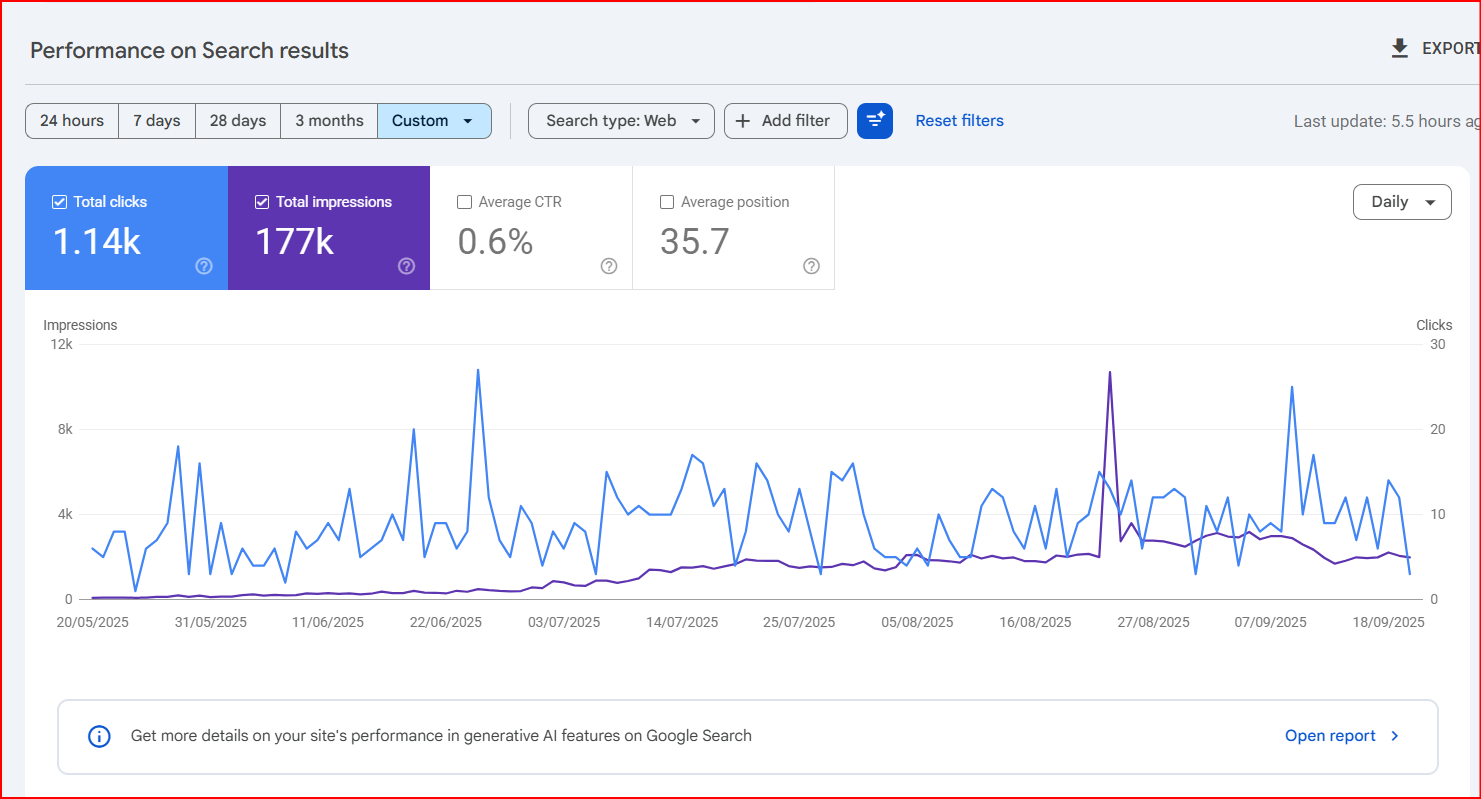
2025 baseline: approximately 177K impressions and 1.14K clicks in the Search Console period shown.
By the 2026 16-month Search Console view, the site had accumulated 6.9 million impressions and 29,500 clicks, with average position shown at 10. The screenshots do not prove that every impression or dollar came from one SEO action, but they show the scale of the change in organic search visibility while the broader growth program was running.
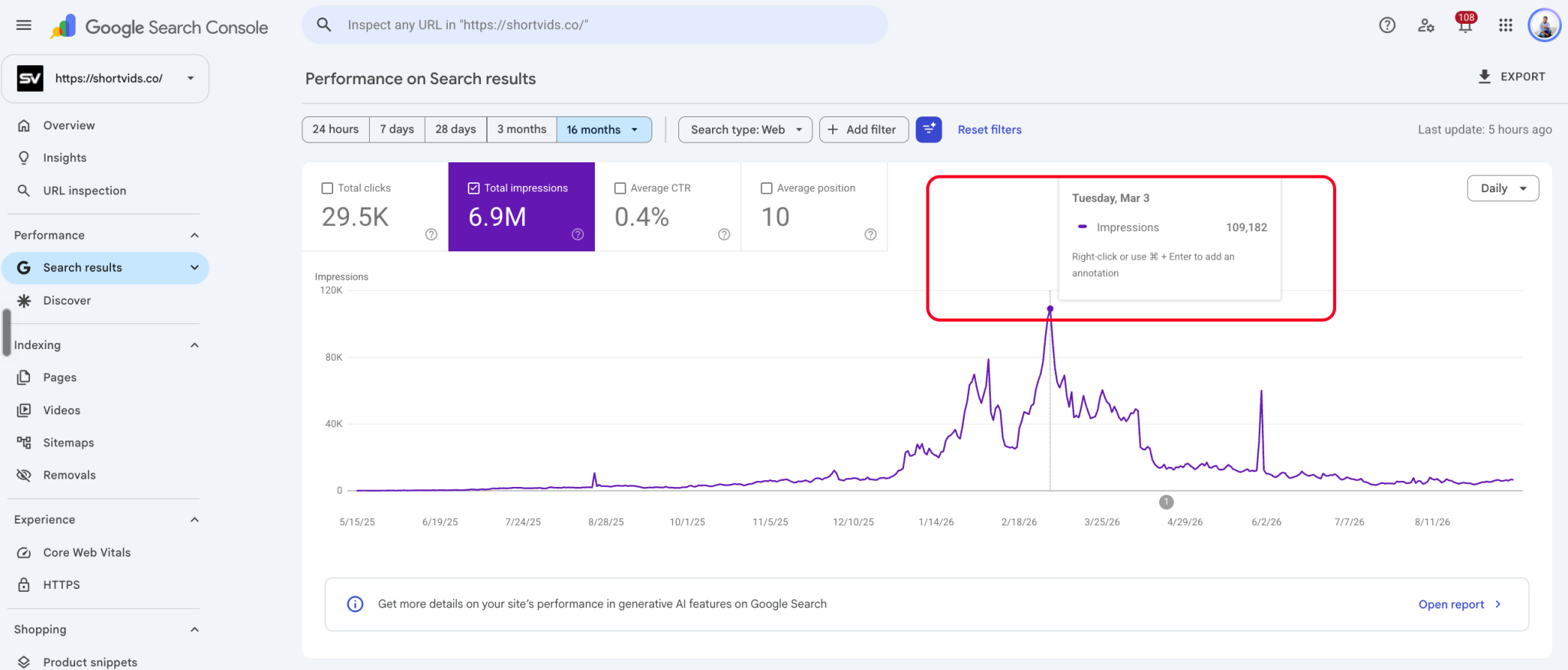
2026 view: 6.9M total impressions, 29.5K clicks and average position 10 in the 16-month Search Console view shown.
The commercial result mattered more. According to the client’s internal reporting, the same B2B brand generated more than $200,000 in revenue in Q2 2026. That is the standard we want AI SEO and GEO work to move toward: not just more impressions, but more qualified discovery that can turn into pipeline and revenue.
For Citedly, this is also why AI visibility cannot be separated from search fundamentals. A brand needs the technical and content foundation to be found, the entity and authority signals to be trusted, and the right commercial pages to convert attention once the buyer arrives.
What We Measure
Prompt Coverage: how many tracked buyer questions include the company.
Brand Mention Rate: how often the company is explicitly named.
Citation Rate: how often the company's pages are used as sources.
Recommendation Share: how often the company survives into a shortlist or direct recommendation.
Competitor Capture: which competitors repeatedly appear when the company does not.
Source Influence: which third-party pages shape the AI answer.
Entity Accuracy: whether the AI describes the company, services and positioning correctly.
Engine Gap: differences across ChatGPT, Gemini, Perplexity and Google AI.
For the measurement layer, see Citedly's guide to tracking AI citations and visibility.
A Practical B2B AI Visibility Audit
If you already have an SEO program, do not start by publishing 50 new articles. Start by testing whether the existing brand evidence survives inside real buyer questions.
Choose 20-30 commercial prompts across problem, category, use case, industry, proof, comparison, pricing and recommendation intent.
Run the same prompts across the AI engines your buyers are likely to use.
Record whether your company is mentioned, cited, recommended, misdescribed or absent.
Identify which competitors repeatedly win and which third-party sources support them.
Compare those answers with your service pages, case studies, pricing information, reviews and external mentions.
Fix the smallest set of content, technical and authority gaps that explain the difference.
Repeat the same prompt set so improvement is measured against a stable baseline.
Frequently asked questions
What is AI SEO for B2B?
AI SEO for B2B is the process of improving how often a company is accurately understood, cited, mentioned and recommended when business buyers use AI systems to research a problem, compare vendors or build a shortlist. It combines traditional SEO foundations with query research, entity clarity, proof, third-party corroboration and AI visibility measurement.
Is B2B GEO the same as B2B SEO?
They overlap, but the measurement is different. SEO primarily measures rankings, traffic and conversions from search. GEO or LLM SEO also measures whether generative systems retrieve your information, name the company correctly and include it in recommendations. In practice, strong B2B companies need both.
How is B2B AI SEO different from SaaS AI SEO?
SaaS buying is often dominated by product features, integrations, pricing, alternatives and workflow fit. Broader B2B services are evaluated more heavily on expertise, outcomes, industry experience, delivery model, risk, reputation and commercial fit. The underlying retrieval principles overlap, but the evidence the buyer needs is different.
What B2B content is most useful for AI search?
Service pages, industry pages, use-case pages, quantified case studies, pricing or engagement-model explainers, comparison content, original research and expert POV are particularly useful because they answer the questions buyers use to shortlist providers.
Do AI recommendations replace salespeople in B2B?
No. Research suggests AI increasingly shapes discovery and shortlisting, while buyers still validate through websites, search, peers and salespeople. AI search changes who reaches the validation stage rather than eliminating it.
Can a smaller B2B company compete with a larger brand in AI search?
Potentially, yes. Semrush's 2026 B2B survey found use-case fit and clear descriptions mattered much more to respondents than simple brand recognition. That creates an opportunity for specialist companies with clear positioning and strong evidence.
See Where AI Puts Your Business Today
Run your real buyer prompts across five AI engines and find out whether you get named, free, in about 60 seconds. Or book a call and we'll walk you through it.
Keep exploring
Read More from Citedly