AI Visibility
Ghost Citations: Why AI Cites Your Website but Doesn't Mention Your Brand
What Is a Ghost Citation?
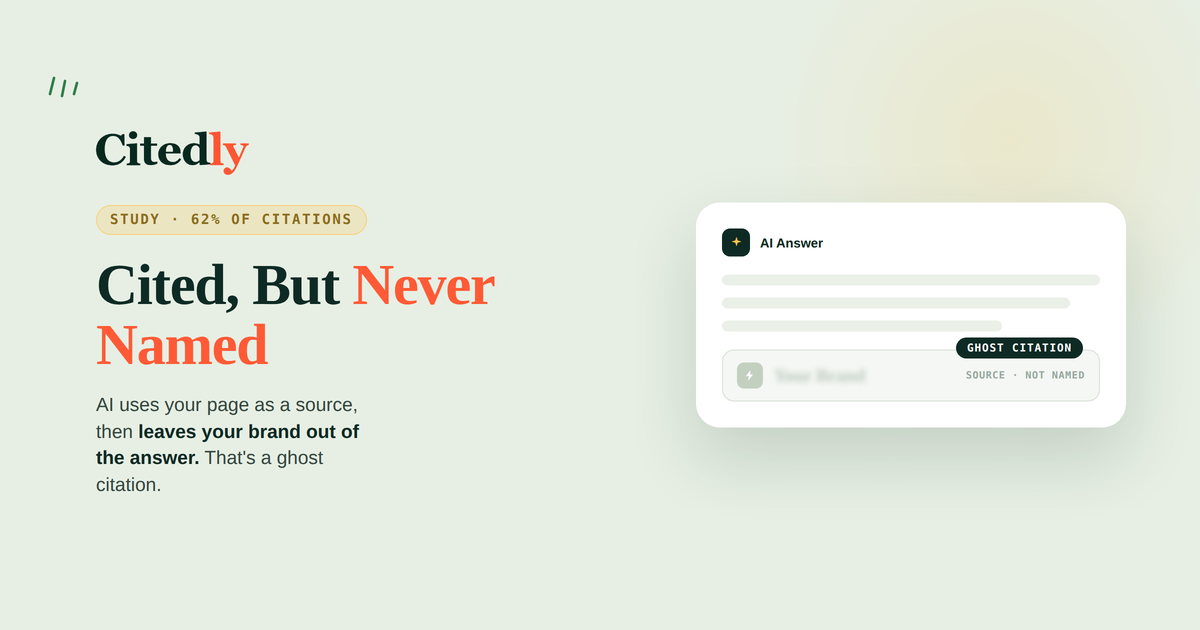
A ghost citation is an AI-generated source link to a website where that website's brand is not mentioned in the answer. The term was coined by growth advisor Kevin Indig to describe a frustrating gap: the AI clearly used your content, it even links to you, yet the reader finishes the answer without ever learning who you are.
Example: ChatGPT uses a page from Citedly as a source but answers the user without ever saying "Citedly." Citedly receives the citation, but not the brand exposure.
That distinction matters because a link and a name do different jobs. If you're hazy on the difference itself, our guide on citations vs mentions breaks it down. The short version:
- A citation is a source link pointing to your page. It is attribution.
- A mention is your brand name written into the answer. It is recognition.
A ghost citation gives you the first without the second.
Ghost Citation vs Brand Mention: The Difference at a Glance
| Ghost Citation | Brand Mention | |
|---|---|---|
| Website cited | Yes | Sometimes |
| Brand named in answer | No | Yes |
| Attribution | Yes | Maybe |
| Brand recognition | Low | High |
| Recommendation signal | Weak | Stronger |
| Worth tracking | Yes | Yes |
The goal isn't to eliminate citations. It's to understand whether your citations are translating into brand recognition, or quietly stopping short of it.
The Data: Most Citations Are Ghosts
Here is the finding that should reframe how you measure AI visibility. In a 2026 study, Semrush and Kevin Indig analyzed nearly 4,000 domain appearances across four major AI engines. The breakdown:
- 61.7% were ghost citations — cited as a source, brand never named.
- 13.2% were both cited and mentioned — the source link plus the brand name appeared.
- 25.1% were mentions with no citation at all — the AI named the brand without linking.
Sit with the first number. Almost two-thirds of the time your content gets pulled into an AI answer, the reader never sees your name. As the study's authors put it, appearing as a source doesn't automatically make your brand visible to users.
The measurement trap: in the study, the citation rate (~75%) was nearly double the mention rate (~38%). If you only track citations, your dashboard looks twice as healthy as your actual brand visibility. That's why tracking AI citations and mentions separately matters.
Each Engine Behaves Completely Differently
This is the part that trips up most measurement: the engines aren't just different in degree, they're opposite in behavior. Same study, per engine:
| Engine | Cites your brand | Names your brand |
|---|---|---|
| ChatGPT | ~87% | ~21% |
| Gemini | ~21% | ~84% |
| Google AI Overviews | High (leans citation) | Lower |
| Google AI Mode | Leans citation | ~2x ChatGPT's mention rate |
ChatGPT behaves like a footnoted research paper: it links sources constantly but rarely says the name out loud. Gemini does the reverse — it names brands conversationally from what it already "knows," but rarely links. So a business can look invisible on one engine and prominent on another for the exact same query. In the study, there was almost no overlap between the brands ChatGPT cited and the ones Gemini named for the same prompts. This is the mention-level version of why visibility differs by engine.
A Ghost Citation in Practice
To make this concrete, here is how a ghost citation actually plays out.
The prompt: "What are the best AI SEO tools for a small business?"
The AI answer: names Brand X, Brand Y, and Brand Z as options, with a Citedly article listed as a cited source.
The problem: Citedly's page was useful enough to be cited, but Citedly itself was never named. The reader trusts the three brands they saw, and has no idea Citedly was behind the answer.
What we would investigate:
- Is the cited brand clearly associated with its category (here, AI visibility)?
- Are third-party sources actually talking about the brand?
- Does the brand have category and comparison content that forces a naming?
- Does the cited page itself clearly identify the brand?
- Does the same cited-not-named pattern repeat across other engines?
That is the difference between reading about ghost citations in theory and diagnosing one in practice.
Why Ghost Citations Matter for Your Business
It is tempting to shrug this off — a citation is still something, right? It is. But the two outcomes serve very different goals:
- No recognition. The customer gets their answer and never learns your name, so there is no brand recall, no "I've heard of them," no shortlist entry next time.
- No recommendation. A mention reads as a suggestion. A ghost citation reads as nothing to the reader, because they never see it.
- No trust transfer. The value of AI naming you is that it feels like a vouch. A source link under the answer doesn't carry that.
To be clear about the value: a ghost citation is not worthless. A citation still means the AI considered your page useful enough to use as a source — it can generate the occasional click, expose your URL, and signal that your content was retrievable and relevant. But it is usually less valuable than a citation that also names the brand. A citation gives you attribution. A mention gives you recognition. If the goal is customer acquisition, recognition is usually the more commercially interesting outcome.
Why It Happens: What Makes AI Name You vs Just Cite You
Closing the gap starts with understanding why it exists. The research and the broader mechanics point to four drivers.
Strong Brands Get Named. Aggregators Get Cited.
The clearest pattern: AI names brands it recognizes as strong, standalone entities, and merely cites sources it treats as raw reference material. In the study, well-known brands like Google and Apple were named far more often than they were linked, while aggregator and reference sites were cited constantly but rarely named. One site was cited 16 times and never once named. Recognition is an entity-strength problem — AI says the names it is confident about.
Content Type Decides the Outcome
What kind of content gets pulled matters enormously:
| Query / content type | Citation rate | Mention rate |
|---|---|---|
| Informational ("what is," "how does") | ~89% | ~18% |
| Comparative ("best," "vs," "recommend") | Lower | ~43% (2.4x more) |
| How-to | — | ~43% |
| Commercial (pricing, buying) | ~84% | ~36% |
Informational content is the ghost-citation factory: AI consumes it as raw data and moves on. Comparative content forces the AI to name the players it is comparing, which is why it earns 2.4x more brand mentions.
How People Phrase the Query
The study found short, conversational queries produce brand mentions almost every time, while long, structured prompts produce mostly ghost citations — a 30x to 50x difference on the same topic. You can't control how customers phrase things, but you can make sure your brand is strong enough to be named when they ask the short, buying-style questions that matter most.
Your Brand's Footprint Across the Wider Web
AI does not only learn about a company from its website. It builds recognition from the broader web: industry publications, reviews, directories, Reddit, LinkedIn, podcasts, news, comparison pages, partner sites, and customer stories. Your website can tell AI what you are. The rest of the web is what establishes that you are recognized. The Semrush study reinforces this: AI mentions are driven by familiarity across the web — PR, community discussion, and clear brand language — not by your own pages alone.
How to Measure It: Your Ghost Citation Rate
You can't manage what you don't measure, and ghost citations are invisible in normal analytics. So it helps to put a number on it. We use a simple, Citedly-defined metric:
Ghost Citation Rate = citation-only appearances ÷ total AI appearances
For example: if your site appears 100 times across AI answers and 43 of those are citations with no brand mention, your ghost citation rate is 43%. The key insight it captures: a high citation rate is not the same as high brand visibility. Two businesses can have identical citation counts and completely different levels of recognition.
Tracked over time, and segmented by engine and query type, your ghost citation rate tells you whether your citations are actually translating into a brand people remember.
The Ghost Citation Recovery Framework
Closing the gap is a brand-recognition problem, not a content-volume problem. We work through it in four steps.
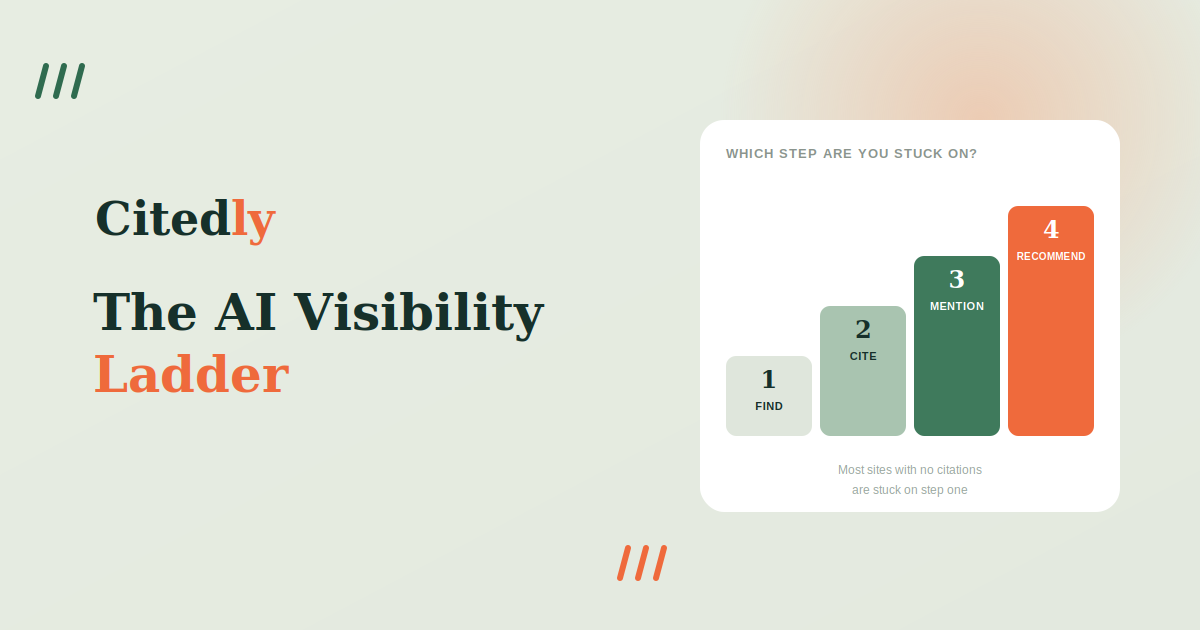
Step 1 — Find
Identify the pages and prompts where AI cites you without naming you. Take 10 to 30 high-intent prompts your buyers actually ask (especially comparative and commercial ones), run them across engines, and log where you are cited but not mentioned. That gap is your target list.
Step 2 — Diagnose
For each ghost citation, work out why the name is missing. Usually it is one of: weak entity recognition, generic positioning, thin commercial or comparison content, weak third-party presence, or an unclear brand association on the cited page itself. Several of these overlap with the reasons AI skips your site entirely.
Step 3 — Reinforce
Build the signals that earn a name, not just a link: comparison and clear category content, entity consistency across the web, third-party mentions, original research, and customer proof. This is the same off-site work behind getting mentioned in AI, and it is why mentions beat backlinks for getting named. Keep your own pages structured so AI can lift them and clearly branded.
Step 4 — Re-test
Run the same prompts again and measure the shift from citation to mention. Recovery is only real when the ghost citation becomes a named one.
"Appearing as a source doesn't automatically make your brand visible to users."
Semrush & Kevin Indig, 2026 ghost citation study
The Bigger Lesson
A citation tells you that AI found your information useful. A mention tells you that AI connected that information to your brand. Those are not the same outcome.
That is why AI visibility shouldn't be measured with a single number. Track where you are cited, where you are mentioned, which prompts trigger each, which engines behave differently, and whether that visibility happens on the searches that actually matter to your business.
The goal isn't simply to become a source. It is to become the source people remember.
How Citedly Closes Your Ghost-Citation Gap
Running citation analysis across AI engines is only the first step. The real work is figuring out why AI cites your content but doesn't name your brand, then strengthening the signals that can turn those silent citations into named recommendations.
Track citations and mentions separately. Citedly tracks your AI citations and brand mentions separately across ChatGPT, Gemini, Perplexity, and Google. This lets you see where your content is being used as a source, where your brand is actually being named, and where you're stuck in the middle: cited, but invisible.
Find the topics where you're a ghost. We identify the buyer prompts, topics, and searches where competitors are being mentioned while your brand is only cited, or doesn't appear at all. That gives you a much clearer picture of where you're losing AI visibility and which opportunities are worth fixing first.
Build the signals that get you named. Getting mentioned isn't just about publishing more content. Citedly works across your SEO, content, entity signals, internal linking, and third-party presence to strengthen the connections between your brand, what you offer, and the searches your potential customers are making.
Keep optimizing as AI search changes. AI answers aren't static. Models change, competitors publish new content, and the sources AI relies on shift over time. That's why Citedly isn't a one-time audit — we continuously track your visibility and optimize around the opportunities that matter most.
Citedly is a done-for-you AI visibility service built for small and local businesses, starting at $299/month with no contract. The goal isn't just to get cited. It's to get named when your next customer asks AI who they should choose.
Frequently asked questions
What is a ghost citation in AI search?
A ghost citation is when an AI engine uses your page as a source and links to it, but never mentions your brand name in the answer. You get attribution the reader rarely notices, and no brand recognition. A 2026 Semrush study found 62% of AI citations are ghost citations.
Why does AI cite my site but not mention my brand?
Because citations and mentions are earned differently. Citations reward page authority and useful content; mentions reward brand recognition. AI names brands it is confident about as entities and cites everyone else as raw reference material. Informational content especially tends to get cited without a mention.
Does being cited by AI still have value?
Yes. A citation still means the AI considered your page useful enough to use as a source, and it can pass a little authority and the occasional click. But a citation alone doesn't guarantee brand recognition. For businesses, it is therefore useful to track citations and mentions separately rather than treating citations as the complete picture of AI visibility.
How do I measure my ghost citation rate?
Divide your citation-only appearances by your total AI appearances across a set of tracked prompts. Run those prompts across engines, log whether each appearance was cited, mentioned, both, or neither, and segment by engine and query type since behavior varies sharply between them.
How do I get AI to mention my brand, not just cite me?
Strengthen your brand as a recognizable entity (consistent details everywhere, presence on trusted reference sources), create comparative "best" and "vs" content that forces AI to name players, and get talked about on third-party sites. These build the recognition that turns a ghost citation into a named mention.
Do comparative pages really get mentioned more?
Yes. In the Semrush study, comparative content ("best," "vs," "recommend") earned about 2.4x more brand mentions than informational content, because comparisons force the AI to name the businesses it is evaluating.
Sources & Methodology
The statistics in this article referring to citation and mention rates come from Semrush's 2026 ghost citation study, conducted with Kevin Indig and Growth Memo. The study analyzed 3,981 domain appearances across 115 prompts, 14 countries, and four AI search engines (ChatGPT, Google AI Overviews, Gemini, and Google AI Mode). For a practical walkthrough of running your own citation analysis, see Campaign Creators' guide on citation analysis for AI visibility.
See Where AI Puts Your Business Today
Run your real buyer prompts across five AI engines and find out whether you get named, free, in about 60 seconds. Or book a call and we'll walk you through it.
Keep exploring
Read More from Citedly
AI Visibility Guide
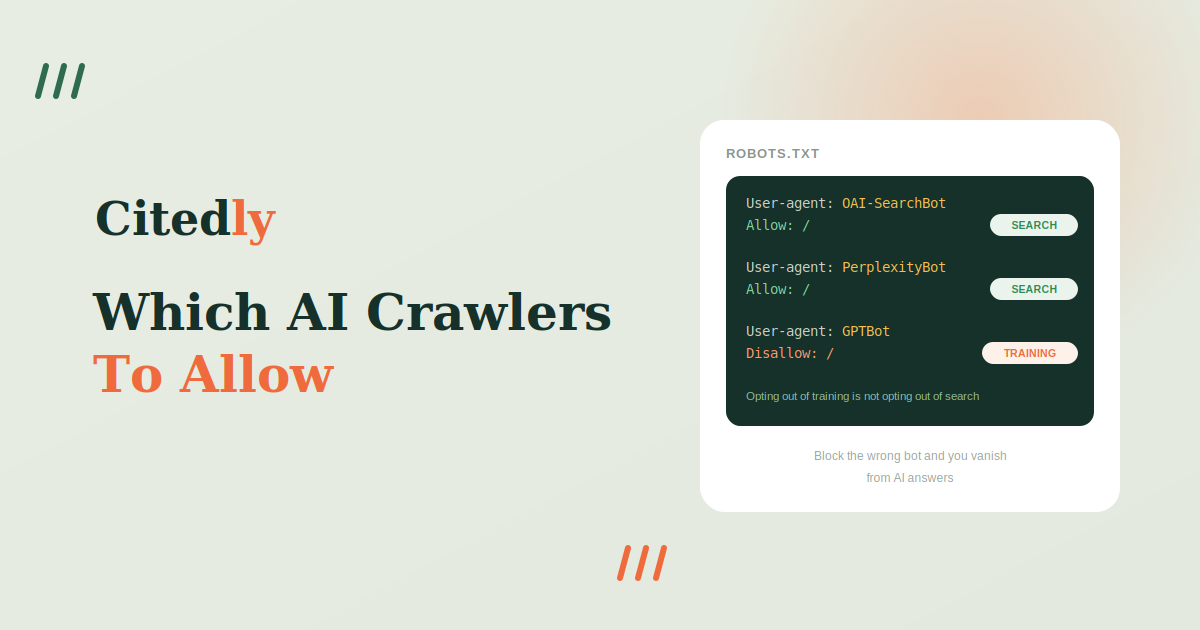
AI Crawlers: Complete List, Robots.txt Rules and Which Ones to Allow
Read article →