Local AI Search
How to Get Your Local Business Recommended by AI (ChatGPT, Gemini & Google AI) in 2026
What Getting Recommended by AI Means for a Local Business
Getting recommended by AI means that when someone nearby asks ChatGPT, Gemini, Perplexity, or Google's AI for a business like yours, the answer actually names your company as an option. That is different from simply ranking somewhere on a search results page. In an AI answer, the shortlist is compressed and the recommendation itself can become the decision surface.
The behavior is moving quickly. BrightLocal's 2026 consumer research found that 45% of consumers used AI tools for local business recommendations in the previous year, up from 6% in 2025. ChatGPT alone was used by 31% of consumers for business recommendations, according to BrightLocal's research.
This is the local version of the broader shift we cover in what AI citations are: visibility is moving from being one link among many to being one of the businesses an AI system is confident enough to name.
What Is Local AI SEO?
Local AI SEO is the process of improving how often a local business is discovered, understood, mentioned, cited, and recommended across AI search experiences such as ChatGPT, Gemini, Google AI Overviews, Google AI Mode, and Perplexity. It combines traditional local SEO foundations with newer AI visibility signals.
The traditional pieces still matter: Google Business Profile, reviews, location pages, citations, accurate business information, and strong local content. Local AI SEO adds another layer: entity consistency, answer-first content, structured data, third-party corroboration, prompt-level tracking, and visibility across multiple AI engines rather than Google alone.
Why the AI Shortlist Is Harder Than the Map Pack
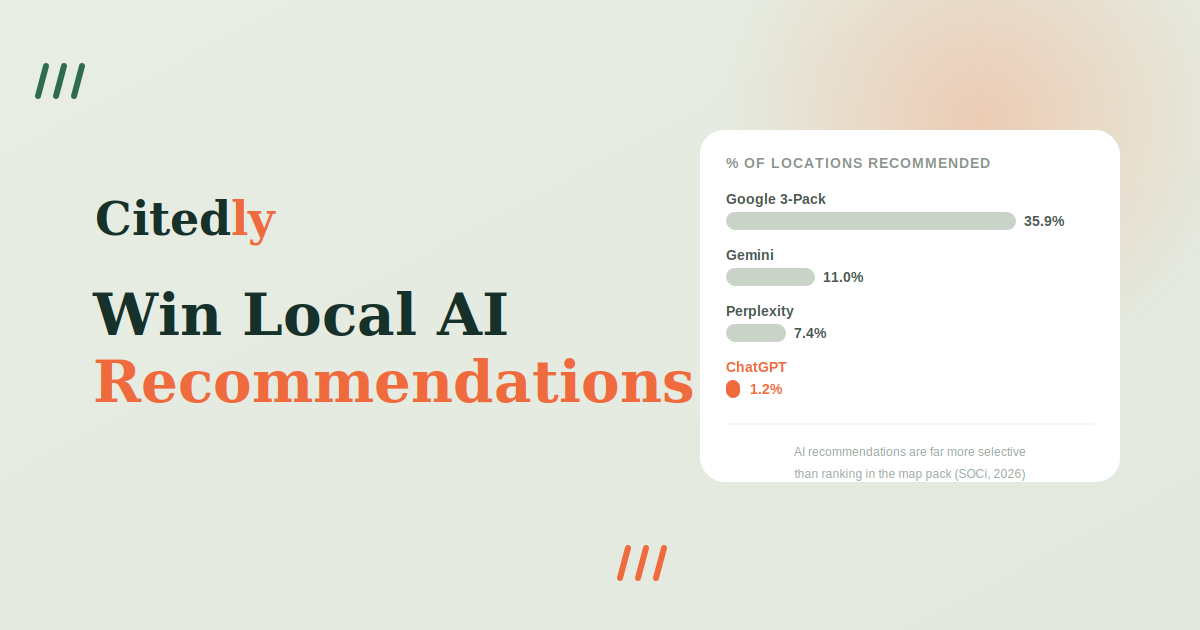
AI recommendations can be considerably more selective than traditional local search. SOCi's 2026 Local Visibility Index analyzed more than 350,000 locations across 2,751 multi-location brands. Those locations appeared in Google's local 3-pack 35.9% of the time, but were recommended by ChatGPT only 1.2%, by Perplexity 7.4%, and by Gemini 11.0%.
The important correction is that 1.2% is a ChatGPT recommendation rate for the audited multi-location brand locations, not a universal percentage for every local business or every AI engine. The broader takeaway still holds: AI recommendations are much harder to earn than ordinary local search visibility.
Local SEO vs Local AI Search: What Actually Changed
They overlap, but they optimize for different outcomes. Knowing the difference tells you where to put your effort.
| Dimension | Traditional Local SEO | Local AI Search |
|---|---|---|
| Goal | Rank in Google's map pack | Get named inside an AI-generated answer |
| Result format | Ranked list and map results | Compressed shortlist or synthesized recommendation |
| Main signals | Proximity, GBP, reviews, local relevance | Reviews, entity consistency, third-party mentions, structured data, extractable content |
| Measurement | Rank position, calls, clicks, impressions | Recommendation frequency, mentions, citations, accuracy, share of model |
| Where you win | Mostly Google properties plus local web signals | Across Google, Bing, directories, reviews, forums, publishers, and brand-owned pages |
The headline: local AI search rewards reputation, consistency, and machine-readable specificity across the web, not just a well-optimized Google presence.
Which Sources Each AI Engine Uses for Local
Because each engine uses a different retrieval stack and source mix, getting recommended everywhere requires broad, consistent presence rather than optimizing for one platform only.
| Engine | Important Local Sources and Signals |
|---|---|
| Google AI / Gemini | Google Business Profile, Maps, reviews, Google's index, merchant and product data where relevant |
| ChatGPT | Bing-indexed web pages, third-party reviews, directories, forums, roundups, and other open-web sources |
| Perplexity | Web search sources, reviews, directories, forums, Reddit, publishers, and local reference pages |
That is also why the same business can be accurately described on one platform and missing on another. We break that problem down in why AI cites you differently across platforms.
How to Get Your Local Business Recommended by AI
This is the core local AI search playbook. None of it requires being a national brand. The goal is to give AI engines enough consistent evidence to understand your business, trust it, and match it to the exact local query.
1. Complete and Optimize Your Google Business Profile
For Google's AI ecosystem, your Google Business Profile is one of the most important structured sources about your business. Complete every relevant field: primary and secondary categories, services, hours, service areas, photos, products where applicable, attributes, and a clear business description. Keep temporary hours and service changes current so AI does not repeat stale information.
2. Build Strong, Recent Reviews
Reviews are a major trust and recommendation signal, but avoid treating observed averages as hard minimum thresholds. SOCi's 2026 benchmark data found that locations recommended by ChatGPT averaged 4.3 stars, Perplexity 4.2, and Gemini 3.9.
- Ask for reviews consistently after real customer experiences.
- Encourage customers to describe the service they received naturally. Detailed reviews give AI more context than a star rating alone.
- Respond to positive and negative reviews so your profiles remain active and your reputation is visibly managed.
- Never manufacture reviews or coach customers to publish false claims.
3. Lock Your Name, Address, Phone, and Description Everywhere
If your name, address, phone number, categories, or service descriptions conflict across your website, Google Business Profile, Bing Places, Yelp, Facebook, industry directories, and review platforms, AI systems have a harder time resolving those records into one confident business entity. Standardize the information and fix outdated listings.
4. Be Specific About What You Do
AI recommends the business it can understand precisely. "We service Honda, Toyota, and Subaru" is more useful than "all makes and models." "Emergency drain cleaning in North Dallas" is easier to match than "full-service plumbing." Build clear service pages that name the service, customer type, location, and relevant specialties without stuffing keywords.
5. Add LocalBusiness Schema and Answer-First Content
Use the most specific schema type that accurately describes the business, such as LocalBusiness, Dentist, MedicalClinic, AutoRepair, Restaurant, Store, or another valid subtype. Add supporting properties only when they match visible, accurate information on the page. Then make the page itself easy to extract by answering the main question immediately under each heading.
Our complete content framework is in how to structure content for AI. Getting mentioned consistently off-site feeds the same signals — see how to earn AI mentions.
6. Get Onto the Directories and "Best Of" Lists AI Reads
For "best [service] in [city]" and comparison-style searches, third-party sources become especially important. Prioritize authoritative directories, local publishers, industry associations, chamber listings, specialist review platforms, and credible roundups that genuinely fit the business.
This off-site footprint is what builds the broader corroboration behind AI brand mentions. Quality matters more than raw volume. A smaller set of accurate, relevant profiles is more useful than hundreds of inconsistent low-quality listings.
7. Make Sure AI Can Crawl and Index Your Website
None of the reputation work helps if your important pages cannot be fetched or indexed. Make sure your pages return normal HTML, important content is not hidden behind client-side rendering only, robots rules are intentional, sitemaps are current, and the site is visible in both Google and Bing. If you have done the work but still remain absent, work through the blockers in why AI isn't citing your website.
How to Rank in ChatGPT for Local Searches
There is no single permanent "ChatGPT local rank," but you can improve the probability that ChatGPT includes your business for buyer prompts such as "best plumber in Dallas" or "med spa near Scottsdale." Focus on the signals ChatGPT can retrieve and corroborate.
- Ensure your site and important local pages are indexed in Bing.
- Make your service and location information explicit on the page.
- Build recent third-party reviews and accurate directory profiles.
- Earn mentions in credible local and industry sources.
- Keep your brand name, category, location, and service descriptions consistent.
- Test a fixed prompt set over time instead of relying on one answer.
For a deeper ChatGPT-specific playbook, see how to get ChatGPT's recommendation.
How AI Handles "Near Me" Searches
"Near me" recommendations depend on more than inserting the phrase into a page. AI systems need strong geographic evidence that the business actually serves the user's location. That evidence can come from Business Profile data, maps, address and service-area information, local reviews, location pages, structured data, and third-party listings.
- Keep your physical address or service area accurate on major local platforms.
- Create a dedicated page for each real location instead of one generic multi-city page.
- Use natural city, neighborhood, and service-area language in relevant pages.
- Keep hours, phone numbers, and appointment information current.
- Earn reviews and local mentions that reinforce the geographic association.
A search like "emergency plumber near me" needs different evidence from "best commercial plumber in Dallas." One is heavily location- and availability-sensitive; the other also depends on specialty, reputation, and category fit.
What Changes by Industry
The framework is universal, but the strongest corroborating sources and content signals vary by category.
Healthcare
For dentists, clinics, med spas, and other healthcare businesses, verifiable expertise and accurate practitioner information matter more because the recommendation may affect health decisions. Use appropriate medical schema, attribute clinical content to real practitioners when applicable, maintain accurate credentials, and build presence on authoritative healthcare directories.
Home Services
For plumbers, HVAC companies, electricians, roofers, and similar businesses, service specificity, availability, location coverage, and review quality are crucial. Create individual service pages, maintain accurate service areas, and build reviews that naturally describe the work performed.
Automotive
Automotive businesses should clearly state the makes, models, certifications, and services they handle. Individual service pages and industry-specific directories can help AI distinguish a hybrid specialist, European repair shop, tire center, or general mechanic.
Restaurants and Retail
Restaurants and retailers benefit from current menus, product categories, inventory or availability information where possible, photos, hours, and niche positioning. AI can answer "best vegan brunch near me" or "where can I buy wide-width running shoes" only when the business provides enough specific information to match the query.
How to Check If AI Recommends Your Local Business
Before fixing anything, establish a baseline. Run the same local buyer questions across multiple engines and record the answers in a simple sheet.
- Run 15–20 real queries. Test prompts such as "best [service] in [city]," "[service] near me," and "emergency [service] open now in [city]."
- Record whether you are named. Also note which competitors appear and how prominently.
- Read the cited sources. The directories, review platforms, roundups, and local publishers repeatedly cited by the engine become your priority list.
- Check factual accuracy. Verify your hours, phone, address, services, pricing, and category when the AI mentions you.
- Track by engine. A business can be visible in Gemini and missing in ChatGPT, so do not collapse everything into one score.
For a repeatable measurement system, use our guide on tracking AI citations.
Local AI Recommendation Checklist
| Check | What Good Looks Like |
|---|---|
| Google Business Profile | Complete, accurate, current, correct categories and services |
| Reviews | Recent, genuine, detailed, actively responded to |
| NAP and entity data | Consistent across website, maps, directories, and review platforms |
| Service and location pages | Specific, useful, answer-first, locally relevant |
| Structured data | Accurate LocalBusiness/service/location schema matching visible content |
| Bing and Google indexing | Important pages discoverable and crawlable |
| Third-party presence | Relevant directories, publishers, roundups, industry sources |
| AI tracking | Fixed local prompt set monitored by engine over time |
The map pack ranks whoever is nearby and relevant. AI recommends whoever the web agrees is trustworthy. For a local business, that agreement is built from reviews, listings, and consistency — not from your homepage.
Have Citedly Get Your Local Business Recommended by AI
Doing all of this consistently is a real ongoing job: maintaining your Business Profile, improving reviews, fixing entity inconsistencies, structuring local pages, implementing schema, earning the right third-party presence, and checking whether each AI engine is actually naming you.
That is what Citedly handles. We work on the on-site and off-site signals that improve AI visibility, then track where your business is mentioned, cited, or replaced by a competitor across major engines. Plans start at $299/month with no contract.
Frequently asked questions
How do I get my local business recommended by AI?
Build a complete Google Business Profile, earn strong recent reviews, keep your business details consistent everywhere, add accurate LocalBusiness schema, publish specific local service content, and build presence on the directories and review sites your category relies on.
Does ranking on Google Maps mean AI will recommend me?
No. Strong local rankings help, but AI recommendation systems use a broader set of signals and may synthesize information from reviews, directories, publishers, maps, forums, and other indexed sources. SOCi's 2026 research found much lower AI recommendation rates than Google local 3-pack visibility among the multi-location brands it studied.
What star rating do I need to be recommended by AI?
There is no universal guaranteed minimum. SOCi's 2026 benchmarks found locations recommended by ChatGPT averaged 4.3 stars, Perplexity 4.2, and Gemini 3.9. Treat these as observed averages, not hard thresholds. Review recency, detail, sentiment, and overall reputation also matter.
How is local AI search different from local SEO?
Local SEO focuses heavily on ranking in maps and search results. Local AI search focuses on being selected, described accurately, cited, or recommended inside generated answers. The foundations overlap, but AI visibility depends more heavily on entity consistency, third-party corroboration, extractable content, and cross-engine measurement.
Do I need to be on every directory?
No. Focus on authoritative and relevant sources for your industry and location. Accurate, complete profiles on the right platforms are more useful than hundreds of thin or conflicting listings.
What if my business has multiple locations?
Each real location should have its own Google Business Profile where eligible, a dedicated location page, location-specific structured data, consistent local listings, and reviews associated with that location. Avoid trying to make one generic page represent every market.
Which AI engine matters most for local businesses?
It depends on where your customers search. Google's AI products, ChatGPT, Gemini, and Perplexity all matter, but their source mixes differ. The practical strategy is to build consistent local signals across the web and measure visibility separately by engine.
How long does it take to get recommended by AI?
There is no fixed timeline. Technical and listing corrections can be picked up relatively quickly after recrawling, while reputation, third-party mentions, and repeated recommendation visibility usually take longer to build. Track changes over weeks and months rather than expecting one update to create a permanent result.
See Where AI Puts Your Business Today
Run your real buyer prompts across five AI engines and find out whether you get named, free, in about 60 seconds. Or book a call and we'll walk you through it.
Keep exploring
Read More from Citedly
AI Visibility Guide
AI Crawlers: Complete List, Robots.txt Rules and Which Ones to Allow
Read article →