Case Study
How A1 Garage Door Became a ~$2 Billion Business — the SEO and Marketing Case Study

Research-based case study · Updated September 2026
The Deal: Why a Garage-Door Company Could Be Worth Around $2 Billion
In September 2026, KKR agreed to acquire A1 Garage Door Service for around $2 billion. By then, Tommy Mello had taken a Phoenix garage-door business into roughly 20 states. In context the attraction is easy to understand: home services combine durable demand with highly fragmented local competition, which gives a well-run operator room to consolidate markets and scale.
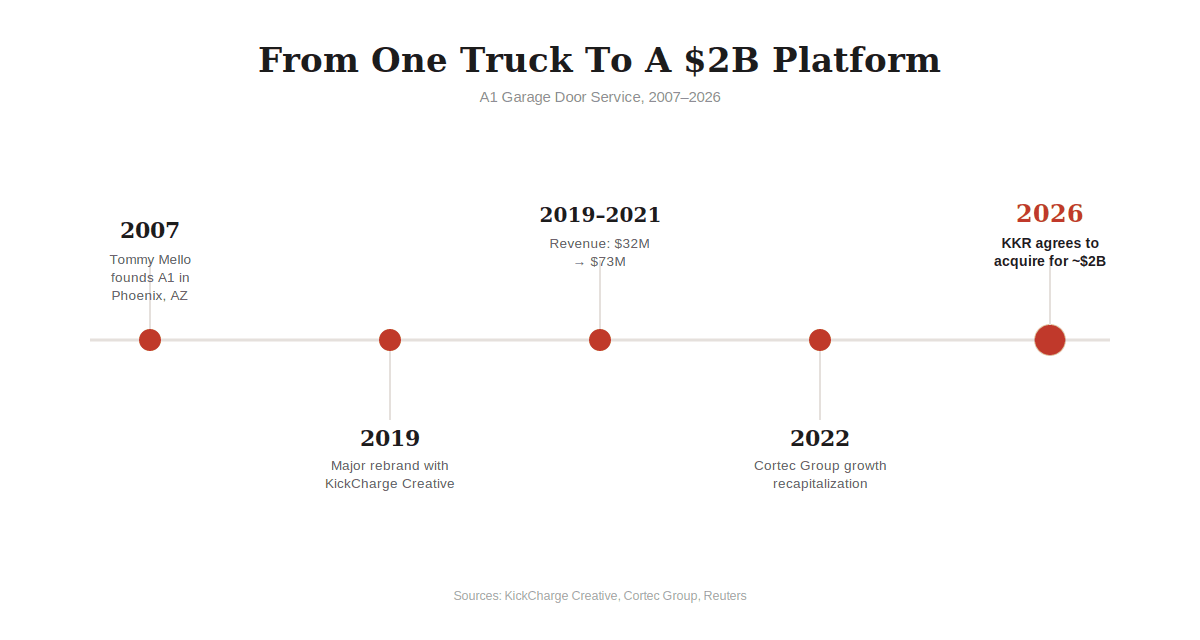
A1 Garage Door Service, 2007–2026. Sources: KickCharge Creative, Cortec Group, Reuters.
Three different companies are usually mixed up in this story, so it helps to separate them before drawing any lessons.
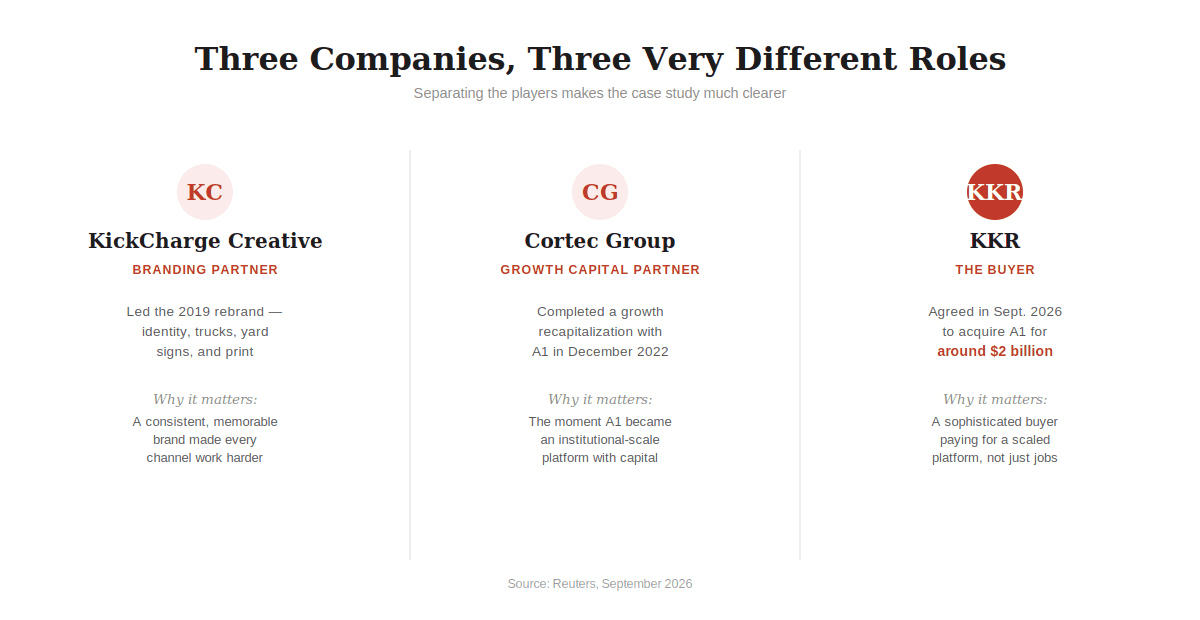
Three companies, three very different roles. Source: Reuters, September 2026.
This is the mindset shift for a plumbing, roofing, window-cleaning or electrical owner. Your company does not have to remain a vehicle for this year's income. If demand generation, brand, operations and local-market expansion become predictable, the business becomes an asset somebody else is willing to pay for.
A1's Marketing Engine Was Not "Just SEO"
We looked past the deal price and traced the machinery already in place. A1 had built a demand system rather than a collection of isolated tactics: direct-response lead generation, a highly consistent offline brand, strong local search infrastructure and market-by-market digital execution. The more we investigated, the more the same pattern appeared everywhere — trucks, billboards, Google Business Profiles, location pages, reviews, content, calls, scheduling and conversion all feeding one growth engine.
| Layer | What A1 Did | Why It Matters to a Local Owner |
|---|---|---|
| Brand | Unified trucks, signage, mailers, billboards, apparel and website. | Every impression reinforces the same company, making branded search and trust easier. |
| Google Business Profiles | Bulk verification, profile optimization, consistent new reviews. | Local visibility scales across dozens of storefronts instead of being managed one-off. |
| Local SEO | Optimized title tags, local content, URLs, service + city relevance. | Each market gets its own discovery surface instead of one generic homepage. |
| Near-me search | Local pages deliberately optimized around "near me" phrases. | Captures urgent, high-intent local demand. |
| Conversion | Calls, scheduling, offers, reviews, cost estimator, service CTAs. | Traffic is pushed toward booked jobs rather than pageviews. |
| Measurement | Traffic, clicks, rankings, GBP performance, conversions, market-level results. | Management can see where demand is growing and where more investment is justified. |
What We Found After Investigating A1's SEO Engine
To see whether search was actually contributing, we went into the published campaign data behind A1's local SEO. The objective was straightforward: improve the visibility of its Google Business Profiles while expanding unbranded organic visibility across every market. What followed was not a one-off ranking win. It was a multi-location SEO system that could be repeated as A1 expanded.
1. Google Business Profile Management at Multi-Location Scale
A1 Garage Doors already had a growing network of storefront profiles, so one of the first structural moves was Google bulk verification. At A1's scale, dozens of local profiles cannot be treated as separate side projects. The profiles were kept complete and paired with a constant flow of fresh reviews, turning Google Business Profile management into an operating process rather than a setup task.
That matters for plumbing, roofing, electrical and other multi-location operators. A Google Business Profile is not a one-time listing. It is an active local landing point that needs categories, service information, photos, reviews, responses and accurate data maintained market by market.
2. Onsite Changes Built Specifically for Map Rankings
The next layer was onsite. Landing pages tied to A1's Google Business Profiles were rebuilt around the searches most likely to produce a job: title tags carrying the core money keyword, body content covering long-tail variations such as "garage door installation near me" and "best garage door repair," and cleaner keyword-relevant URLs. The local page and the GBP were optimized as one acquisition unit.
A GBP rarely works in isolation. The page it sends users to becomes part of the trust and relevance system. A weak generic page limits both conversion and local relevance; a market-specific page supports rankings, answers the buyer's question and closes the lead. The same discipline applies to structuring content for AI: specific pages beat generic ones for both humans and machines.
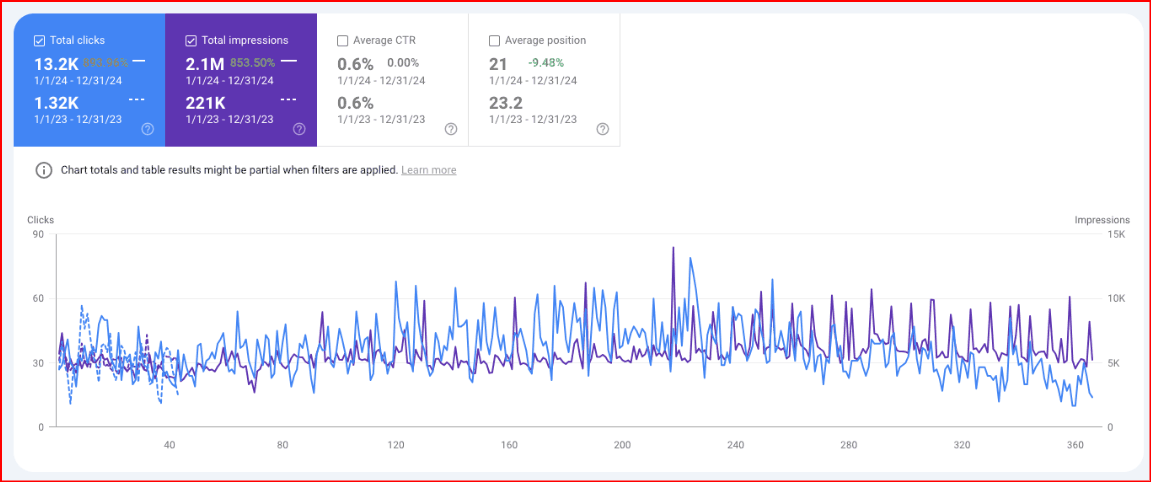
SEO performance data for A1 Garage Door Service. Credit: Sterling Sky.
The screenshot above from Sterling Sky shows the scale of the change. In the 2024 comparison, total clicks were shown at roughly 13.2K versus 1.32K in the earlier period, while impressions were around 2.1M versus 221K. The exact attribution belongs to Sterling Sky's campaign data, but the commercial lesson is straightforward: location-led SEO created a much larger pool of non-brand discovery.
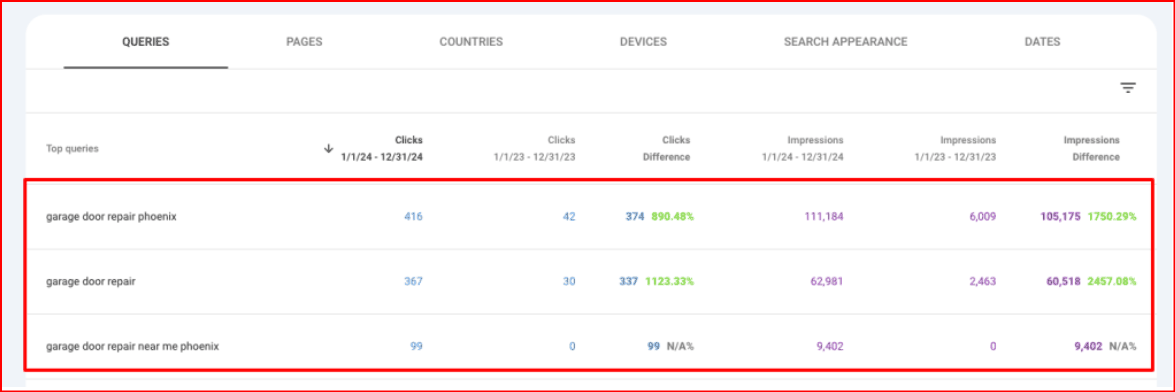
Google Search Console query performance for A1 Garage Door Service. Credit: Sterling Sky.
The query-level view is even more useful. "Garage door repair phoenix" clicks rose from 42 to 416, "garage door repair" from 30 to 367, and "garage door repair near me phoenix" from 0 to 99 clicks. Those are exactly the unbranded searches that create new-customer demand rather than harvesting people who already know the brand.
3. Location Pages Became a Customer-Acquisition Asset
Across the location-page portfolio, unbranded organic clicks improved by more than 900% in 2024 versus 2023. The work concentrated on commercially valuable terms such as "garage door repair" across A1's markets — exactly the query type that introduces a brand to a homeowner who has never heard of it.
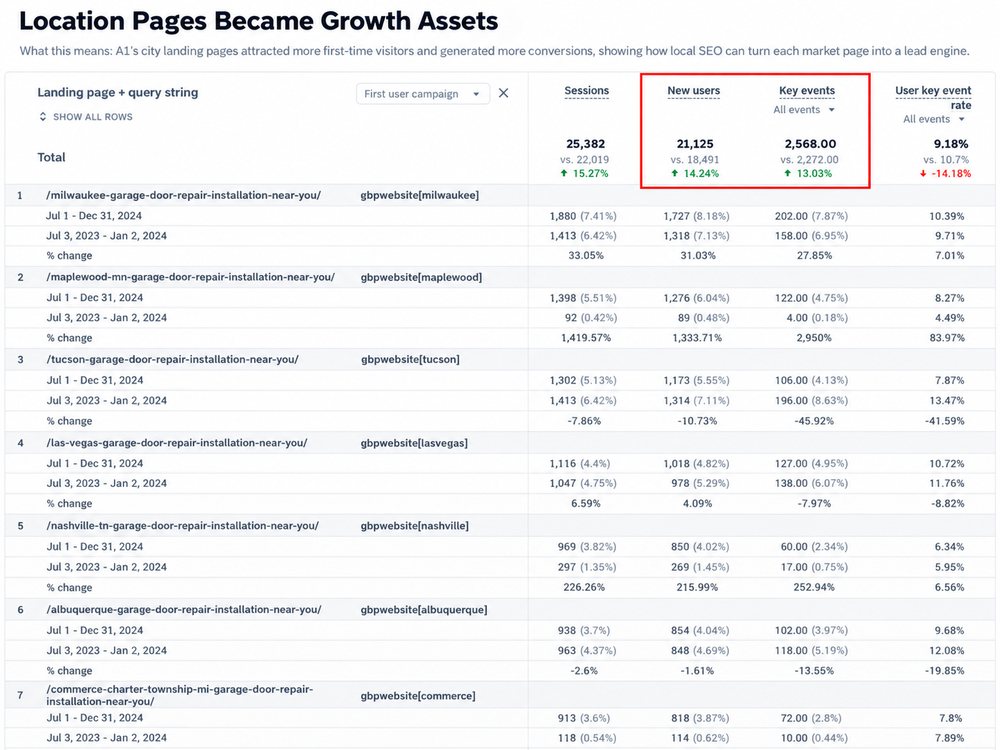
Location-page analytics for A1 Garage Door Service. Credit: Sterling Sky.
The analytics illustrate why local landing pages matter at scale: individual pages for markets such as Milwaukee, Maplewood, Tucson, Las Vegas, Nashville and Albuquerque each become independent demand generators. One corporate website can therefore behave like dozens of local acquisition machines.
4. "Near Me" Was Treated as a Real Search Category
The same local-page system deliberately targeted "near me" intent through 2023 and 2024. That produced almost 900% growth in unbranded "near me" clicks in 2024 versus 2023 — a critical result for home services, where the highest-value searches happen when a customer needs someone nearby immediately.
For HVAC, plumbing, garage doors, electricians, pest control and cleaning businesses, that is the intent that matters. The prospect is not researching an industry. They are looking for somebody nearby who can solve the problem now — which is also how local businesses get recommended by AI.
5. SEO Was Integrated With A1's Internal Teams
One of the most important things we found is that SEO was not operating in a silo. The processes were integrated with A1's internal teams so search work supported the same goal as the rest of the company: more qualified inbound demand and more revenue. That is how serious growth companies treat SEO — as part of website development, reviews, market expansion, conversion and operations, not a monthly ranking report from an outside vendor.
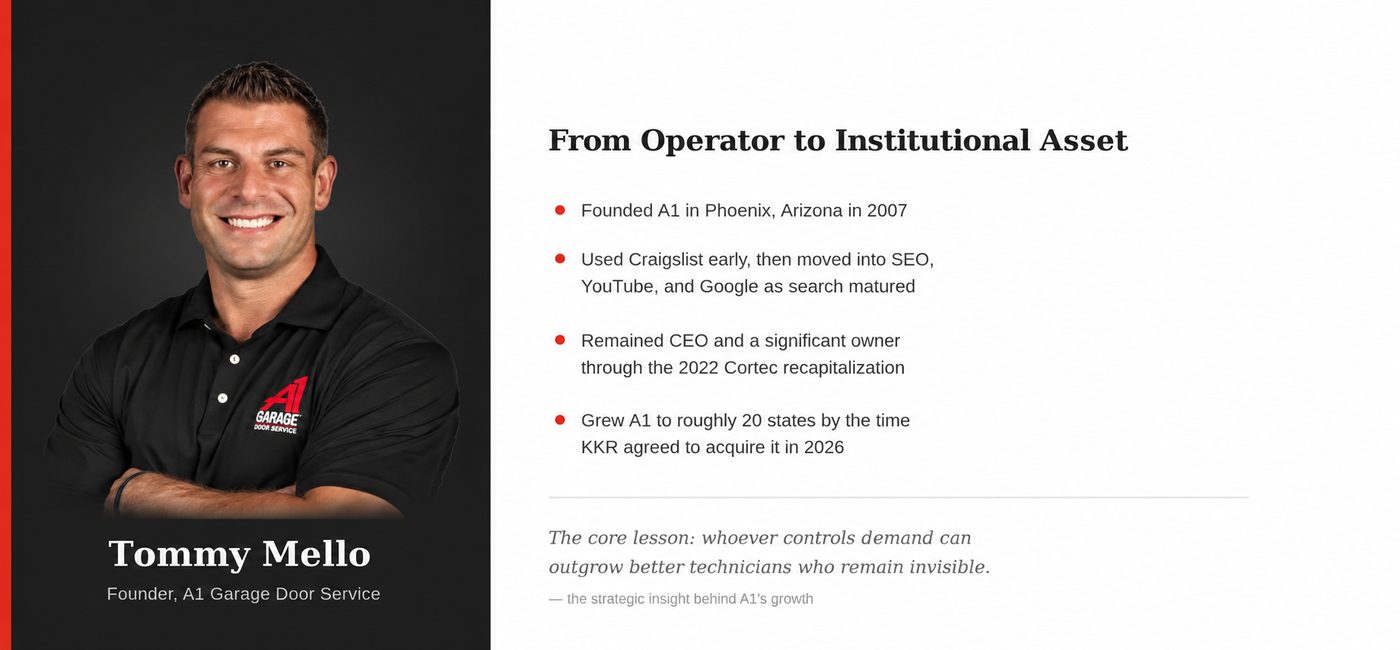
Tommy Mello controlled demand early — the strategic insight behind A1's growth.
Whoever controls demand can outgrow better technicians who remain invisible. That is the whole A1 lesson in one sentence.
— the Citedly team, after reviewing A1's published campaign data
The Website Architecture: One Domain, Many Local Markets
There's one important correction to the common description of A1's website strategy: A1 does not appear to use a separate domain for every city or state. The current site uses one primary domain, a1garage.com, and builds geographic depth underneath it. That is usually the stronger architecture, because authority, links, content history and brand signals compound to one domain.
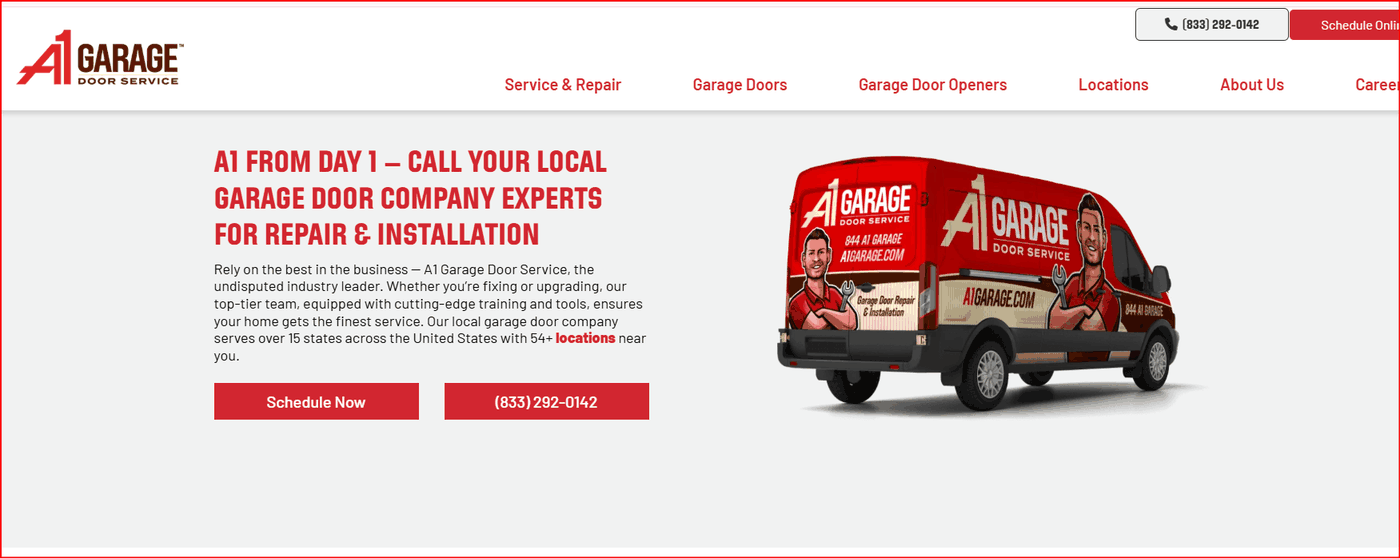
A1 Garage Door Service website. Source: A1 Garage Door Service.
| Website Layer | A1 Example | What the Layer Does |
|---|---|---|
| Core domain | a1garage.com | Concentrates brand authority and acts as the main conversion hub. |
| Locations hub | /areas-served/ and Locations navigation | Creates a discovery path for every operating market. |
| State pages | Arizona, Florida, Texas, Wisconsin, etc. | Builds regional relevance and routes users into local markets. |
| City / market pages | Phoenix, Scottsdale, Tucson, Mesa, Tempe and many others | Targets city-level and "near me" demand. |
| Service pages | Repair, emergency repair, springs, openers, installation, maintenance | Matches service-specific commercial intent. |
| Content / blog | Pricing, maintenance, comparisons, homeowner questions | Captures research queries and supports topical authority. |
| Conversion layer | Schedule Online, Call Now, offers, cost estimator | Turns discovery traffic into leads and jobs. |
This architecture matters most when you expand. A new city is not simply a new truck. It needs a repeatable digital footprint: location page, GBP, reviews, service relevance, local proof, internal links, tracking and a conversion path. That's how a website starts behaving like infrastructure rather than marketing collateral.
A1 Also Built Content Around Real Buyer Questions
A1's blog increasingly reflects the same commercial logic. Topics include emergency repair cost, opener installation cost, maintenance, estimates, smart-garage technology, company comparisons and diagnosis guides. Those are not vanity articles. They map directly to the questions homeowners ask before choosing whether to repair, replace, compare providers or spend money.
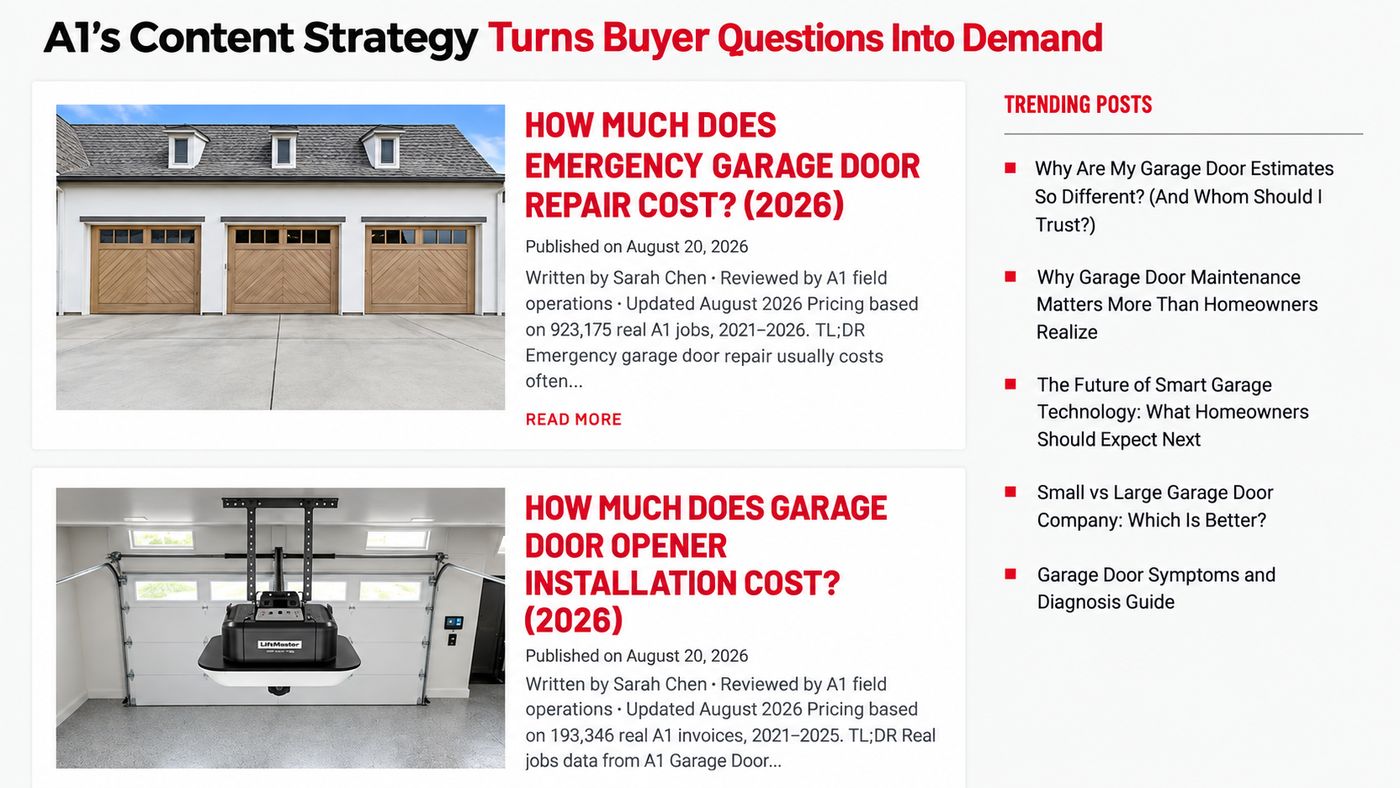
A1 Garage Door Service blog. Source: A1 Garage Door Service.
That structure is also increasingly useful for AI search. ChatGPT, Gemini, Perplexity and Google AI systems need clear, specific, well-supported pages they can quote when a user asks a buyer question. Traditional SEO creates the discoverable page; answer-engine optimization makes the page easier for AI to understand, cite and recommend. If you're unsure which one you're missing, start with what AI citations actually are and why AI isn't citing your website.
Branding Made the Search Engine Work Harder
The SEO growth makes more sense when you look at the brand surrounding it. A1 repeated the same identity across vehicle wraps, yard signs, billboards, mailers, apparel, the website and other customer touchpoints. A homeowner might first notice the truck, later see the same name in Google, then read hundreds of reviews before booking. Search wasn't working alone; it was harvesting demand the broader brand helped create.
- The truck is not separate from search. Every branded vehicle creates local awareness that later turns into a branded Google search.
- When the same identity appears on the truck, Google Business Profile, reviews, local landing page and website, recognition compounds.
- Offline brand, local SEO and conversion infrastructure reinforce each other instead of competing for budget.
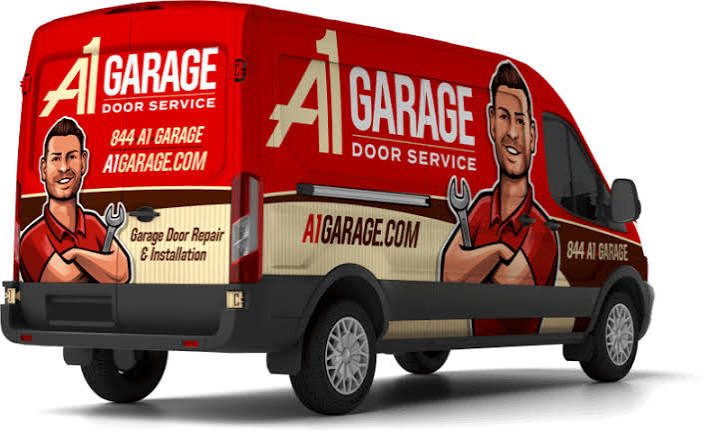
Brand consistency is also the reason AI engines connect scattered evidence to one company. When the naming is inconsistent, you get the ghost citation problem — cited as a source, never named as the recommendation. Roofers, plumbers, electricians and window-cleaning companies all hit the same wall.
Why A1's Recent Hires Matter
A business that thinks marketing is "finished" does not keep hiring people to improve it. Recent A1 job listings show continued investment in web strategy, SEO, digital experience, creative production and strategic growth.
| Role | Evidence of What A1 Values |
|---|---|
| Senior Manager, Web & Digital Experience | Own the portfolio of websites, conversion rate, SEO, local SEO, content strategy, analytics and emerging search opportunities. |
| Creative Specialist | Support social content, campaign assets, blog graphics, thumbnails and brand consistency across markets. |
| Growth Strategy Manager | Evaluate greenfield expansion, M&A, new ventures and market-level growth using analytics and financial modeling. |
The Objection: "We Already Have a Decent Website and Local SEO"
Good. That means you have the first layer. The mistake is treating that layer as the finish line.
| Good-Enough Local Marketing | A1-Style Asset Building |
|---|---|
| A website that generates some leads | A location-scalable site designed to support every market and service. |
| One GBP per branch, mostly left alone | Systematic GBP management, fresh reviews and coordinated landing pages. |
| A few pages ranking for core keywords | A portfolio of state, city, service, cost, comparison and emergency-intent pages. |
| Traffic reports | Market-level measurement tied to leads, conversion and expansion decisions. |
| A brand that looks professional | A brand repeated across trucks, signs, ads, reviews, search and the website. |
| SEO as a vendor line item | SEO, content, CRO and local search integrated into the growth engine. |
| Owner makes a good living | A repeatable demand system that supports more crews, locations and eventually an exit. |
A decent website helps you earn a living. A repeatable customer-acquisition machine helps you create enterprise value.
How Citedly Will Execute This Strategy for Your Local Business
Citedly takes the same core growth principles that helped companies like A1 scale and turns them into an execution plan for plumbing, roofing, window-cleaning, electrical, HVAC, garage-door, pest-control and other local service businesses.
We build your local search architecture. Citedly.co creates and optimizes location-based pages for the cities and service areas you want to win, so your business can rank for searches like "roof repair in Tampa," "emergency plumber in Dallas" or "electrician near me" without relying on one generic homepage.
We optimize your Google Business Profile ecosystem. We help structure your GBP strategy across locations, improve profile completeness, keep business information consistent, strengthen review signals, and make sure each profile supports the right local market.
We connect every location to a conversion-focused landing page. Instead of sending traffic to a broad corporate page, Citedly builds market-specific pages around the exact service, city, buyer intent, trust signals, reviews and CTA needed to turn local traffic into calls and bookings.
We create the pages your customers actually search for. We build commercial-intent content around emergency services, pricing, repair vs. replacement, financing, warranties, comparisons, "best" searches and other high-value questions that influence who gets hired — the same discipline behind structuring content for AI.
We expand visibility beyond branded searches. Citedly focuses on the unbranded terms that bring in new customers, such as "best roofing company near me" or "emergency plumber in Dallas," so growth does not depend only on people already knowing your business name.
We track which markets are actually producing demand. We measure visibility market by market across rankings, traffic, AI mentions, citations, competitors and buyer-intent prompts, so you can see where you are gaining ground and where competitors still win. That includes tracking AI citations alongside your ranking reports.
We continuously improve the website after launch. Citedly treats your site as an ongoing growth asset, not a one-time project. We keep improving SEO, local SEO, content structure, crawlability, AI-readiness, internal linking and conversion opportunities as your business expands.
We make your business visible in AI search too. Using Citedly's proprietary prompt library built from thousands of real-user search-style conversations, we identify the questions people ask ChatGPT, Gemini, Perplexity and Google AI about your category, then structure your pages and authority signals to improve your chances of being mentioned, cited and recommended — instead of being cited silently, which is the ghost citation problem.
The goal is not just to "do SEO." It is to build the same kind of repeatable visibility and lead-generation infrastructure that can help a local business grow from one market to many — and become a more valuable business in the process.
Where Citedly Extends the A1 Playbook: From SEO to AI Visibility
The A1 numbers show what happens when a local-service company becomes dramatically easier to discover for non-branded searches. The next version of that same problem is AI discovery: being visible not only when someone types a keyword into Google, but when they ask ChatGPT, Gemini, Perplexity or Google AI who they should hire.
Citedly has built a proprietary prompt library from thousands of aggregated, anonymized real-user conversations and buyer questions collected from public sources. For home services, those prompts map the real language people use around urgent repairs, pricing, repair-versus-replace decisions, comparisons, service areas, warranties and provider recommendations.
Instead of optimizing only for a keyword such as "roof repair Tampa" or "emergency plumber Dallas," Citedly also maps the question patterns that show up in AI conversations:
- "Who is the best roofing company near me for storm damage?"
- "Is $9,000 a fair price to replace a sewer line in my city?"
- "Should I repair a 12-year-old water heater or replace it?"
- "Which window-cleaning company has the best reviews for high-rise work?"
- "What should I ask before hiring an electrician?"
Those answers are assembled from pages AI engines can actually quote, which is why structuring content for AI matters as much as your keyword list. It's also why AI citations behave differently from backlinks: being linked is not the same as being named.
The objective isn't to replace classic SEO. It's to stack AI visibility on top of the same foundation A1 used: strong local pages, real reviews, clear entity information, third-party authority and a website that answers high-intent questions better than competitors. Once that foundation exists, the work becomes getting ChatGPT to recommend your business, earning space in Google AI Overviews, and understanding what GEO actually costs before you commit a budget.
The Bigger Lesson: Build a Business Someone Else Would Want to Own
A1 Garage Door is not proof that every local business will sell for $2 billion. It is proof that a home-service company becomes far more valuable when marketing stops being a collection of tactics and becomes a system.
For an owner, that changes the goal. You are no longer asking only, "How many leads did SEO bring me this month?" You start asking: Can this business reliably create demand in a new city? Can it convert that demand without me personally answering the phone? Can it build a brand people search for by name? Can it keep getting discovered as search moves from Google into AI?
That is how a good local business becomes a scalable company — and how a scalable company eventually becomes an asset capable of funding an early retirement, a recapitalization or a major acquisition.
Frequently asked questions
Did KKR handle A1 Garage Door's marketing?
No. KKR is the private-equity buyer that agreed in September 2026 to acquire A1 for around $2 billion, according to Reuters. A1 previously worked with KickCharge Creative on branding and partnered with Cortec Group for growth capital in 2022.
How much did A1's local SEO actually grow unbranded traffic?
Sterling Sky's published case study reports nearly 1,000% growth in unbranded Maps clicks, more than 900% growth in unbranded organic clicks to location pages, and almost 900% growth in unbranded "near me" clicks in 2024 versus 2023.
Does A1 use a separate website for each city?
No. A1 uses one primary domain and builds state, city and service pages underneath it. That concentrates authority on a single domain instead of splitting it across weak duplicate sites.
Can local SEO alone make a service business worth acquiring?
No. SEO was one layer of A1's engine. Brand consistency, Google Business Profile management, review generation, call handling, conversion tracking, recruiting and operating systems all contributed to a demand machine a buyer would pay for.
What should a local business do about AI search now?
Make sure the pages a buyer needs actually exist and are specific enough for AI to quote, then measure whether AI engines name you. Citedly runs your real buyer prompts across five AI engines so you can see whether you are cited, named, or missing entirely.
Sources & Methodology: Deal details from Reuters (September 2026). Local SEO performance data and screenshots from Sterling Sky's published A1 Garage Door Service case study. Website and blog structure observed on a1garage.com. Branding context from KickCharge Creative; growth-capital context from Cortec Group. Percentages reflect the periods stated in the original sources and are correlational, not proof of single-channel causation.
See Where AI Puts Your Business Today
Run your real buyer prompts across five AI engines and find out whether you get named, free, in about 60 seconds. Or book a call and we'll walk you through it.
Keep exploring
Read More from Citedly

AI Visibility Guide
AI Crawlers: Complete List, Robots.txt Rules and Which Ones to Allow
Read article →