AI Visibility Guide
How to Hire an AI SEO Agency (and Why No One Can Guarantee Citations)
How to Hire an AI SEO Agency (and Why No One Can Guarantee Citations)
By Hadeel Yousaf, Founder of Citedly and LLM researcher
TL;DR: No AI SEO agency, whether it calls itself AI SEO, GEO or AI visibility, can guarantee you citations in AI answers, and Google's own guidance now says as much about providers in this category. What a good agency can promise is a defined scope of work, honest measurement, and a realistic estimate rather than a guaranteed outcome. This is what to ask before you sign, the warning signs worth walking away from, and the cases where hiring anyone at all is the wrong move.
Key Takeaways
- Nobody can guarantee AI citations, and a provider who promises them is selling something they do not control.
- Google updated its hiring guidance in June 2026 to address AEO and GEO services specifically.
- Judge a provider on scope and measurement, not on predicted outcomes.
- Being cited is not the same as being named, so ask which one they are reporting.
- A provider who cannot tell you what they cannot do is the one to worry about.
- Sometimes the honest answer is to fix your own site first and hire nobody.
Why I Am Writing This as Someone Who Sells This Service
I run an AI SEO agency. That is a conflict of interest and you should read this with that in mind.
I am writing it anyway because the question keeps arriving at our site in the form of queries like "do generative engine optimization agencies guarantee citations in AI responses?" and "we want providers who assess this honestly and back it with data instead of just selling us a package." People are trying to work out who to trust in a category barely two years old, with no established norms and a lot of confident marketing.
So this is the buying guide I would want if I were on the other side of the table, including the parts that are inconvenient for me.
Can Anyone Guarantee AI Citations?
No. Not us, not anyone, and the reasons are structural rather than a matter of skill or effort.
An agency does not control the AI engine, does not control the third-party sites that corroborate your brand, and cannot see the ranking systems involved. What it controls is the quality and accessibility of your evidence. That changes your odds. It does not produce a guaranteed result.
What Does Google Say About This?
Google addressed this directly in June 2026. Its guidance on hiring an SEO was revised to cover third-party services, including those promising improvements for AI experiences, which Google names as AEO and GEO services.
Three points from that update matter when you are choosing a provider:
- Third-party tools do not have access to Google's internal ranking data, so their predictions are their own and may not happen.
- Google does not evaluate or endorse third-party SEO tools or services, so any claim of being Google-approved should be treated with scepticism.
- Using a service or tool does not guarantee ranking success, and a provider promising a number-one position is a reason to look elsewhere.
Google also suggests three questions, which I think are good ones: does the provider cite official documentation to support its recommendations, does its AI optimisation advice match Google's own generative AI guidance, and do its tools align with that guidance?
Why Is a Guarantee Especially Impossible Here?
Because AI answers are not deterministic. Ask the same question twice and you can get different sources, different brands and a different order, minutes apart. There is no fixed position to hold, which means there is nothing to guarantee even in principle.
"In classic SEO a guarantee was dishonest. In AI search it is incoherent. There is no position one to promise, so a guaranteed citation is a promise about a thing that does not exist."
Hadeel Yousaf, Founder of Citedly
There is a second reason, and it is the one most buyers miss. A large share of the work that earns AI visibility happens on sites your agency does not own. Reviews, forum threads, industry roundups, press. An agency can pursue those. It cannot promise that an independent publisher will write about you.
What Should an AI SEO Agency Actually Promise?
A defined scope, a measurement method, and a realistic estimate. Those three things are entirely within a provider's control, which is exactly why they are what you should be buying.
Here is the difference in practice.
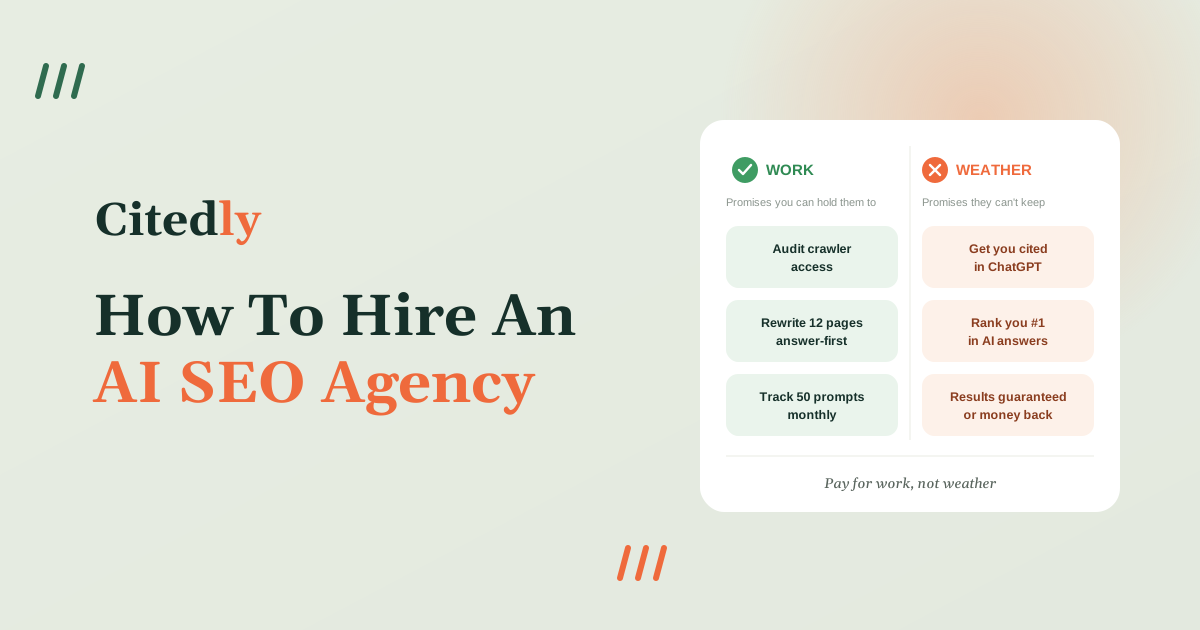
| A promise you can hold them to | A promise they cannot keep |
|---|---|
| We will audit crawler access and fix what blocks retrieval | We will get you cited in ChatGPT |
| We will rewrite these twelve pages to answer-first structure | We will rank you number one in AI answers |
| We will track fifty prompts monthly and report movement | We will raise your citation share by 30% |
| We will pursue listings on these named third-party sources | We will get you featured on these sites |
| We will tell you if this is not working after ninety days | Results guaranteed or your money back |
The left column is work. The right column is weather. Pay for work.
What Questions Should You Ask Before Hiring?
Ask about measurement first, because that is where most of the dishonesty in this category lives. Then ask about the work itself.
Questions About Measurement
These separate providers who measure from providers who report.
- What exactly are you counting, citations or mentions? They are different outcomes with different causes, and conflating them hides the most common failure mode in this field.
- How many prompts, chosen by whom, and how often? A visibility figure from ten prompts the agency picked is close to meaningless. Ask to see the list and to add your own.
- What is my baseline today? If they cannot tell you where you stand before starting, they cannot credibly tell you what changed later.
- What does your tool actually observe, and what does it estimate? Most AI visibility numbers come from sampling a prompt set, not from watching real user sessions. That is fine, as long as nobody pretends otherwise.
- Will you show me the months where nothing moved? The answer to this tells you more about a provider than any case study.
Why the Citation Versus Mention Question Matters So Much
Because a provider can truthfully report a win that does nothing for you. Semrush, with Kevin Indig, analysed 3,981 brand appearances across ChatGPT, AI Overviews, Gemini and AI Mode in June 2026 and found 61.7% were cases where the source was linked but the brand was never named. Only 13.2% got both.
So "we got you cited" can mean your page was used and your company was never mentioned. That is a real outcome, but it is not the outcome most businesses think they are buying. We cover the distinction in AI citations vs mentions and the specific failure in ghost citations.
Questions About the Work
- What will you actually change in month one? You want specific artefacts: a crawler audit, named pages rewritten, schema added. Not "strategy."
- Which parts of this require my team? Content approval, access, sign-off on anything published in your name. Agencies that imply zero effort from you are managing your expectations badly.
- What do you do that I could not do myself in a weekend? A good provider will answer this honestly and it is usually about sustained execution, not secret knowledge.
- What would make you tell me to stop paying you? Any provider worth hiring has an answer.
Questions About Their Own Evidence
- Can you show your own AI visibility? An agency selling AI visibility that is invisible in AI answers is worth a raised eyebrow, though a new agency can reasonably be early in its own journey.
- Are your case studies verifiable? Named clients, or at least data you can inspect. A screenshot of an unnamed dashboard is not evidence.
- Do you cite sources for your claims? Google explicitly suggests checking whether a provider's recommendations are supported by official documentation.
What Are the Red Flags?
Some of these come from Google's updated guidance, some from what I see in this market.
| Red flag | Why it matters |
|---|---|
| Guaranteed citations, mentions or rankings | Nobody controls the outcome, so this is a promise about someone else's system |
| Claims of a special relationship with Google or OpenAI | Google names this as a warning sign, and no such partner programme exists for citations |
| llms.txt as a headline deliverable | Google states you do not need llms.txt for its AI features |
| A proprietary score with no stated method | If you cannot audit how a number is built, you cannot tell when it is wrong |
| Reporting that only ever goes up | Real measurement is noisy, and a smooth line usually means a flattering method |
| Long contracts with no exit before results | The work compounds over months, but you should be able to leave |
| Volume promises as the main offer | Twenty articles a month is an input, not an outcome |
On that third row, it is worth being specific because so much is sold on it. Google's guidance on AI features says there is no need for llms.txt, no special schema requirement, and no need to chunk your content. A package built mainly on those three things is built on sand.
When Should You Not Hire Anyone?
Three situations, and I would rather say this plainly than take the work.
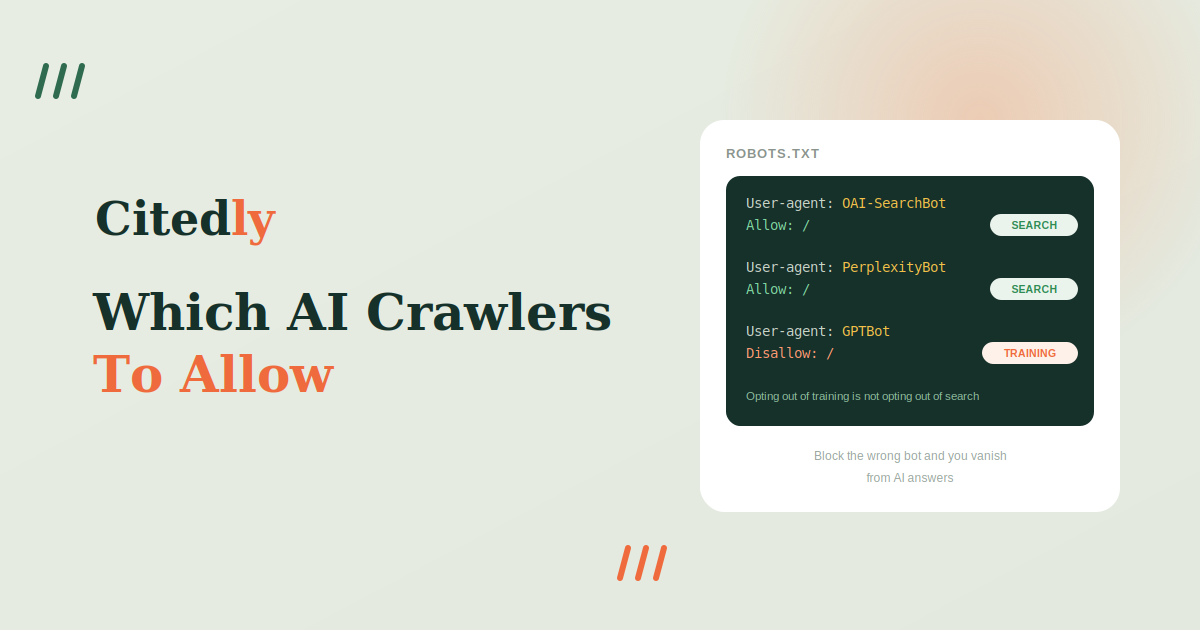
When your site cannot be crawled. If AI crawlers are blocked or your content only renders with JavaScript, that is a technical fix, not a retainer. Our AI crawlers reference and the checklist in why AI isn't citing your website cover it, and a developer can often resolve it in a day.
When you have no content to work with. Agencies can optimise what exists and build what is missing, but if your site is four thin pages, you are paying agency rates for basic content production. Build the foundation first.
When you have not checked whether you already appear. I have audited sites that believed they were invisible in AI answers and were not. Bing Webmaster Tools reports citation data free, and most businesses have never looked. Start with tracking your AI citations before you buy anything.
"The most useful thing I can tell a prospect is sometimes that they do not need me yet. It costs me a sale and saves them four months of paying for the wrong stage."
Hadeel Yousaf, Founder of Citedly
How Much Should This Cost?
Enough to fund real work, not so much that you cannot test whether it works. The market runs from low hundreds a month to enterprise contracts, and the spread is wide enough that price alone tells you very little.
I have not repeated the numbers here because we cover them properly in how much GEO costs and benchmark real providers in the AI visibility pricing benchmark. The one pricing principle relevant to hiring: a provider who will not publish or state a price range is asking you to negotiate without information.
How Do You Judge Whether It Is Working?
Judge it on movement across a stable prompt set over a quarter, not on any single citation or any single month.
Three things to look for by month three:
- Technical blockers resolved, which should happen in weeks, not months.
- Your own pages appearing for prompts where you previously did not, even a few.
- The provider telling you what has not worked, unprompted.
The last one is the real test. Reporting that only contains good news is not reporting.
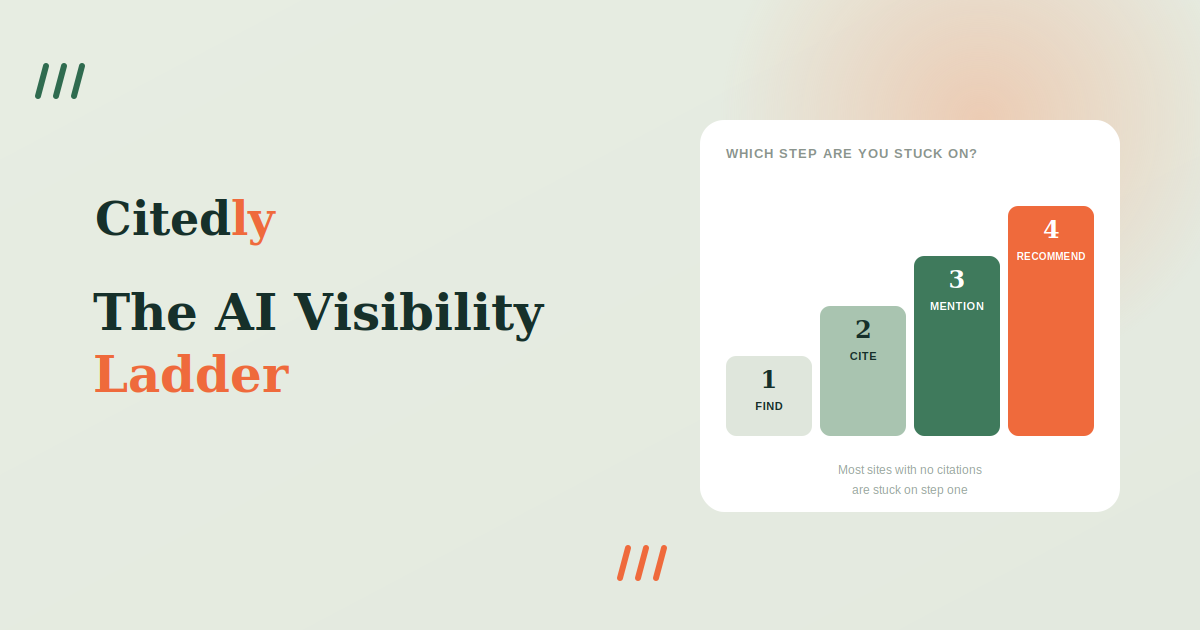
It also helps to know which stage you are stuck at, because the fix differs. Being undiscoverable is a different problem from being cited but never named, which is different again from being named but never recommended. That framework is in the AI Visibility Ladder.
Frequently Asked Questions
Do AI SEO Agencies Guarantee Citations in AI Responses?
No reputable agency does, because none of them control the engines, the third-party sources, or the non-deterministic way answers are generated. Google's guidance states that third-party services cannot guarantee performance and that their predictions are their own. Treat a guarantee as a reason to look elsewhere rather than a sign of confidence.
How Do I Know If an AI SEO Agency Is Legitimate?
Ask what they will change in month one, what they are counting, and what would make them tell you to stop. Legitimate providers answer all three specifically. Google also suggests checking whether their recommendations cite official documentation and whether their AI advice matches Google's own generative AI guidance.
Is AI SEO Just GEO With a New Name?
They are the same discipline. AI SEO, GEO, AEO and AI visibility all describe getting your brand into AI answers, and Google treats optimising for generative AI features as a form of SEO. The work overlaps heavily: crawlability, clear answers, evidence, reputation. What differs is what you measure, since there is no ranking position to report. Be sceptical of anyone selling any of these labels as an entirely separate discipline requiring entirely new tactics.
Can I Just Do This Myself?
Often yes, at least at the start. Crawler access, answer-first rewriting and a manual prompt set are all achievable without an agency, and we publish the methods. The case for hiring is sustained execution and the off-site work, not secret techniques. If you have the time, start yourself and hire when the bottleneck is capacity.
How Long Before I See Results?
Technical fixes can show up within weeks once pages are recrawled. Content changes take a month or two to be reflected. The parts that depend on third-party sources, which is most of what drives being recommended rather than merely cited, compound over two to three months at least. Anyone promising faster is guessing.
Should I Hire an Agency or Buy a Tool?
They solve different problems. A tool tells you where you stand. An agency changes it. Most businesses that buy a tool first end up with a dashboard they do not act on, which is why we usually suggest the free measurement stack before either. Our AI SEO tools comparison covers the software side.
What If My Provider Is Already Reporting Great Numbers?
Ask what the numbers are built from. How many prompts, who chose them, and are they citations or mentions. If the prompt set is small and the agency picked it, the figure is easy to flatter without anyone lying. Ask to add ten prompts of your own and see whether the picture changes.
What I Would Do in Your Position
Spend an hour before you talk to anyone. Check whether AI crawlers can reach your site, look at Bing Webmaster Tools to see whether you are already cited, and write down twenty questions your buyers actually ask. That hour will make every sales conversation sharper, because you will know what you are buying.
Then ask any provider, us included, the measurement questions above. The ones who answer them plainly are the ones worth considering.
Start With Your Baseline, Not a Contract
Run your real buyer prompts across five AI engines and see where you stand today, free, in about 60 seconds. Or book a call and we will tell you honestly whether you need an agency yet.
Keep exploring
Read More from Citedly
AI Visibility Guide
AI Crawlers: Complete List, Robots.txt Rules and Which Ones to Allow
Read article →